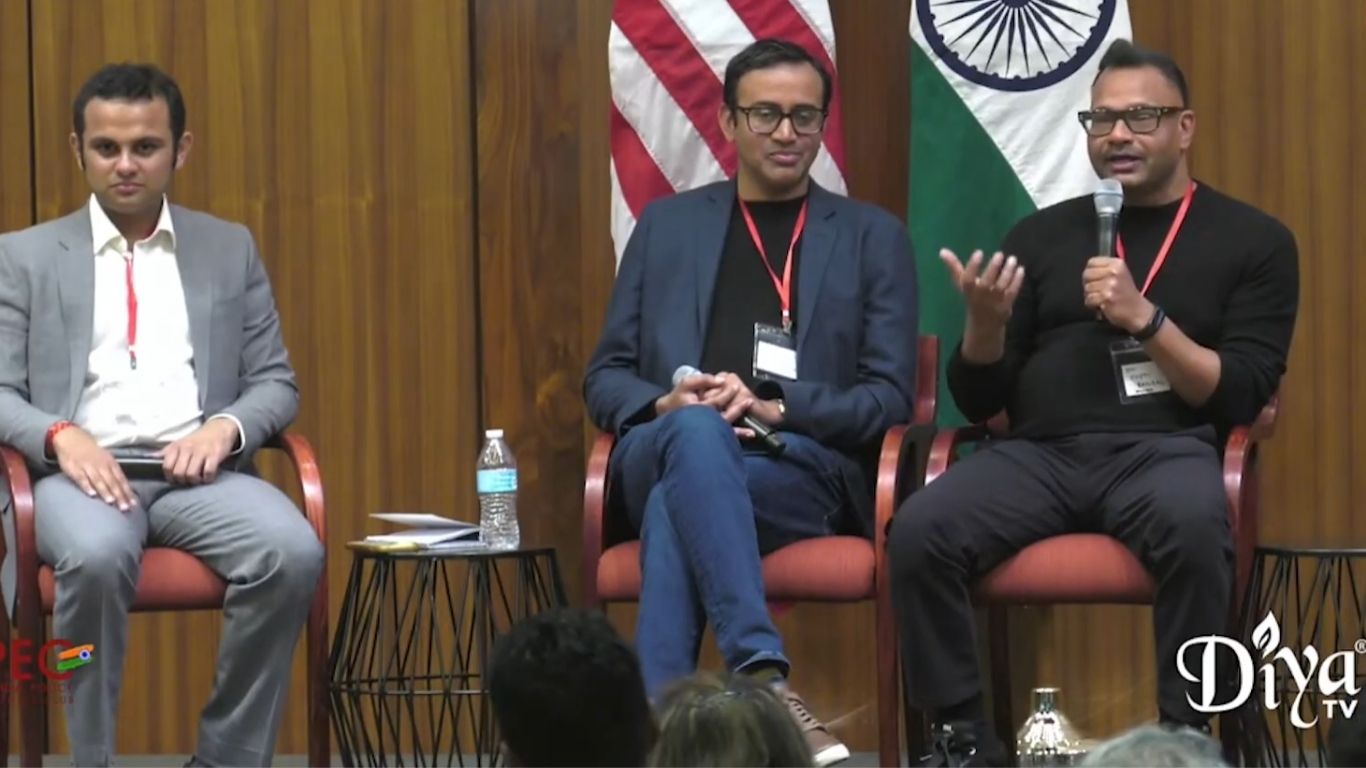
STANFORD, Calif. (Diya TV) — Anand Chandrasekaran and Jyoti Bansal sat down for an exclusive conversation, at the Stanford India Conference 2026, on where artificial intelligence is heading and what it means for the India–U.S. technology relationship.
Chandrasekaran is Managing Partner at Celesta Capital and co-founder of Crescendo, an AI-native contact center startup. He previously served as a Partner at General Catalyst, where he helped establish the firm’s India investing practice, and held product leadership roles at Meta, Bharti Airtel, Snapdeal, and Five9. He has seeded more than 80 companies, seven of which are valued above $1 billion, and was recognized by the HURUN India Report as India’s top seed investor three years running from 2022 to 2024.
Bansal grew up in Rajasthan, studied computer science at IIT Delhi, and moved to Silicon Valley in 2000. He founded AppDynamics in 2008 and sold it to Cisco for $3.7 billion in 2017, one day before its planned IPO. He went on to co-found Harness, an AI-native software delivery platform now valued at $5.5 billion after raising $240 million, and Traceable AI, a cybersecurity company he later merged with Harness. He is also co-founder of Unusual Ventures. Harness employs over 1,200 people across 14 offices, with roughly a third of its workforce based in India.
Bansal’s core argument is that in the age of AI, writing code is no longer the bottleneck — everything after is. Testing, deployment verification, security scanning, and governance become more critical as AI accelerates code production. He draws a hard line between AI-assisted tools, which bolt features onto existing infrastructure, and AI-native platforms, which use AI to make decisions throughout the delivery pipeline. His bet is that the latter will define the next decade of enterprise software.
Chandrasekaran’s view centers on democratization. Across his career — from transitioning Airtel’s 300 million subscribers to a data-first network to backing AI-powered healthcare startups in India — his consistent thesis has been that the India–U.S. corridor is a two-way innovation highway, not just a talent pipeline. That framing is increasingly relevant as India’s engineering base moves from implementing AI systems to building them.
Diya TV was a proud media partner for the conference.