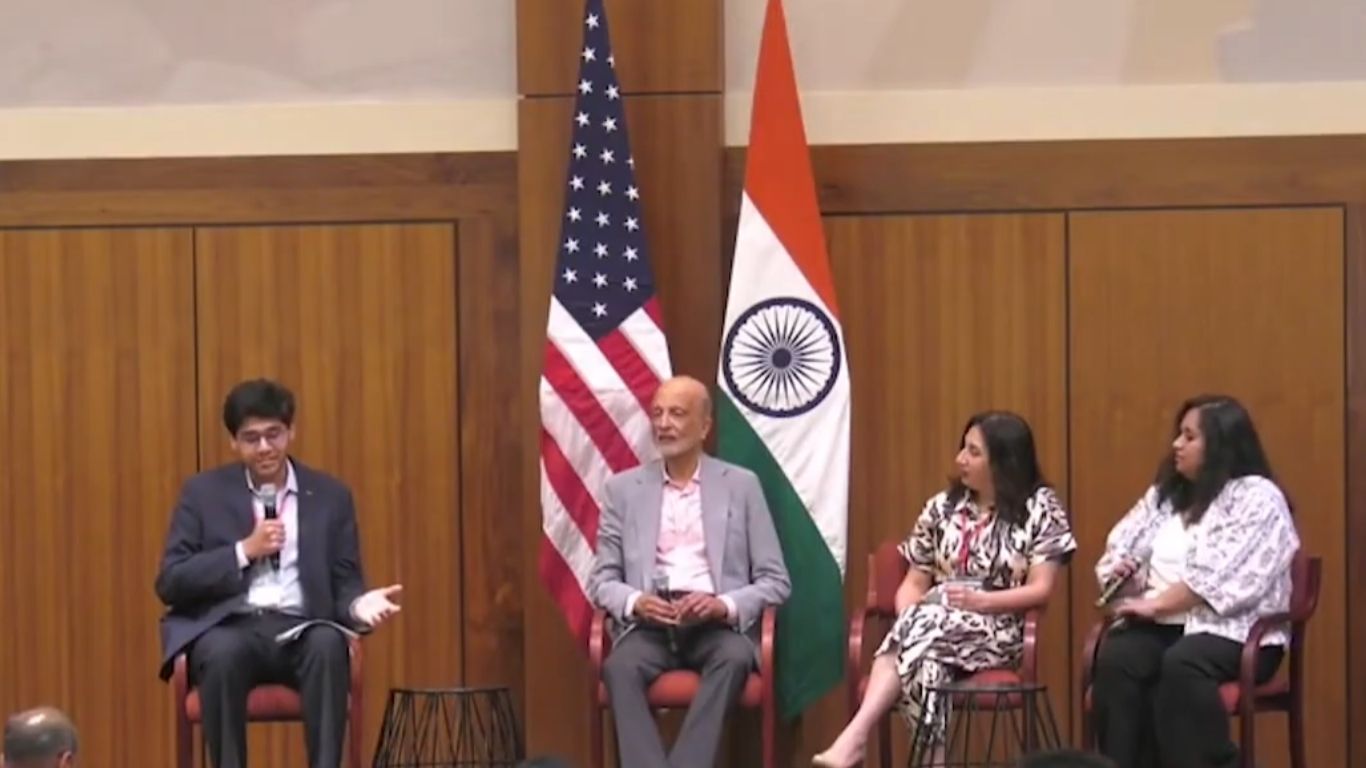
STANFORD, Calif. (Diya TV) — At the Stanford India Conference 2026, themed India–US at the Crossroads: Building Bridges, Forging Futures, three seasoned changemakers sat down for an exclusive conversation that cut to the heart of a defining question: how can the Indian diaspora and its allies turn influence into lasting impact?
The panel brought together MR Rangaswami, Founder of Indiaspora and Sandhill Ventures; Manushi Yadav, Director of Strategy and Partnerships at Pratham USA; and Mamta Bhandari, Founding Supporter of The/Nudge Institute. Produced by SIPEC and broadcast exclusively by Diya TV, the discussion was a masterclass in what community-driven, cross-border philanthropy can look like when practiced with intention.
MR Rangaswami has spent over a decade building the institutional architecture for Indian American civic engagement. In 2012, he founded Indiaspora with a mission to transform the collective success of the global Indian diaspora into meaningful, lasting change — in India and on the world stage. What began as a gathering of roughly 100 community leaders has since grown into a movement connecting 35 million Indians worldwide through philanthropy, leadership, and advocacy.
At Stanford, Rangaswami’s message was consistent with the ethos he has championed for years: that the Indian diaspora’s wealth of professional achievement carries with it a responsibility to give back. “Indiaspora is not just a community,” he has said. “It’s a movement.” His organization has helped establish the India Philanthropy Alliance, convening more than 20 U.S.-based nonprofits working in India, and in 2024 released a landmark impact report co-authored with the Boston Consulting Group. The Stanford panel gave him a platform to extend that conversation to the next generation of leaders.
Manushi Yadav brought a grounded, operational perspective to the discussion. With nearly a decade of experience working directly with Pratham in India — across program management, operations, and strategic partnerships — she now leads institutional fundraising and cross-sector collaboration for Pratham USA.
Pratham is one of India’s largest and most decorated education NGOs. Founded in 1995, the organization reaches more than five million children and young people annually through programs spanning early childhood education, foundational literacy and numeracy, girls’ empowerment, and vocational skilling. Its evidence-based “Teaching at the Right Level” (TaRL) approach has been recognized globally, most recently advancing to the top five of the MacArthur Foundation’s prestigious $100 million 100&Change competition.
For Yadav, the US–India corridor represents not just a funding channel, but a genuine partnership. “The last person on the ground who knows locally the people is the person guiding us to a viable solution,” she has noted, describing Pratham’s network of 7,000 local community connectors reaching 20,000 communities across India. At Stanford, she spoke to the importance of building institutional bridges — connecting diaspora donors, U.S. foundations, and corporate partners with grassroots programs that understand the terrain.
Mamta Bhandari, as a Founding Supporter of The/Nudge Institute, represents a generation of diaspora philanthropists who are moving beyond one-time donations toward sustained systems change. The/Nudge Institute works at the intersection of livelihoods, poverty alleviation, and social entrepreneurship, supporting rural communities across India to build durable economic independence.
The organization’s work reflects a philosophy that resonated throughout the panel: that sustainable impact requires not just funding, but a long-term commitment to institutions, communities, and the people who serve them.
What tied the three panelists together was a shared conviction that the US–India relationship — at its best — is not transactional but transformative. The diaspora is uniquely positioned to serve as a bridge: understanding both contexts, trusted by communities on both sides, and equipped with the networks and resources to catalyze change at scale.
The Stanford India Conference itself is a reflection of this potential. Organized and moderated entirely by students, it is the largest India-focused conference on the West Coast, drawing leaders from politics, business, health, technology, and media. That a student-run forum convened a panel of this caliber speaks to the seriousness with which the next generation of Indian Americans is engaging with these questions.
Diya TV was a proud media partner for the conference.