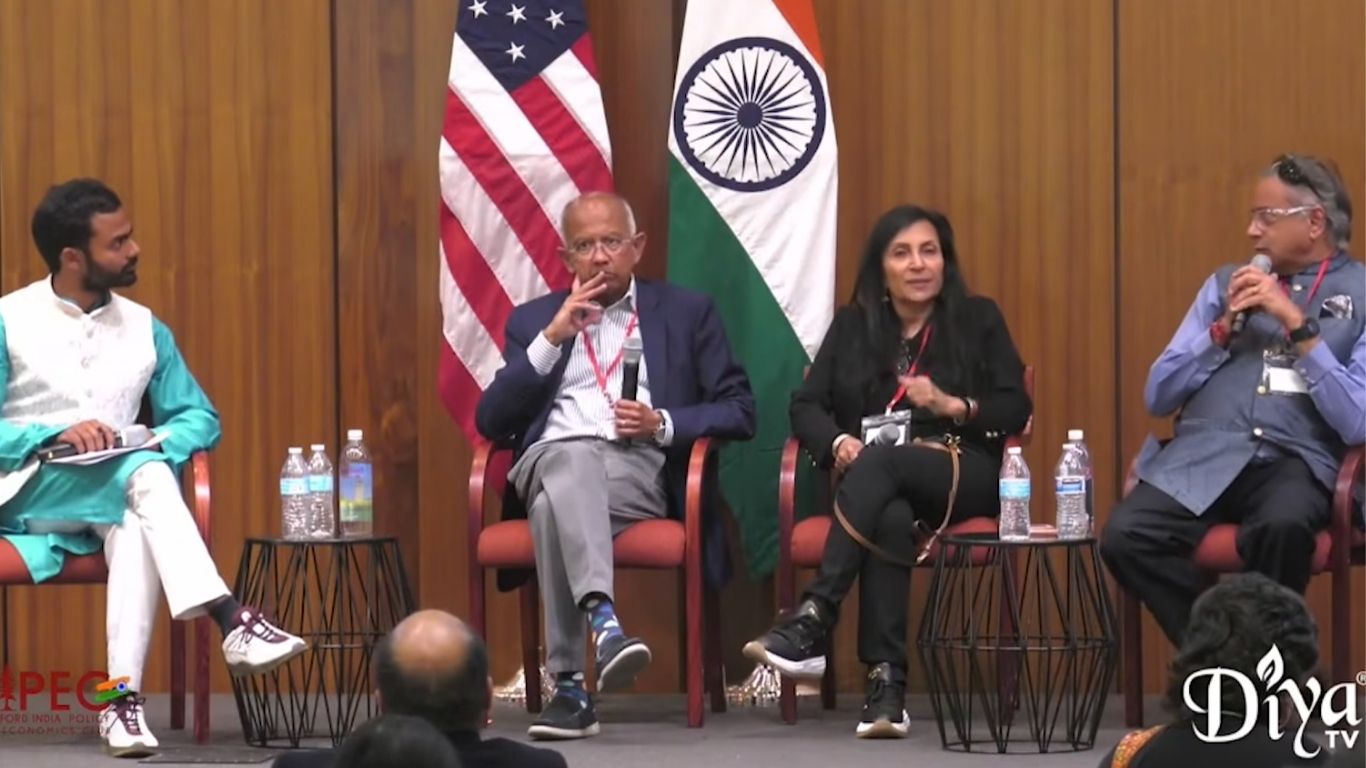
STANFORD, Calif. (Diya TV) — Shashi Tharoor, Sumit Ganguly, and Asha Jadeja sat down for a conversation at Stanford University on strategic convergence in an era of fragmented geopolitics.
Tharoor opened by tracing multi-alignment, a term he coined in a speech at Berkeley twenty years ago, to describe a post-cold war world where countries connect according to interests rather than fixed alliances. India’s foreign minister could sit with Russia and China in one format, add Brazil and South Africa for BRICS, drop the Russians for environmental talks, drop the Chinese for south-south cooperation — each serving a distinct purpose. The concept went nowhere when Tharoor advanced it as Minister of State for External Affairs — “it sank like a lead balloon” — but has since been revived by Jaishankar. On strategic autonomy, he traced it to the anti-colonial struggle: India spent two hundred years with a foreign power determining its position on world affairs, and from Nehru onward the core principle was that no one would dictate India’s stand. He recounted the probably apocryphal story of John Foster Dulles asking Nehru “Are you with us or against us?” and Nehru replying simply, “Yes.”
Ganguly was asked how Washington views India’s strategic autonomy. His answer: “It’s exceedingly difficult to say what Washington thinks these days.” Policymaking has become concentrated in the White House, with key decisions made with little consultation from the State Department or the Pentagon. He noted Rubio’s upcoming trip to New Delhi for the Quad Foreign Ministers’ Conference — talks on trade, energy, and defense — as the next significant signal of where Washington stands on India.
Jadeja came at it from the lens of innovation, arguing that deliberately connecting Silicon Valley, Bangalore, and Tel Aviv would strengthen democratic institutions and free-market values at precisely the moment they are under pressure. She described seeding a network of nodes at Hoover, UC San Diego, Hudson, and the Center for New American Security. She also argued that traditional foreign policy labels like multi-alignment are becoming irrelevant as the U.S. moves away from international institutions and reverts to raw power. “If this happens seriously in a sustained manner, a lot of international institutions are going to crumble, and India cannot be sitting on the sidelines. It must take a stand, and that stand has to be with the free world.”
Tharoor agreed with the concern. If the U.S. abandons international rules, what remains is the law of the jungle — and that precedent doesn’t only benefit America. China and Russia will apply the same logic in their own backyards. Countries that stayed silent over Gaza and Iran to avoid antagonizing Washington have accepted a precedent any major power can now use. “India’s interest would definitely be in somehow reconstructing some semblance of world order,” he said, “in which pretty much everyone — and I say pretty much because the U.S. may choose to exempt itself — would agree to common rules of the road.”
Ganguly offered a longer view on the relationship itself. During the Cold War there was no significant diaspora, no trade or investment relationship worth mentioning, and India barely registered in American strategic thinking. Today India is the U.S.’s tenth largest trading partner, American investment is substantial, and the diaspora has repeatedly proven its leverage — most notably in 1998 after India’s nuclear tests and in 2008 during the U.S.–India nuclear accord. “Regardless of who assumes office in 2028, I have every faith that the U.S.–India relationship will remain on course.”
Tharoor pushed back, flagging the diaspora’s near-total silence when Trump imposed 50% tariffs. He described a congresswoman from Texas telling him she had 19,000 Indian Americans in her district and had not received a single call — compared to hundreds on anything involving Israel. Jadeja agreed it was an embarrassment but explained that the Indian American community is now the wealthiest in the country, and that wealth has produced a new anxiety about becoming a target of resentment. With 70 to 80 percent of H-1B visas going to Indians, the community sits directly in the crosshairs of nativist politics, and most are choosing to lie low. She pointed to the Jewish diaspora’s model — sustained grassroots organizing at every level of government — as the template. “Give it five years.” Ganguly noted that the Indian community is no longer a monolith, politically divided in ways that make unified action harder, and without the sense of existential threat that has historically held the Jewish diaspora together.
Diya TV was a proud media partner for the conference.