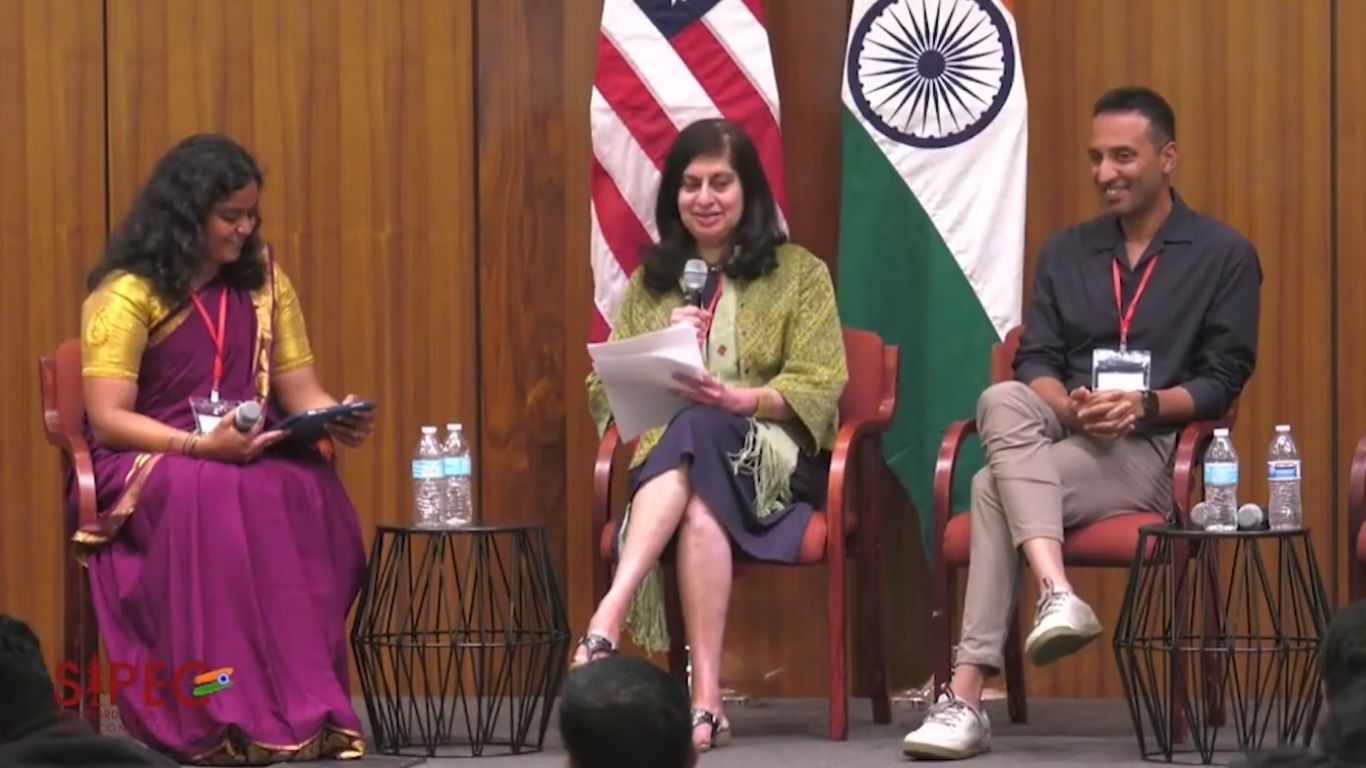
STANFORD, Calif. (Diya TV) — Parameswaran Iyer, Amoghavarsha JS, and Radhika Shah sat down for a conversation on what sustainable growth actually demands in a country like India.
The panel was framed around a tension the moderator, a Stanford dual-masters student, put plainly at the outset: sustainability conversations tend to split between idealism and pragmatism, between activists demanding immediate transitions and policymakers confronting the realities of energy access, infrastructure, and jobs. India, she said, doesn’t get to choose a side. It has to hold both.
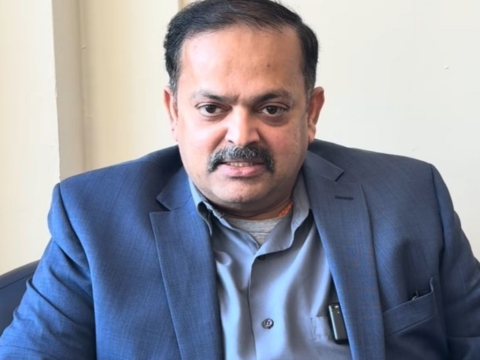
Iyer, joining virtually as Executive Director at the World Bank and former CEO of NITI Aayog, opened by pushing back on the idea that development and sustainability are in tension. India’s progress on energy access, he argued, has become a global reference point — the World Bank’s Mission 300 for Africa is actively drawing on India’s model. But his deeper point was about ownership. Sustainable development in India, he said, works when citizens are not just recipients but participants. He pointed to the LIFE program — Lifestyle for Environment — launched by Prime Minister Modi at COP26, which approaches sustainability from the demand side, asking how people can actively contribute to a better environment. “In the end it takes a top-down and a bottom-up approach to make development sustainable.”
He illustrated this with his own experience running the Swachh Bharat Mission, India’s campaign to eliminate open defecation. When the program launched, roughly 600 million people in India — 60% of the global total — practiced open defecation, and sanitation coverage stood at around 35%. The mission set out to build 110 million household toilets and change the behavior of 550 million people in five years. Iyer described four major challenges: speed, scale, stigma — many people didn’t believe indoor toilets were desirable — and sustainability. The lessons he drew, which he summarized as four Ps, have since been adapted globally: political leadership at the highest level, public financing ($20 billion committed by state and central government), partnerships with NGOs, schools, and technical agencies, and people’s participation. “Make ownership by the users. It’s got to be demand-led.”
Amoghavarsha, one of India’s most celebrated wildlife filmmakers, opened with a provocation: the panel should stop using the word sustainability and start using survivability. “Fresh air and fresh water are going to be the next big crisis. It’s not a vertical — it has to be horizontal.” He found it baffling that clean air and water had become politically polarized. “Is there anybody who says I don’t want fresh air? Clearly nobody.”
His argument for India’s role in the global ecological conversation was built on a striking fact: India is home to 75% of the world’s wild tigers and the highest population of Asian elephants on earth. “If there were an Olympics for biodiversity of land and life, India would win a gold medal.” And yet, he said, India is not speaking loudly enough about this. His films — including one with Sir David Attenborough and another with the late Dr. Puneeth Rajkumar that drew three to four million people to cinemas and sparked the formation of independent nonprofits — convinced him that storytelling is the missing accelerant. “Every time we’ve had a great success story in conservation it’s been because of narrative.” He closed by previewing a new project called “Wild” — described as a message of hope, kindness, and love — and made a direct appeal to the room: “Hard activism and alienating people doesn’t work. We need all hands on deck.”
Shah, a Stanford alumni leader and co-founder of the Stanford Alumni Alliance on Innovation for Global Impact, grounded her contribution in the SDG framework, arguing that human development and sustainability are integrally linked and cannot be solved in isolation. She cited two Indian examples she finds compelling: the ATRI ecology conservation research institute, which integrates conservation science with socially just development in the trans-Himalayas and has demonstrated that protecting biodiversity while advancing community wellbeing is possible when local communities are engaged; and Andhra Pradesh’s zero-chemical natural farming initiative, anchored in women’s self-help groups, which has brought one million farmers to traditional agricultural practices with better yields, better livelihoods, and better community health — a model now being adopted in Zambia.
On AI and financing, Shah argued that AI could be transformative — in healthcare, education, agriculture, and rural information access — but only if built with ethical guardrails, local sovereign models, and genuine attention to local context and culture. “This electricity will only be an equalizer and not a divider if we develop it right.” On financing, she pointed to blended finance and green and impact-linked bonds as mechanisms worth watching.
Asked what single mission India should launch next on the scale of Swachh Bharat, Iyer proposed a circular water mission. India holds only 4% of the world’s freshwater reserves while housing 18% of its population, and the country generates enormous volumes of municipal wastewater from 4,000 urban local bodies with minimal treatment or reuse. A serious circular water economy, he argued, could eventually become a $35 billion industry. “It’s good for sustainability, but it’s also an economic opportunity.”
Amoghavarsha returned to scale: there are, he said, perhaps enough conservationists in the world to fill one football field. The mathematical problem is how to get a billion people to care. India, he believes, is positioned to be the place from which the next great cultural revolution for the wild emerges — not through hard activism but through the kind of storytelling that brings people in.
Shah closed by citing social entrepreneurs transforming public schools, India’s technology leaders applying innovation to rural development, and the students in the room as sources of hope. “I do believe together we can bend the arc of global development toward sustainable futures that nurture all people and planet.”
Diya TV was a proud media partner for the conference.