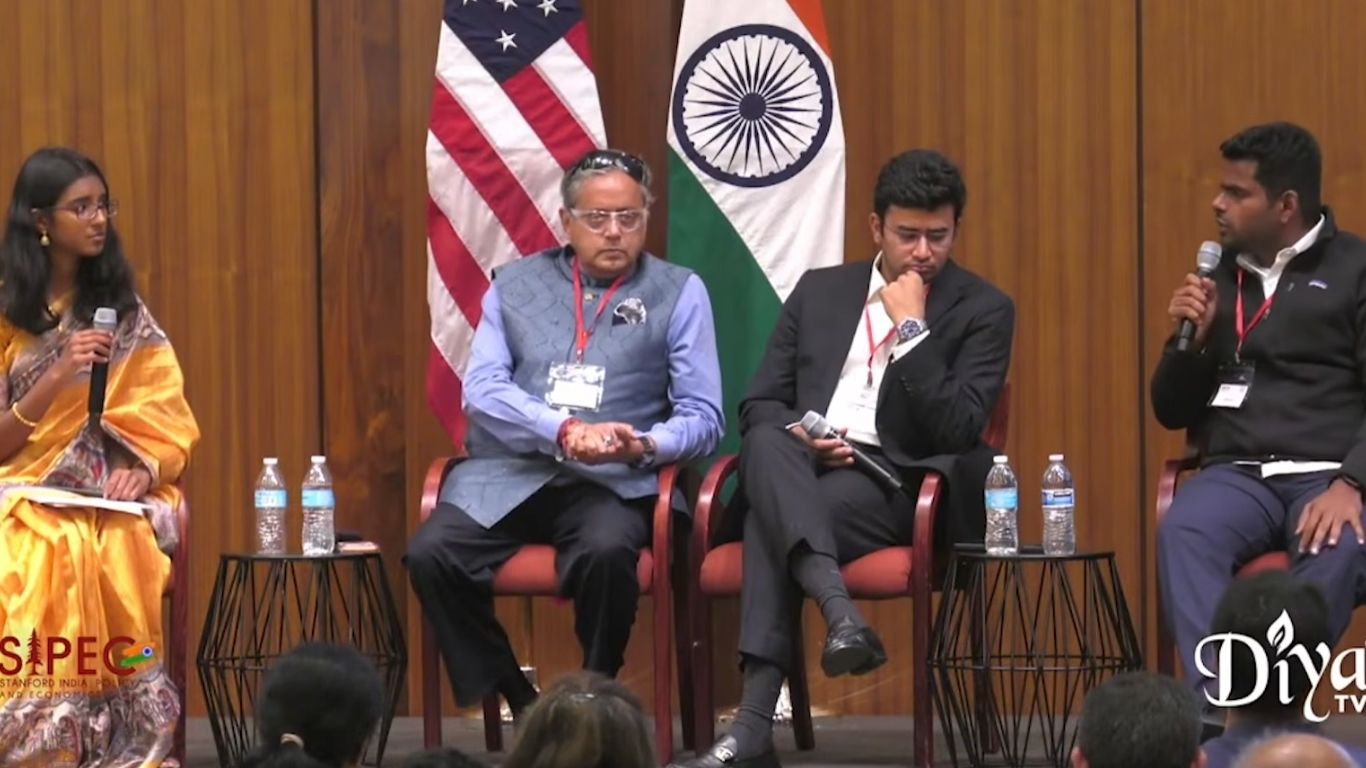
STANFORD, Calif. (Diya TV) — At the Stanford India Conference 2026, Shashi Tharoor of the Indian National Congress, Tejasvi Surya of the BJP, and K. Annamalai, former Tamil Nadu BJP president, debated India’s identity, urban governance, and economic philosophy in a panel titled “India, That Is Bharat: Growth, Governance and Identity.”
Tharoor opened the identity question by drawing on Kerala’s history. The principle he returned to was acceptance, which he distinguished carefully from tolerance. Tolerance, he said, is patronizing — it implies one side has the truth and magnanimously indulges the other’s right to be wrong. Acceptance, the concept he attributed to Vivekananda, is a mutual recognition that each side holds its own truth and respects the other’s. Kerala had practiced this for centuries: the Jewish diaspora that settled there never experienced antisemitic persecution; Islam arrived not by the sword but through Arab traders who had come to the coast for a thousand years before the Prophet; when the Muslim community grew large enough to need a mosque, the Zamorin gave them a disused temple. The oldest mosque outside the Arab world, in Kodungallur, still has a traditional Kerala lamp at its entrance. His political point was blunt: “All you need is 1% of them to feel they have no stake in this society anymore — just 1% — and your country becomes ungovernable.”
Surya’s response was conciliatory on the philosophical level — Vivekananda’s principles, he said, are also the BJP’s principles — but sharp on state practice. His objection was to policies that treat citizens as members of religious communities rather than as individuals, specifically the Karnataka government’s minority colony development fund, which he called state-sponsored ghettoization. Tharoor pushed back: the disproportionate poverty and underrepresentation of Muslim communities in North India is partly a legacy of Partition, when the Muslim middle class largely left for Pakistan, and targeted support is a response to that structural reality, not a cause of it. Surya’s counter was that the parties claiming to represent those communities had been in power for 65 years. Neither man fully conceded.
Annamalai cut through the philosophy to raise the Special Intensive Revision of electoral rolls in West Bengal, which he had overseen across several states. His position: Bengal is a special case with decades of fraudulent voter registrations, the Supreme Court is monitoring the process, and it is fair. Tharoor’s response: 34 lakh people filed appeals claiming they were legitimate voters, only a few hundred were heard before the election, and the BJP won Bengal by a margin of 30 lakh votes.
All three agreed on urban governance. Surya opened with a Tokyo anecdote: when Bengaluru and Osaka were suggested as sister cities, the question arose — who should the mayor of Osaka call in Bengaluru? The answer: there has been no functional elected corporation in Bengaluru for seven years. A city of 15 million has been run by two bureaucrats. The 73rd and 74th constitutional amendments were meant to empower urban local bodies but did so only on paper. The real power sits with state governments, and the political economy makes devolution unattractive — 60% of Karnataka’s GDP comes from Bengaluru alone. Tharoor, who introduced a private members’ bill on precisely this issue, said Indian mayors are glorified chairs of powerless committees, the municipal commissioner reports to the chief minister, and the system was designed by the British to prevent Indians from holding real power. Both he and Surya called for directly elected mayors with genuine budgetary authority. Annamalai noted that Chennai had a directly elected mayor in MK Stalin until the system was dismantled through horse-trading, and that Madurai — among the oldest cities on earth — now ranks last in garbage collection among Indian cities with populations over a million.
On the freebie debate, Annamalai laid out Tamil Nadu’s numbers: the state has the highest debt of any Indian state, over ten lakh crore rupees, and TVK’s election promises would cost 93,000 crore in year one alone. He noted the irony that Vijay won without distributing cash to voters while the parties that did distribute money found voters took it and voted for Vijay anyway. Tharoor described himself as on the right wing of the Congress party on economics, acknowledged that Kerala is functionally insolvent — borrowing each year by September just to pay salaries — and said the distinction between essential welfare and freebies is genuinely hard to draw in a democracy where a majority of voters live near subsistence. He recalled Chandrababu Naidu making the honest case against competitive rice subsidies in Andhra Pradesh in the 1990s and promptly losing re-election. Surya pointed to 50-year interest-free central loans to states, conditional on 50% going to capital assets, as a structural tool to redirect spending toward investment. A former finance commission member in the audience pushed back on the whole framing: governments that deliver get re-elected, governments that only promise get thrown out, and the Congress — the party that promises most — wins the fewest elections.
On delimitation, the freeze on Lok Sabha boundaries based on the 1971 census has left northern states, whose populations have grown rapidly, with MPs representing far larger constituencies than southern states that controlled their growth. The coming census will trigger a redelimitation that could shift parliamentary weight decisively toward the Hindi heartland. Tharoor outlined three frameworks: the American model of balancing population-based lower house representation with an equal-state upper house — requiring a stronger Rajya Sabha; a states reorganization commission to break up large states like UP so that more units could have equal upper house representation; and the EU’s degressive proportionality, where larger states get more seats but with floors and ceilings. He added that India’s problem is inverted from most federations — its fiscal contributors, Karnataka, Tamil Nadu, and Kerala, are among the less populous states, meaning delimitation would simultaneously reduce their political weight and their fiscal returns. Surya’s proposal: expand the total from 543 to 850 seats with a flat 50% increase for every state, so no state loses its proportion, constituencies shrink, and MPs become more accountable. Tharoor argued an 850-member parliament cannot debate or deliberate. Surya said the answer is longer parliamentary sessions, not frozen constituency sizes.
Tharoor closed by asking the room to stay engaged and treat the diaspora as a national reserve with responsibilities. Annamalai urged students to spend time in villages and work alongside elected representatives. Surya said that if you solve for India, you are solving for the world.
Diya TV was a proud media partner for the conference.