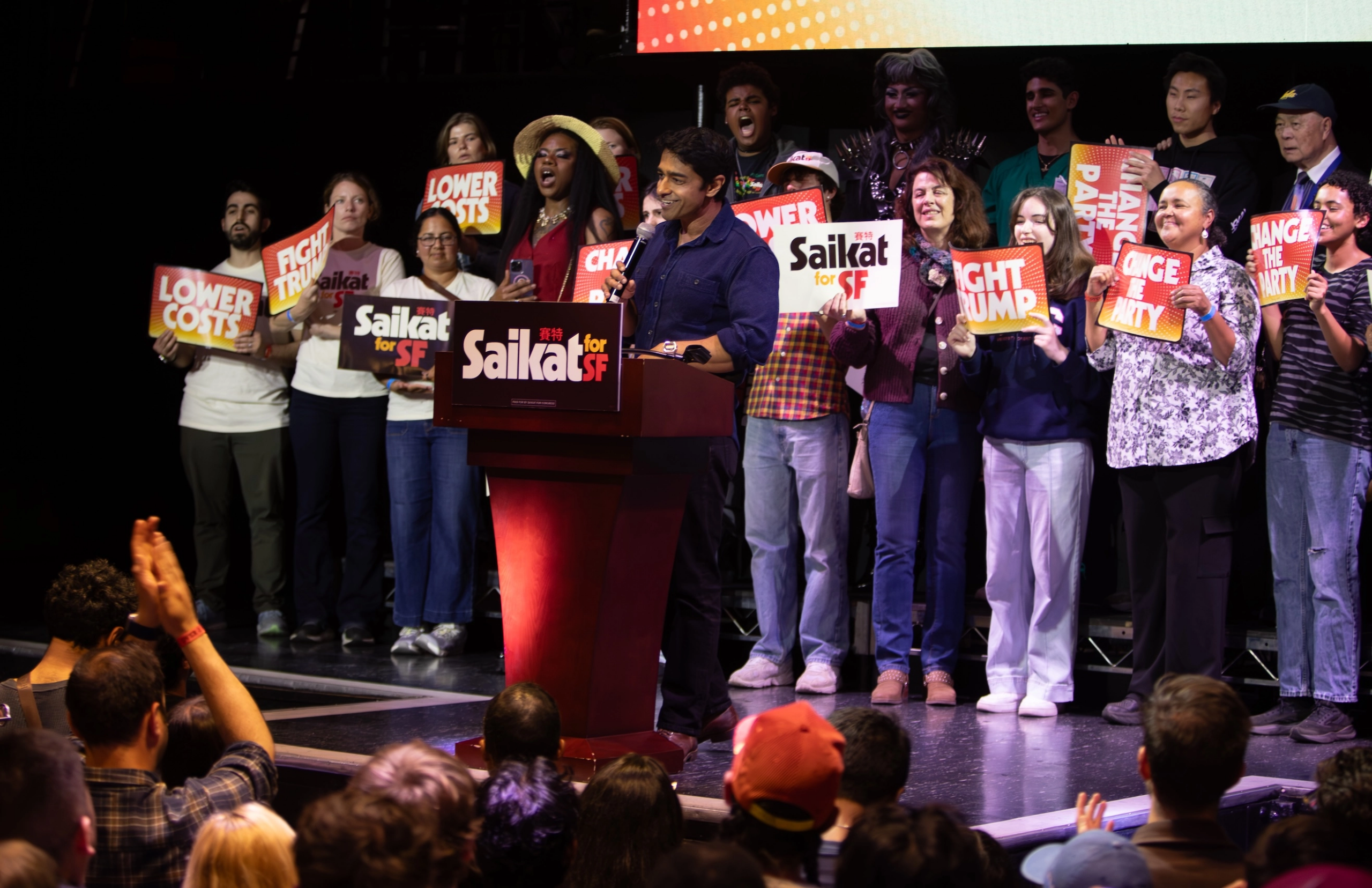
SAN FRANCISCO (Diya TV) — Saikat Chakrabarti, a candidate for California’s 11th Congressional District and former Chief of Staff to Rep. Alexandria Ocasio-Cortez, argued in an interview with Diya TV that the Democratic Party’s dysfunction is not a product of ideological division between its progressive and moderate wings, but of financial ties between incumbent lawmakers and corporate donors that prevent action on broadly popular legislation.
“The real divide is not so much progressive and moderate,” Chakrabarti told host Ravi Kapur on “The Public Interest.” “It’s Democrats who want to actually do something, and Democrats who don’t want to do something.”
Chakrabarti, 40, is one of three major candidates running to fill the seat being vacated by former House Speaker Nancy Pelosi, who represented the San Francisco district for nearly 38 years before announcing her retirement. His opponents are state Senator Scott Wiener, widely considered the frontrunner, and San Francisco Supervisor Connie Chan. A San Francisco Chronicle poll conducted ahead of the June 2 primary showed Wiener leading at approximately 40 percent of likely voters, with Chakrabarti at 18 percent and Chan at 17 percent. Under California’s top-two primary system, only the top two finishers advance to the November general election regardless of party.
Chakrabarti was born in Fort Worth, Texas, to Indian immigrant parents and graduated from Harvard University in 2007. He moved to San Francisco and became a founding engineer at Stripe, the payments company now valued at over $70 billion. In 2015 he left the private sector to serve as Director of Organizing Technology on Sanders’s 2016 presidential campaign, where he built digital tools to support grassroots fundraising and volunteer coordination. He co-founded Justice Democrats in January 2017 alongside Zack Exley, Kyle Kulinski, and Cenk Uygur, with the goal of recruiting candidates who pledge to refuse corporate PAC money. In 2018 he managed Ocasio-Cortez’s primary campaign against 10-term incumbent Rep. Joe Crowley in New York’s 14th District, a race Ocasio-Cortez won by 15 percentage points. He then served as her Chief of Staff until 2019, during which time he helped draft the Green New Deal resolution. He currently leads New Consensus, a think tank focused on economic and climate policy.
Chakrabarti has self-funded nearly $10 million of his congressional campaign as of late May 2026, according to Federal Election Commission filings, more than all other candidates in the race combined. He has framed the spending as a necessary counter to outside money opposing him. A PAC called Abundant Future, backed by Y Combinator CEO Garry Tan, venture capitalist Michael Moritz, Yelp CEO Jeremy Stoppelman, and crypto billionaire Chris Larsen among others, has spent over $760,000 against his campaign, according to filings reported by Mission Local.
His main policy argument on the interview centered on the Loan Shark Prevention Act, a two-page bill he helped draft while serving as Ocasio-Cortez’s Chief of Staff. The bill was introduced in May 2019 by Ocasio-Cortez and Senator Bernie Sanders and would have established a national cap of 15 percent on interest rates for all consumer loans. The legislation was aimed primarily at payday lenders, whose products carry annualized percentage rates that average around 391 percent according to federal data, with rates in some states reaching 667 percent or higher. The 15 percent cap mirrored an existing limit Congress imposed on credit unions in 1980.
“It was extremely popular in red, blue, purple, every district,” Chakrabarti said of the bill. He said a faction of House Democrats declined to support it not on policy grounds but out of concern for their financial industry donors. “Some of the so-called moderates in the caucus didn’t want to sign on because they were worried that doing actual caps on interest rates would upset a lot of their donors,” he said. The bill was never brought to a full House vote.
Chakrabarti said the episode reflects a structural problem in the party. “We have a donor class that does control a whole lot of the current establishment,” he said, “and that is what I believe we need to replace — not just because it’s the right thing to do, which I think it is, but because politically that’s the only way I see out of it.”
He cited a December 2025 Quinnipiac University poll in which only 18 percent of voters approved of the job Democrats in Congress were doing, a figure Quinnipiac described as a record low in its polling history dating to 2009. Among self-identified Democrats in the same survey, 48 percent disapproved of their own party’s congressional performance. “The party is not liked,” Chakrabarti said. “So it needs a new vision. It needs to be clearly in for working people, and it needs to have real solutions for the problems people are facing.”
On the question of where he fits within the party, Chakrabarti acknowledged his platform would be described as progressive — he supports higher taxes on billionaires and centimillionaires, including himself, Medicare for All, and affordable housing legislation — but argued those labels obscure more than they reveal. He noted that candidates considered moderates, such as gubernatorial candidate Matt Mahan, share many of the same social policy positions. The more meaningful distinction, he said, is whether a politician is willing to act on those positions when donor pressure runs the other way.
Chakrabarti has endorsements from Representatives Rashida Tlaib of Michigan and Ilhan Omar of Minnesota, former Representative Jamaal Bowman of New York, and the Sunrise Movement, a youth climate advocacy group. Ocasio-Cortez has not endorsed him despite his central role in her 2018 campaign and time in her office. Justice Democrats, the organization he co-founded, is formally backing his bid.