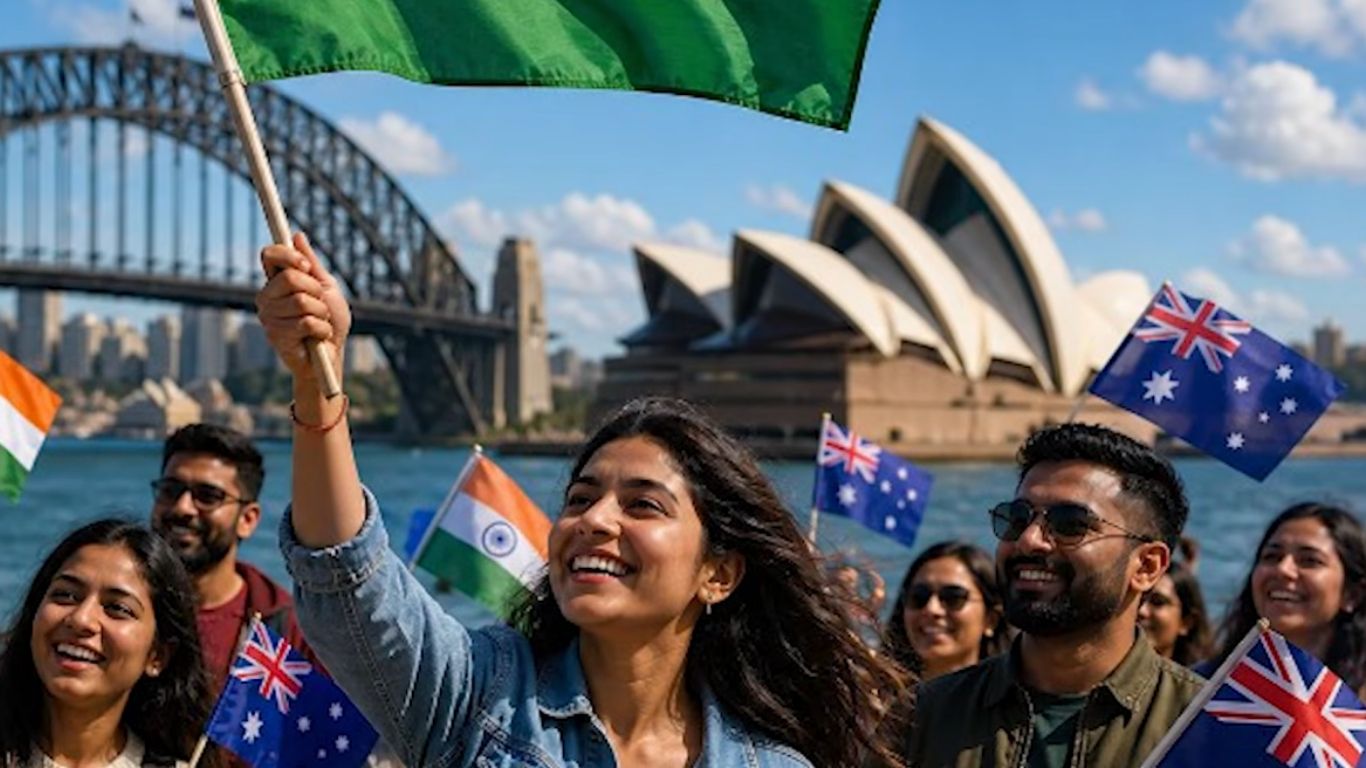
MELBOURNE (Diya TV) — People born in India have become the largest overseas-born group in Australia for the first time, marking a major shift in the nation’s migration story and highlighting the growing influence of the Indian diaspora.
New data released by the Australian Bureau of Statistics on April 29 showed that 971,020 Indian-born residents lived in Australia as of June 30, 2025. That figure narrowly surpassed the 970,950 residents born in England, which had long held the top spot among overseas-born populations. The milestone reflects decades of changes in Australia’s immigration system and the growing role of skilled migration and international education in shaping the country’s population.
Australia’s overseas-born population reached 8.8 million people in 2025, accounting for 32% of the country’s 27.6 million residents. That is the highest share recorded since 1891. India has driven much of that growth. The Indian-born population increased by 522,000 people between 2015 and 2025, making it the fastest-growing major migrant community in Australia.
China ranked as the third-largest overseas-born group with 731,540 residents, followed by New Zealand with 637,680 and the Philippines with 412,530. In 2015, Australia was home to just 449,040 Indian-born residents. The community has more than doubled in size over the past decade. India-born residents now make up about 3.5% of Australia’s total population. Experts say the trend reflects strong demand for skilled workers and international students. Australia has increasingly relied on these pathways to support economic growth and fill labor shortages.
The rapid growth of the Indian community is not only about population numbers. It also reflects the group’s strong educational and professional profile. A 2025 report prepared by the University of Queensland for the Department of Foreign Affairs and Trade found that nearly 70% of Indian-born migrants who arrived since 2006 hold a university degree or higher qualification. Researchers described the community as highly educated and relatively young. The median age of India-born residents is 36.1 years, significantly younger than that of many older migrant groups that arrived from Europe after World War II.
This demographic profile has helped strengthen Australia’s workforce. Indian-born migrants have an employment rate of 85.3%, higher than the average for all overseas-born residents. Many have also launched businesses across sectors such as technology, health care, logistics, and professional services. Indian entrepreneurs continue to play a growing role in local economies, particularly in Sydney and Melbourne.
The expanding Indian diaspora has also left a visible mark on Australia’s cultural landscape. Major festivals such as Diwali and Tamil New Year attract large crowds across Australian cities. Indian food, music, and arts have become increasingly popular among the broader population.
Areas such as Harris Park in Sydney and Dandenong in Melbourne have emerged as well-known hubs for Indian culture, restaurants, and businesses. These developments have strengthened cultural ties between Australia and India while contributing to Australia’s identity as a multicultural society.
Despite the economic and cultural benefits of migration, population growth has become a contentious political issue. Australia faces a severe housing shortage, with rising rents and home prices creating pressure for many residents. As a result, debates about immigration levels have intensified. The Australian Bureau of Statistics noted that the proportion of overseas-born residents is approaching the record level reached in 1891.
Some anti-immigration groups have gained visibility in recent years. In 2025, vandals targeted a Hindu temple in Melbourne’s suburb of Boronia with racist graffiti. Protesters also organized demonstrations against Indian migration in several cities. Members of the Indian community say they continue to encounter anti-immigration sentiment. However, many also point to the significant economic, social, and cultural contributions migrants make across Australia.
Looking ahead, projections suggest the Indian-born population could exceed 1 million in 2026 and reach 1.7 million by 2041. If those forecasts hold, the Indian diaspora will play an even larger role in shaping Australia’s economy, workforce, and multicultural future.