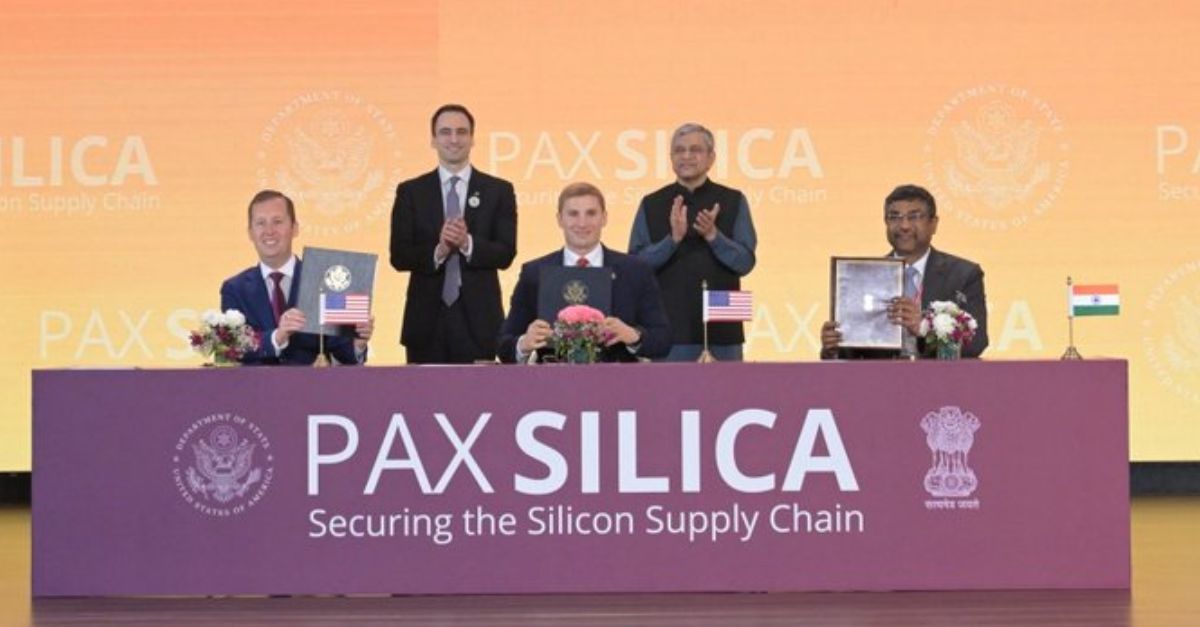
NEW DELHI (Diya TV) — India has formally joined the United States-led Pax Silica coalition, marking a major step in U.S.-India technology cooperation. Officials from both countries signed the Pax Silica Declaration on Friday during the Global AI Impact Summit in New Delhi. The move signals deeper collaboration on artificial intelligence, semiconductor supply chains, and economic security.
U.S. Ambassador to India Sergio Gor and U.S. Under Secretary of State Jacob Helberg attended the signing ceremony alongside India’s Information Technology Minister Ashwini Vaishnaw. Leaders described the agreement as a milestone in strengthening democratic control over critical technologies.
Pax Silica is a U.S. State Department initiative focused on artificial intelligence and secure supply chains. It aims to protect the global silicon stack, from critical minerals to semiconductor manufacturing and AI data centers. The coalition seeks to reduce dependence on unreliable supply chains and promote cooperation among trusted partners.
The initiative launched in December at a summit in Washington. Founding partners include Australia, Greece, Israel, Japan, Qatar, the Republic of Korea, Singapore, the United Arab Emirates, and the United Kingdom. With India’s entry, Pax Silica expands its reach into one of the world’s fastest-growing digital economies. India is a global technology hub with deep engineering talent and a strong semiconductor market.
Gor called India’s entry into Pax Silica “strategic and essential.” He said the coalition will help free societies maintain leadership in advanced technology. He framed the partnership as a defense against coercive economic practices and supply chain disruptions.
“It’s about whether innovation happens in Bangalore and Silicon Valley or in surveillance states,” Gor said during his keynote address. He stressed that economic security directly supports national security.
Helberg echoed that message. He said India’s decision underscores the link between economic strength and national resilience. He described Pax Silica as a response to global pressures that threaten open markets and technological freedom. Indian officials emphasized that the agreement supports responsible AI development and secure technology ecosystems. Vaishnaw said India remains committed to inclusive innovation and reliable partnerships.
The Pax Silica Declaration builds on recent progress in U.S.-India relations. Leaders recently finalized an interim trade agreement aimed at resolving long-standing friction points. Gor said that the agreement shaped the economic contours of the Indo-Pacific region.
“This is about building together,” he said. “Not just buying from one another.”
Officials also announced other major initiatives this week. The India-America Connect subsea cable project will strengthen digital infrastructure between the two countries. Google pledged a $15 billion infrastructure investment to support India’s growing technology sector. Together, these agreements set a clear path for deeper collaboration through 2030 and beyond. They reflect a shared goal to secure semiconductor supply chains, expand AI research, and boost economic growth.
The signing took place during the India AI Impact Summit 2026, the first global AI summit hosted in the Global South. The event brought together policymakers, industry leaders, academics, and civil society representatives from more than 110 countries. Organizers said 30 international organizations participated. Around 20 heads of state or government attended, along with about 45 ministers. The summit followed earlier AI gatherings in the United Kingdom in 2023, South Korea in 2024, and France in 2025.
The conference focused on responsible AI governance, ethical development, and inclusive technological growth. Speakers stressed the need for global cooperation in shaping AI rules and standards.
Gor described the U.S.-India relationship as a “coalition of the capable and the willing.” He said the partnership aims to secure the commanding heights of the global technology economy. He argued that strength multiplies when democratic nations work together. India’s entry into Pax Silica signals a shared commitment to secure semiconductor production, critical minerals access, and advanced AI systems. It also reflects a broader push for economic security in the face of geopolitical challenges.