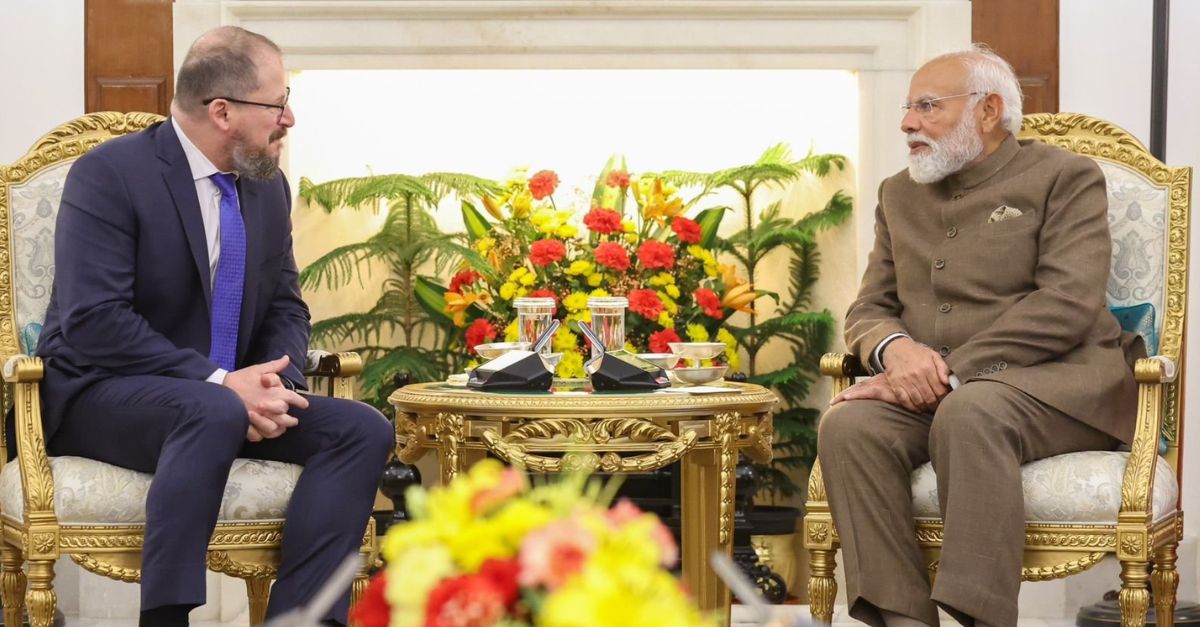
NEW DELHI (Diya TV) — Indian Prime Minister Narendra Modi met with Cristiano R. Amon, president and CEO of Qualcomm, to discuss deeper collaboration in artificial intelligence, semiconductors, and next-generation technologies. The meeting took place on the sidelines of the India Mobile Congress and highlighted India’s growing push to become a global technology hub. The talks focused on expanding Qualcomm’s role in India’s semiconductor industry and AI ecosystem. Both sides stressed the importance of innovation, skilling, and local manufacturing.
Modi praised Qualcomm’s support for India’s semiconductor and AI initiatives. He said India offers unmatched talent and scale to build future technologies. He noted that the country’s large pool of engineers and skilled professionals can drive innovation across industries.
“It was a wonderful meeting with Mr. Cristiano R. Amon and discussing India’s strides in AI, innovation,n and skilling,” Modi wrote in a post on X. He added that Qualcomm’s commitment to India’s semiconductor and AI missions will help shape a shared digital future.
India has stepped up efforts to build a strong semiconductor ecosystem. The government has rolled out incentives to boost chip manufacturing and design. It has also launched the IndiaAI Mission to accelerate research, development, and adoption of artificial intelligence across sectors. Amon echoed Modi’s optimism. He said Qualcomm wants to expand its partnership with India. He highlighted opportunities in AI-powered smartphones, personal computers, smart glasses, automotive technology, and industrial solutions.
The leaders also discussed collaboration on 6G technology. India aims to become a key player in the next generation of wireless communication. Qualcomm, a global leader in mobile chipsets and connectivity, plays a major role in developing advanced wireless standards.
Amon said the company looks forward to supporting India’s transition to 6G. He stressed the importance of building an Indian ecosystem around AI-driven devices and connected technologies. The meeting signals stronger ties between the Indian government and global semiconductor companies. Industry experts say such partnerships can help India reduce its reliance on imported chips and build local capabilities.
Qualcomm plans to expand its investments in India in areas such as smart glasses, automotive systems, and industrial technology. The company has partnered with Indian eyewear brand Lenskart to build smart glasses for the Indian market. The product is expected to launch at the start of the next fiscal year.
Amon thanked Modi for the discussion on fostering a broader partnership. He said Qualcomm sees strong opportunities in India’s AI smartphone market and connected devices ecosystem. Savi Soin, president of Qualcomm India, also shared his enthusiasm after meeting the prime minister. He said Qualcomm remains fully committed to supporting India’s digital growth and innovation journey.
Amon and Soin also met Union Electronics and IT Minister Ashwini Vaishnaw. They discussed building AI-first ecosystems and accelerating local design and development across industries. During the meeting, Amon gifted Vaishnaw a jersey from Manchester United. He later wrote that he looks forward to the AI Impact Summit 2026 in India. The discussions focused on boosting India’s digital transformation. Both sides explored ways to increase local research, design,n and manufacturing in semiconductors and AI-driven technologies.
At the India Mobile Congress, Qualcomm also announced a partnership with Havells to develop AI-led smart home products. The companies plan to introduce innovations across categories such as air conditioners, washing machines, air purifiers, water heaters, smart fans,s and smart switches.
The partnership will integrate AI features to improve energy management, enable cloud connectivity, and offer voice-enabled controls. These features aim to create a more connected and efficient smart home ecosystem. Industry analysts say collaborations like this can accelerate the adoption of AI and Internet of Things technologies in Indian households.