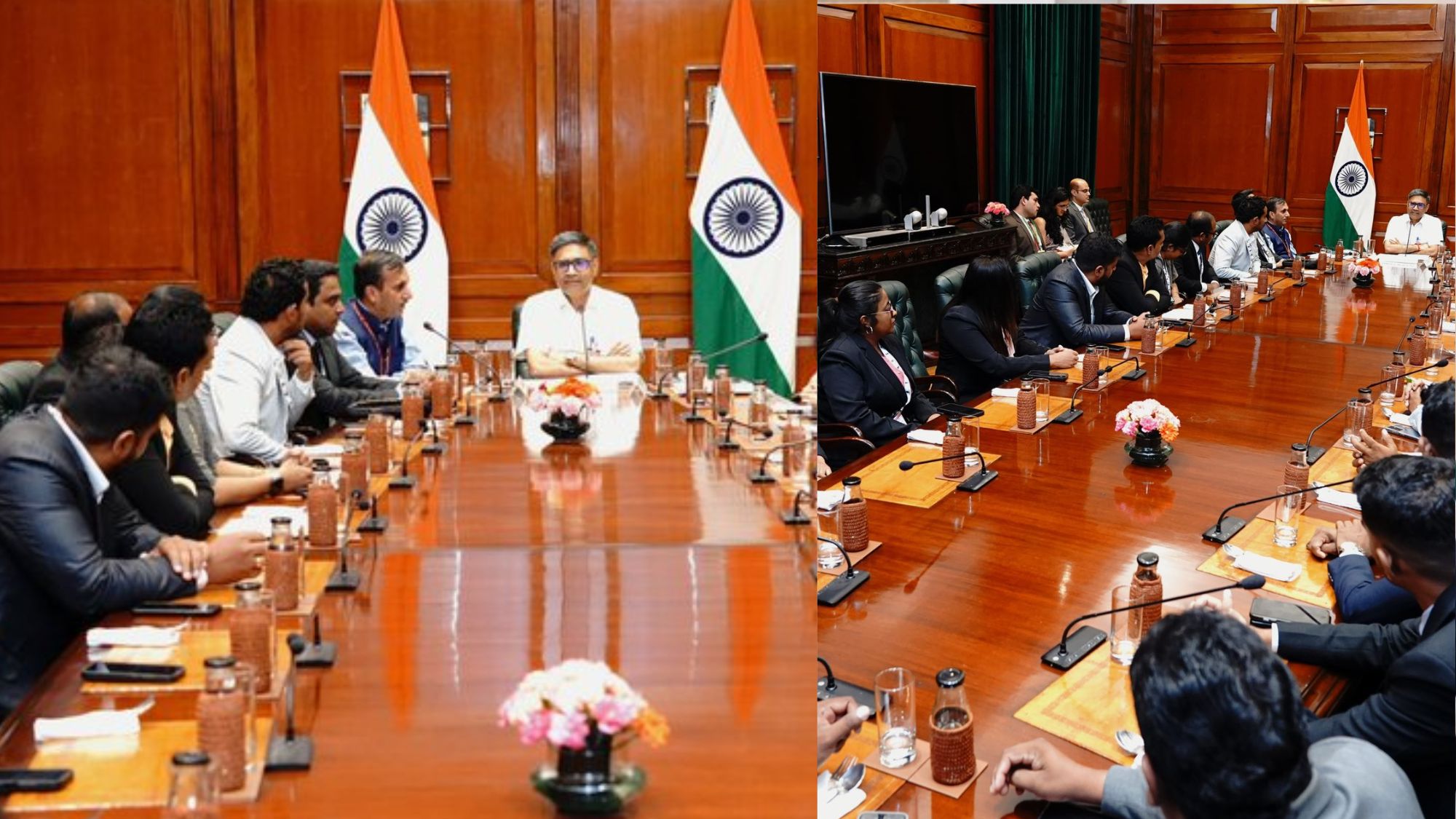
NEW DELHI (Diya TV) — A 24-member delegation of young political leaders from Sri Lanka began a two-week visit to India on Tuesday, aimed at deepening the growing partnership between the two nations. The delegation, representing 14 political parties, met with India’s Foreign Secretary Vikram Misri in New Delhi to kick off their program.
The Ministry of External Affairs (MEA) said the visit reflects India’s continued efforts to strengthen political ties with Sri Lanka. The initiative is part of India’s Neighbourhood First policy and Vision MAHASAGAR (Mutual and Holistic Advancement for Security and Growth Across Regions), which prioritizes regional cooperation and connectivity.
During the meeting, Misri highlighted the vital role of young political leaders in shaping the future of the India-Sri Lanka relationship. He emphasized their position as key stakeholders in the long-term roadmap between the two countries.
“They are an important bridge between the present and the future,” said MEA spokesperson Randhir Jaiswal in a post on X. “Their engagement helps deepen the #IndiaSriLanka partnership.”
The talks also touched on regional geopolitics and ongoing security cooperation between the two nations.
The delegation includes 20 Members of Parliament from Sri Lanka, four senior parliamentary officials—including the Secretary General—and Deputy Speaker Rizvie Salih. They represent a cross-section of political ideologies, reinforcing India’s outreach to a broad spectrum of Sri Lankan leadership.
This engagement follows a prior meeting in Colombo between the delegation and India’s High Commissioner to Sri Lanka, Santosh Jha. There, the leaders discussed initiatives to promote cooperation and mutual growth before embarking on the visit to India.
India and Sri Lanka share over 2,500 years of cultural and historical connections. The relationship is rooted in common heritage and strong people-to-people ties. These shared foundations continue to support a growing partnership across key sectors like infrastructure, education, trade, and defense.
India’s focus on neighborhood diplomacy has placed Sri Lanka at the center of its regional outreach. As part of its development support, India continues to assist Sri Lanka’s economic recovery through financial aid, capacity-building programs, and infrastructure investments.
This visit follows a series of high-level exchanges between India and Sri Lanka over the past two years. In April, Prime Minister Narendra Modi visited Sri Lanka and met with President Anura Kumara Dissanayake, who assumed office in September 2024. Modi was the first foreign leader to pay a state visit since the new president took office.
During that visit, the two leaders discussed economic cooperation, cultural exchanges, and strategic ties. India announced a comprehensive training package for 700 Sri Lankan citizens annually and finalized debt restructuring agreements to assist in Sri Lanka’s economic stabilization.
Earlier, Indian External Affairs Minister S. Jaishankar became the first foreign dignitary to visit Sri Lanka after Dissanayake’s election. India also gifted 22 diesel locomotives to Sri Lanka and converted completed Line of Credit projects worth $20 million into grants.
Later, President Dissanayake made his first overseas visit to India, where he met President Droupadi Murmu, Prime Minister Modi, and other senior leaders. The two countries signed several agreements, including one to amend the Double Taxation Agreement and another to train Sri Lankan civil servants.
India announced an additional $14.9 million for a railway signaling project in Sri Lanka’s Maho-Anuradhapura section. It is also committed to offering 100 scholarships each year to students from the University of Jaffna and Eastern University.