BEIJING (Diya TV) — Indian External Affairs Minister S. Jaishankar met top Chinese officials in Beijing on Monday, signaling renewed diplomatic efforts to stabilize India-China relations. His visit marks the first since the deadly Galwan Valley clash in May 2020 and comes ahead of the Shanghai Cooperation Organisation (SCO) summit set to take place in Tianjin later this year.
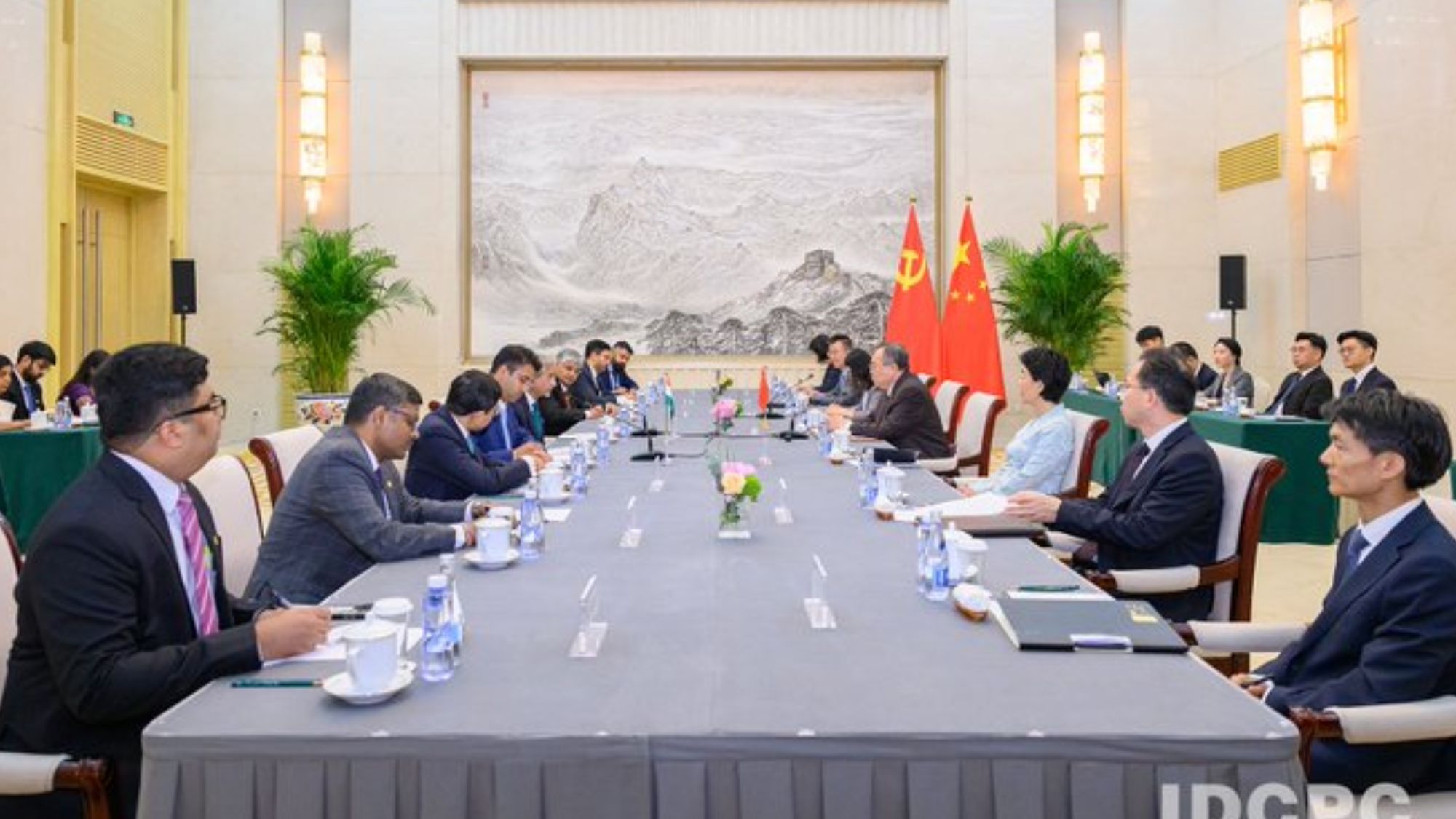
Jaishankar held a meeting with Liu Jianchao, Minister of the International Department of the Communist Party of China (CPC) Central Committee. Liu emphasized the importance of steady relations between China and India, calling them “two neighboring major developing countries” and “major emerging economies.”
Liu noted that closer cooperation could benefit both nations’ modernization goals and meet the aspirations of the Global South. He also expressed the CPC’s willingness to increase exchanges with India’s ruling Bharatiya Janata Party (BJP). According to Liu, such political engagement can help improve bilateral conditions and foster mutual trust.
Following the talks, Jaishankar posted on X saying, “Good to meet IDCPC Minister Liu Jianchao in Beijing. Discussed the changing global order and the emergence of multipolarity. Spoke about a constructive India-China relationship in that context.”
Jaishankar underlined the need for a stable and forward-looking approach in managing ties between the two Asian powers. He called for greater people-to-people exchanges and urged China to lift trade barriers.
“It is incumbent on us to address aspects related to the border, normalize people-to-people exchanges and avoid restrictive trade measures and roadblocks,” Jaishankar wrote. “Confident that on the foundation of mutual respect, mutual interest and mutual sensitivity, ties can develop along a positive trajectory.”
Jaishankar also met with Wang Yi, China’s Foreign Minister and a member of the Political Bureau of the CPC Central Committee. The two discussed ways to build a stable and constructive relationship. Jaishankar reiterated India’s commitment to open dialogue and peaceful diplomacy.
Later, he held discussions with Chinese Vice President Han Zheng. During the meeting, Jaishankar stressed that normalizing ties could bring “mutually beneficial” outcomes. He noted that both countries, as large economies and neighbors, have a shared responsibility to maintain regional peace.
Jaishankar’s visit to Beijing is linked to his participation in the upcoming SCO Council of Foreign Ministers’ Meeting in Tianjin. The SCO’s main goals include fighting terrorism, separatism, and extremism across the region.
“We will be meeting in the format of the SCO, whose primary mandate is to combat terrorism, separatism, and extremism,” Jaishankar said in his remarks to the Chinese Foreign Minister. “This is a shared concern, and India hopes that zero tolerance for terrorism will be strongly upheld.”
The SCO, a regional intergovernmental organization, includes India, China, Pakistan, Russia, and several Central Asian nations. Iran and Belarus are also members. The group works to improve political, economic, and security cooperation across Eurasia.
Jaishankar also met SCO Secretary-General Nurlan Yermekbayev. They discussed the organization’s growing relevance and ongoing reforms aimed at modernizing its functions. “Glad to meet SCO SG Nurlan Yermekbayev in Beijing today,” Jaishankar posted. “Discussed the contribution and importance of SCO, as well as the endeavors to modernize its working.”
India’s participation in recent SCO-related events signals its continued commitment to regional diplomacy. Last month, Defense Minister Rajnath Singh and National Security Advisor Ajit Doval attended the SCO meetings in China, focusing on defense and security matters.
Jaishankar’s visit comes at a crucial time in the region. Both countries appear ready to address long-standing issues and explore ways to cooperate. With China and India playing major roles in the global south, efforts to improve ties may carry significant weight for regional stability.
As both countries prepare for the SCO Heads of State Council meeting later this year, diplomatic conversations like these may lay the foundation for better cooperation. While serious challenges remain, this high-level engagement shows a willingness on both sides to rebuild trust and work toward common goals.