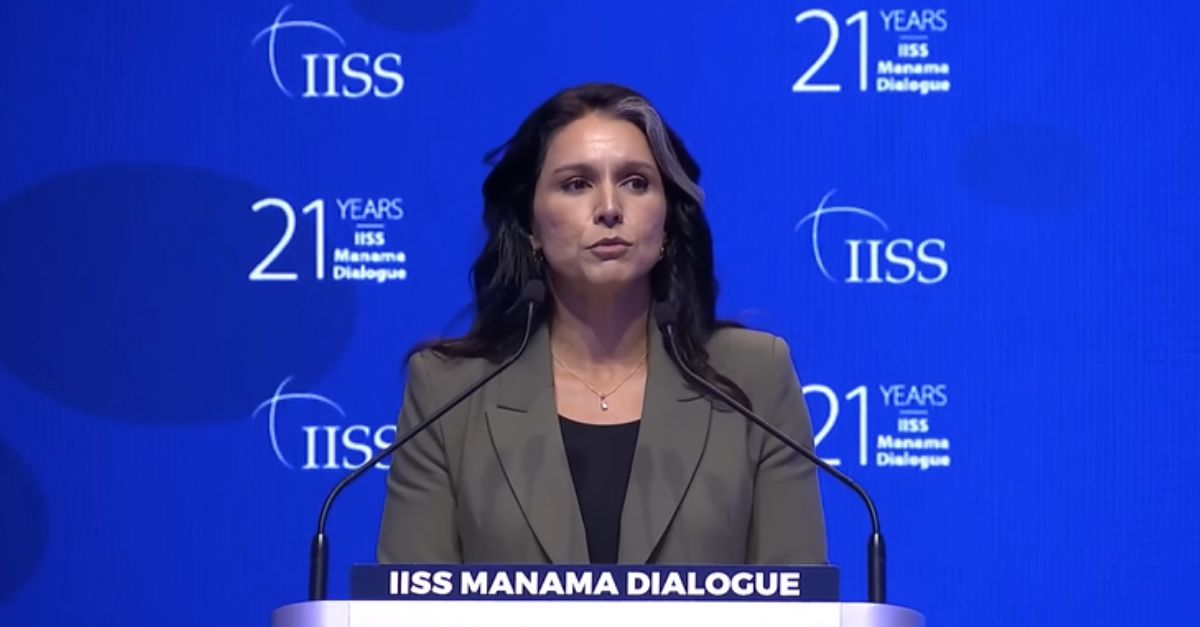
MANAMA, Bahrain (Diya TV) — The United States has ended its decades-long strategy of “regime change or nation building” in the Middle East, according to Director of National Intelligence Tulsi Gabbard, who spoke Friday at a major regional security summit. Speaking at the Manama Dialogue, an annual conference hosted by the International Institute for Strategic Studies, Gabbard said that under President Donald Trump’s second term, America has shifted away from military intervention and toward economic growth and regional stability.
“For decades, our foreign policy has been trapped in a counterproductive and endless cycle of regime change or nation building,” Gabbard said. “It was a one-size-fits-all approach, of toppling regimes, trying to impose our system of governance on others, intervening in conflicts that were barely understood, and walking away with more enemies than allies.”
The statement reflects the broader Trump administration policy reset in the Middle East. The administration now focuses on ending wars, promoting trade, and ensuring long-term peace. Gabbard highlighted several recent diplomatic efforts that mark a clear break from past U.S. policies. She pointed to the ceasefire that stopped the Israel-Hamas war in Gaza and the halt to Israel’s 12-day conflict with Iran, both of which came after U.S. intervention.
In those crises, Trump directed American bombers to strike Iranian nuclear sites, pushing both sides toward negotiation rather than continued war. The outcome, Gabbard said, showed the benefits of a more targeted and results-driven strategy.
“In the past, the U.S. often stayed in wars without a clear goal or exit plan,” she said. “Now we aim to stabilize the region through diplomacy and economic cooperation.”
Gabbard’s remarks mirror Trump’s own long-held view that America’s post-9/11 wars brought heavy costs but limited success. Trillions of dollars were spent, and thousands of U.S. service members lost their lives. Trump campaigned on ending what he called “forever wars.” During his first term, he negotiated the withdrawal of U.S. forces from Afghanistan. The final pullout in 2021, under the Biden administration, became chaotic and drew sharp criticism at home and abroad.
Despite that turmoil, Trump’s team has pushed forward with a realignment of U.S. foreign policy—one centered on national interest rather than ideological goals. As part of this realignment, Trump has also built new, unconventional alliances. One of the most surprising has been his support for Syria’s interim President Ahmad al-Sharaa, a former al-Qaida fighter who was once imprisoned by U.S. forces in Iraq.
The administration has described al-Sharaa as a “pragmatic leader” capable of stabilizing Syria after years of war. Critics, however, say the move raises questions about U.S. credibility and the moral cost of working with former extremists. Gabbard did not address this partnership in her remarks, but analysts at the summit said it reflects Washington’s growing willingness to prioritize stability over ideology.
While ending large-scale nation-building efforts, Trump’s foreign policy still involves a strong U.S. military presence abroad. Gabbard did not mention the deployment of U.S. warships near South America, which has fueled concerns of new conflicts.
Reports indicate that U.S. forces have carried out airstrikes against suspected drug traffickers and that the CIA has resumed covert operations in Venezuela. Those actions have sparked speculation that Trump could still seek to topple Venezuela’s authoritarian leader, despite his stated opposition to regime change.
Gabbard’s comments suggest the U.S. is trying to balance strength with restraint. Instead of occupying nations or building governments from scratch, the Trump administration prefers to use targeted military power, economic pressure, and strategic alliances to achieve results.
“The results of our old policies were clear,” Gabbard said. “Trillions spent, countless lives lost, and in many cases, the creation of greater security threats.”
By shifting focus, she said, the U.S. hopes to “lead through partnership, not occupation.”
The speech at the Manama Dialogue signals a defining moment for U.S. foreign policy in the Middle East. For many regional leaders, the change offers hope that Washington’s new doctrine could bring lasting peace after decades of war. Still, critics warn that turning away from democracy promotion could embolden authoritarian regimes. Supporters argue that economic development and stability will create the conditions for freedom over time.
As Gabbard concluded, “Our goal now is not to remake nations in America’s image, but to help our partners build their own paths to peace and prosperity.”