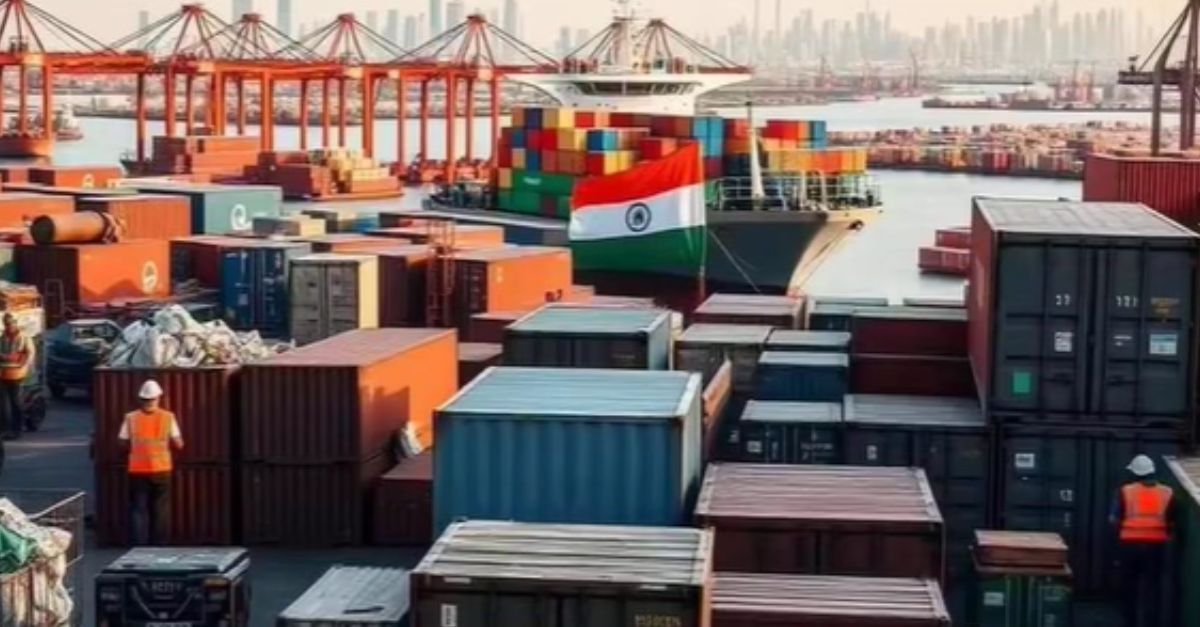
NEW DELHI (Diya TV) — India’s export diversification strategy is starting to pay off after the United States imposed a steep 50% tariff on Indian goods earlier this year. While shipments to America have fallen sharply, Indian exporters are finding new opportunities across Asia, Europe, and the Middle East. After Washington raised tariffs first to 25% on Aug. 7 and then to 50% on Aug. 25, many Indian exporters began shifting their focus to alternative destinations. The move, though initially disruptive, has helped open new trade routes and strengthen India’s global export base.
According to fresh government data for September, India’s exports to China, Vietnam, and Thailand jumped more than 60%. Exports of basmati rice to Iran surged sixfold to $41.07 million. Cotton garment shipments to the United Arab Emirates, France and Japan also climbed during the month.
Overall merchandise exports rose 6.7% year over year to $36.38 billion in September. The trend shows that India’s trade diversification strategy is helping offset the impact of reduced access to the U.S. market. The United States remains India’s largest export destination, accounting for about one-fifth of total merchandise exports. However, exports to the U.S. dropped 11.93% in September to $5.46 billion.
Several key sectors have taken a hit. Marine product exports to the U.S. fell 26.9%, while handmade carpets declined by 26.14%. Tea exports to America dropped 22%, and shipments of gems, jewelry, and leather goods also weakened.
Despite these declines, exporters quickly adapted. Marine product exports to Asian nations such as China, Vietnam, and Thailand grew more than 60%. Handmade carpets found new buyers in Canada and Sweden. Tea exports rose in the United Arab Emirates, Iraq, and Germany.
Officials said India’s focus on new trade partners is beginning to yield visible results. “Export diversification is visible and is supported by India’s free trade agreements, thrust on production-linked incentive schemes and the integration with global supply chains,” an official told The Economic Times.
Ajay Sahai, director general of the Federation of Indian Export Organisations, said the shift is healthy for long-term export growth. “Export diversification has started to happen, and this is healthy for the growth of India’s exports,” he said.
The Commerce Ministry has identified 40 major importing countries across North America, Europe, Asia, Africa, Latin America, and Oceania to deepen trade ties. These markets represent nearly three-fourths of global demand for textiles and apparel. India plans to boost its current 5–6% market share in sectors like apparel, home textiles, technical textiles, and handicrafts through targeted outreach programs.
Trade officials in New Delhi and Washington are in talks over a new bilateral trade agreement (BTA). Both sides aim to raise total trade to $500 billion by 2030. The additional tariffs introduced by Washington in August were justified by U.S. officials as a response to India’s alleged trade ties with Russia amid the Ukraine conflict. The 50% duty, introduced in two phases, hit products including textiles, gems, seafood, and machinery.
Despite the tariffs, Indian exporters are optimistic. Many believe that tapping into new markets will make India’s export ecosystem more resilient in the long run. While diversification is gaining momentum, several product segments remain heavily dependent on American demand. Nearly 60% of India’s carpet exports, 50% of made-ups, 30% of gems and jewelry, and 40% of apparel exports still go to the U.S. market.
Industry experts say that while shifting away from the U.S. will take time, early signs of growth in Asia, Europe, and the Middle East are encouraging. The rise in exports to China, Vietnam, and Thailand shows that India’s manufacturers can compete effectively in global markets beyond the U.S. India’s diversification push marks a key shift in its export strategy. By reducing overreliance on one major market, the country is building a more balanced trade network. The rise in exports to multiple regions demonstrates the flexibility and competitiveness of Indian exporters.