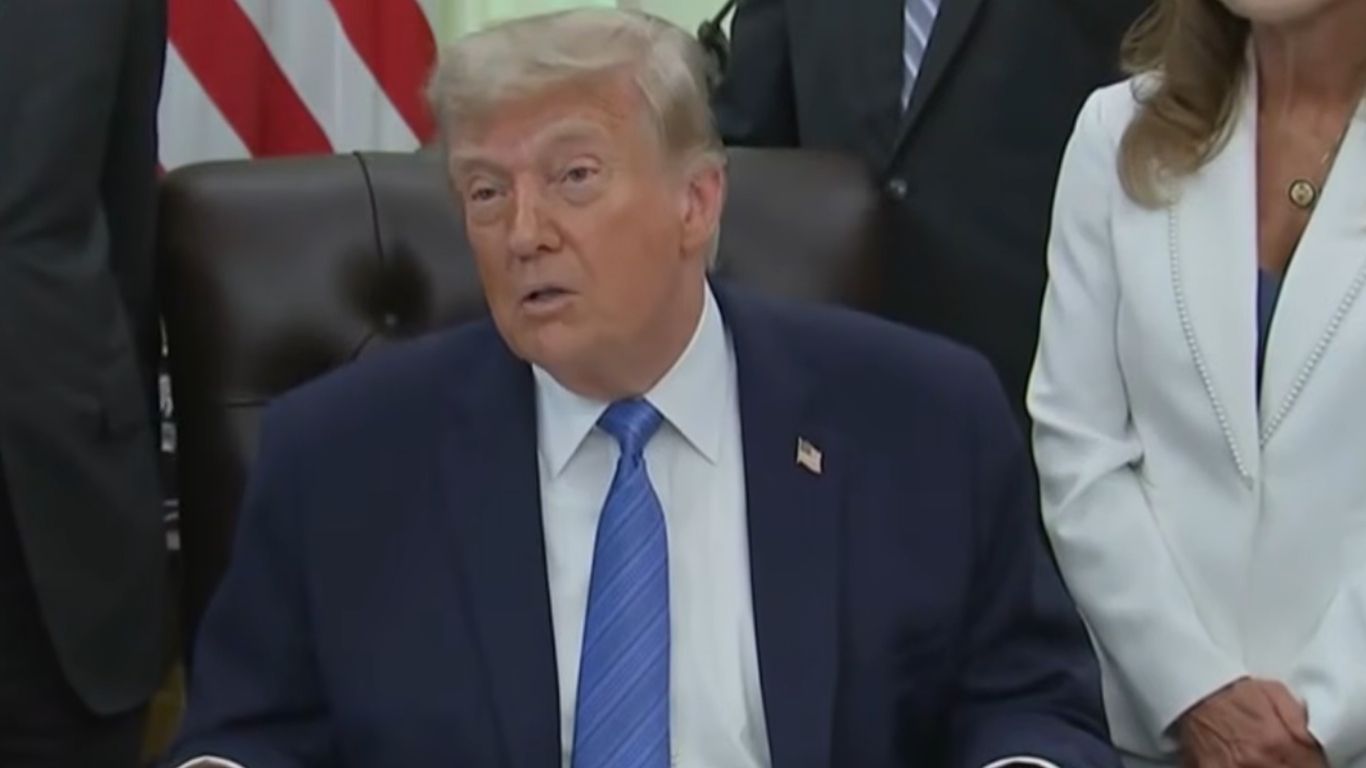
WASHINGTON (Diya TV) — President Donald Trump’s investment accounts carried out thousands of stock trades in early 2026, according to a federal financial disclosure reviewed by CBS News. The activity included more than 3,600 transactions across hundreds of companies and funds. The scale and timing of the trades have raised new concerns about ethics, transparency, and potential conflicts of interest.
The disclosure, filed on an OGE Form 278-T, shows 2,346 purchases and 1,296 sales between Jan. 6 and March 30, 2026. The total value of trades ranged between $212 million and $695 million.
The accounts traded across 1,026 firms and funds. Major technology companies such as Microsoft, Amazon, Meta, Netflix, Oracle, and AMD appeared most often in the records. The filings also show heavy activity in exchange-traded funds and financial instruments tied to broad market indexes.
Trading increased sharply in March, when the accounts made 1,565 purchases compared with roughly 400 buys in each of the previous two months. On March 23 alone, the accounts executed 283 purchases and 17 sales.
The disclosure also shows large single transactions. On Feb. 10, the accounts sold major positions in Microsoft, Amazon and Meta, each valued between $5 million and $25 million. Overall, stock purchases totaled between $126 million and $399 million, while sales ranged from $86 million to $296 million.
The high volume of trading has drawn scrutiny from ethics experts and Democratic lawmakers. Sen. Elizabeth Warren, D-Mass., called for an investigation into possible insider trading and questioned whether the president’s position could influence investment decisions.
Some transactions also drew attention due to timing. The disclosure shows purchases in companies such as Nvidia, Palantir, and Eli Lilly around periods when the administration made policy moves or the president publicly commented on related industries.
Legal experts told CBS News that presidents are not subject to the same conflict-of-interest laws as other federal officials. However, they warned that active trading while in office can create the appearance of impropriety, especially when policy decisions may affect market outcomes.
Richard Briffault, a Columbia Law School professor who studies government ethics, said the structure of the president’s financial arrangements leaves questions about oversight. He noted that the arrangement depends heavily on trust rather than independent monitoring.
The Trump Organization said the president and his family do not direct or approve trades. It said independent third-party managers handle all investment decisions and provide no advance notice of activity.
Some investment professionals reviewed the data and suggested the activity may reflect tax strategies rather than discretionary trading. One manager told CBS News the pattern resembles tax-loss harvesting, where investors sell securities at a loss to offset gains elsewhere.
David Salem, a portfolio manager at Hedgeye Asset Management, said the trades may also reflect “direct indexing,” a method that mimics index funds through individual securities while allowing tax optimization. He said computer-driven systems can automate such strategies on a large scale for wealthy clients.
Salem also pointed to the spike in activity on March 23, which coincided with index rebalancing events. He said such timing can generate high volumes of trades in systematic portfolios.
Other financial advisers disagreed on the explanation. Eric Diton, president of The Wealth Alliance, said the volume of trades is difficult to justify under typical investment strategies and appears unusually high even for sophisticated tax planning approaches.
The disclosure has renewed debate over whether elected officials should be allowed to actively trade stocks while in office. Stock trading by presidents is legal, and current law does not require full divestment of personal assets.
Several lawmakers have proposed changes. Sen. Andy Kim, D-N.J., has backed legislation that would ban stock trading by officials across the executive, legislative and judicial branches. A bipartisan Senate proposal known as the HONEST Act would also require officials to divest assets upon taking office, though it has not advanced to final passage.