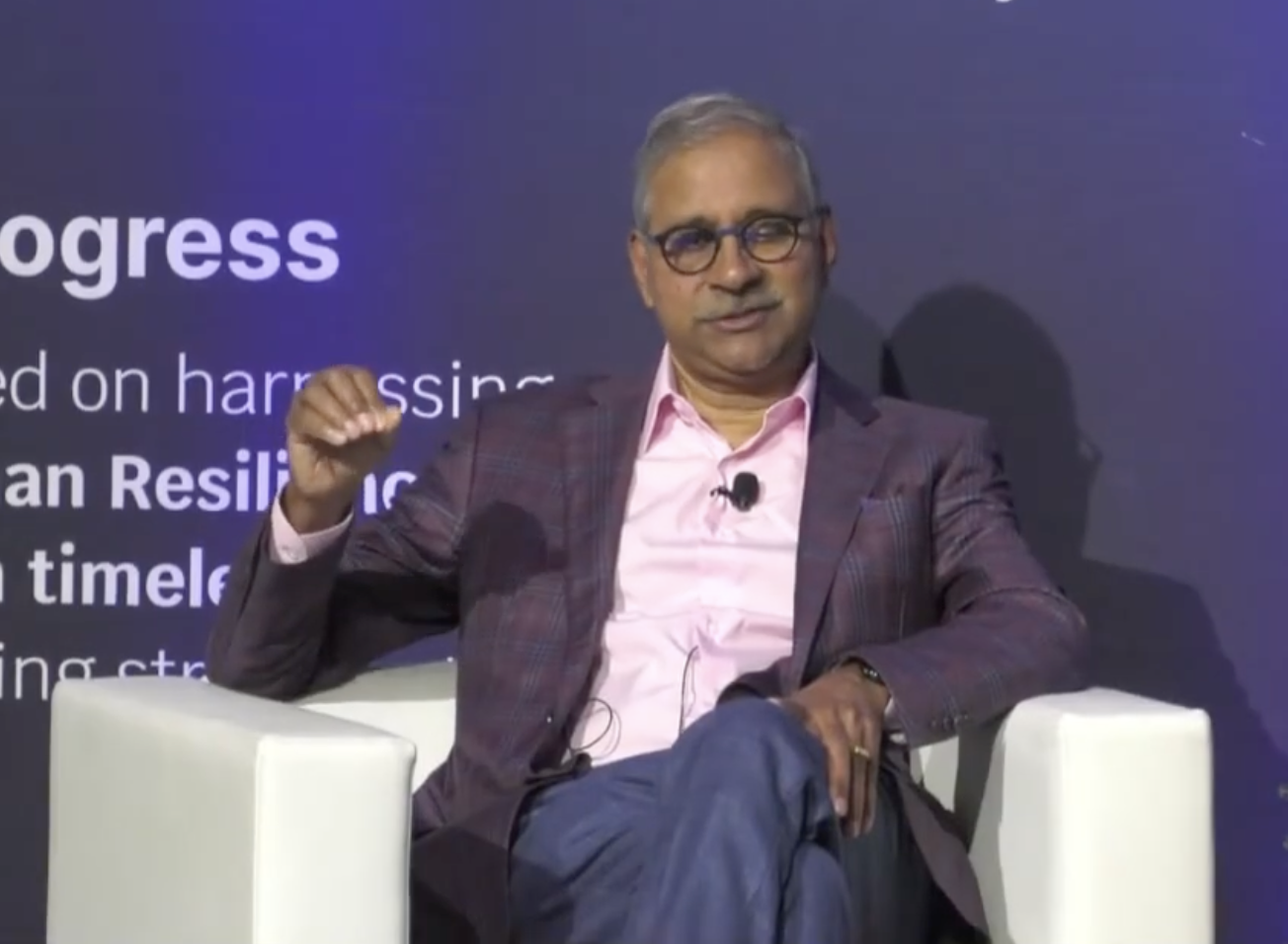
SAN FRANCISCO (Diya TV) — Ram Shriram, one of Google’s earliest investors and a longtime Stanford board member, sat down for a wide-ranging conversation at the Global Science Innovation Forum in Silicon Valley, moderated by M.R. Rangaswami, Founder and Chairman of Indiaspora.
Shriram opened by revisiting one of the most consequential bets in technology history. Google in 1998 was a contrarian investment. There were seven search engines at the time, and every venture capitalist they approached said no. What set Google apart, he explained, was PageRank, a fundamentally different approach to determining the quality of search results based on the number and reputation of sites linking to a given page. “People are going to migrate towards choices that give them better outcomes, better results, better information,” he said. “That’s how the company got built.”
On the question of how Google has sustained its edge through research, Shriram traced it back to a decision made by Larry Page in 2011. Seeing early where AI was heading, Page set about acquiring the best talent he could not build internally. The result was the 2014 acquisition of DeepMind, which at the time had 600 people, 400 of whom held PhDs. Combined with Google’s internal research group, the company had roughly a thousand research scientists working on AI well before the topic entered mainstream conversation. Shriram described the model as a careful balance between primary research and applied engineering, with distinct teams responsible for each. “You cannot legislate innovation,” he said. “You let them pursue it on their own time.” The original transformer paper, the architectural foundation for virtually every large language model in existence today, came out of Google Brain in 2017. Google chose not to productize it at the time, citing safety concerns, and the rest of the industry was built on top of it.
The conversation turned to Stanford’s role in Silicon Valley’s innovation ecosystem. Shriram traced the university’s success to two things: a revolving door that allows faculty to take leaves of absence to found companies and return, and a deliberately simple approach to licensing technology out of the university. He contrasted Google’s spin-out, in which Stanford accepted a 2% equity stake in lieu of cash, with Netscape’s troubled experience licensing browser technology from the University of Illinois in the 1990s. The University of Illinois demanded cash, received nothing, and lost six founding team members in the process. Stanford’s 2% stake eventually generated $400 million. “They’re not trying to extract a pound of flesh when these young companies have almost no money,” he said.
Globally, close to $3.5 trillion is flowing into AI, propping up US GDP growth through data center construction, employment, and related investment in energy infrastructure. But he was candid about the bubble dynamics. “If it smells and acts like a bubble,” he said, citing the example of Allbirds, a shoe company that pivoted to AI chips and saw its stock rise 200%. Out of the noise, he believes, genuinely foundational companies will emerge alongside a wave of failures.
One investment he highlighted was LM Arena, also known as LM SYS, a benchmarking platform created by a Berkeley professor and students that has become the de facto standard for evaluating AI models across the industry. Every major company now submits its models for evaluation on metrics including math, coding, output quality, and cost per token. “It has become the benchmark,” he said, “much like the metric system.”
Shriram acknowledged the pace of innovation is faster than any policy framework can track, and national regulation in the US has so far opted for a largely hands-off approach. He noted that the major LLM companies are largely self-regulating through internal ethics teams, and cited Anthropic’s decision not to release a recent model after discovering it could be used to identify decades-old security vulnerabilities as an example of the kind of commercial and ethical tradeoffs these companies are navigating. “It could help the good people and the bad people,” he said. “So they chose not to release it.” Any policy framework developed today, he concluded, would likely be obsolete before it took effect.