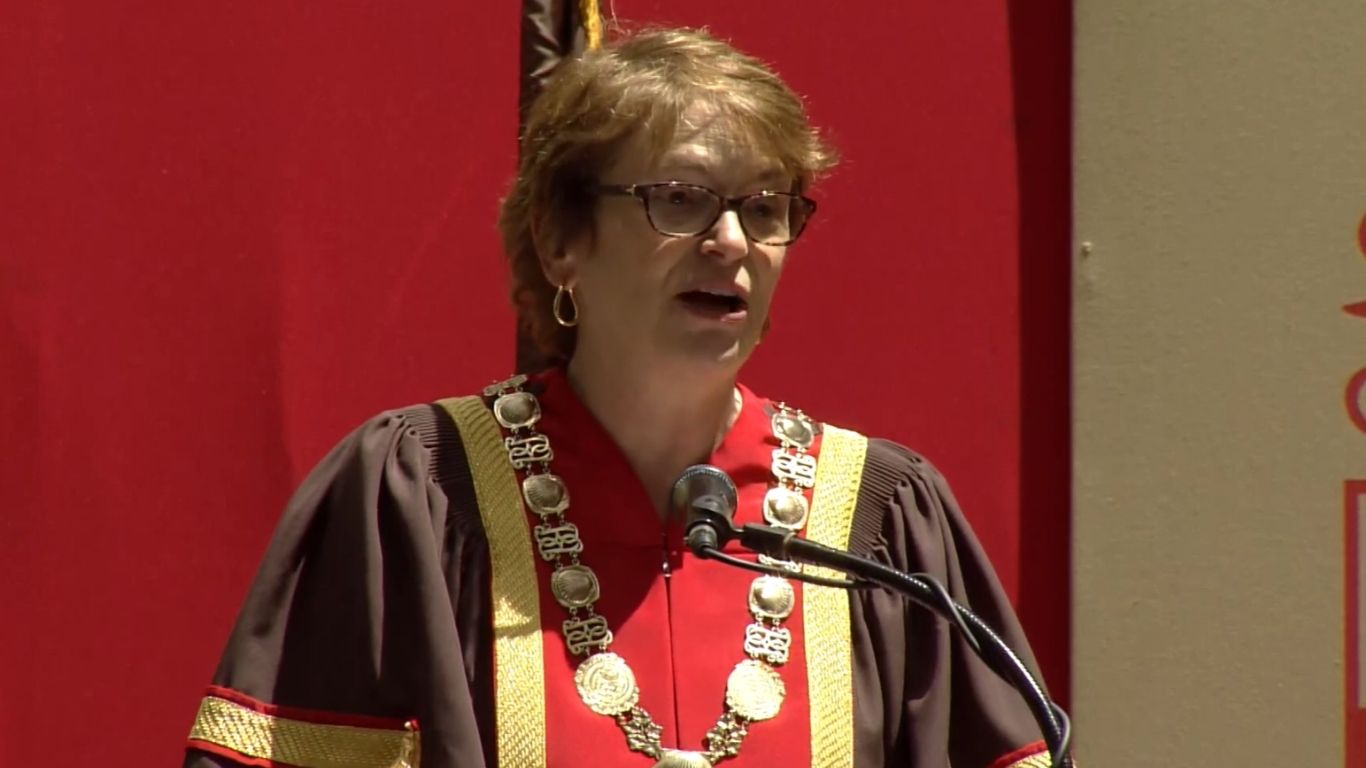
PROVIDENCE, R.I. (Diya TV) — Brown University President Christina H. Paxson announced Monday that she will step down at the end of the 2026-27 academic year. Her decision will close a leadership tenure that began in 2012 and made her the longest-serving current president in the Ivy League.
Paxson shared the news in an open letter to the Brown community. She said leaving after the coming academic year is the right decision for her and her family. She also noted that she had extended her time in office to guide the university through major challenges, including a difficult dispute with the Trump administration.
Her departure follows one of the most challenging periods in Brown University’s recent history. The school faced federal funding threats, campus debate, and a tragic shooting. Even so, Paxson remained at the center of key decisions that shaped the university’s response.
Brown settled with the Trump administration last summer after federal officials moved to block about $510 million in research funding. The administration argued that elite universities had failed to respond properly to concerns about antisemitism and protests linked to the war in Gaza. As a result, Brown entered negotiations to protect its research programs.
Under the agreement, Brown committed $50 million to workforce development programs in Rhode Island. In return, the university secured the restoration of its research funding. The settlement also preserved Brown’s authority over academic matters. However, it aligned the university with the administration’s positions on transgender athletes and merit-based admissions policies.
The agreement sparked mixed reactions across campus. Some students and faculty criticized the settlement. They argued that the university had given too much ground to the federal government. Others believed the agreement helped protect important research projects and academic operations.
Later, Paxson took a different stand against another federal proposal. She strongly opposed an idea that would have tied research funding to a university’s ideological alignment. She warned that such a plan could threaten academic freedom and weaken the independence of higher education institutions.
Soon after, the Trump administration stepped back from the proposed compact. Instead, officials encouraged colleges and universities to explain publicly how they address concerns about higher education. That change ended discussions over the broader agreement that had raised concerns among many university leaders.
Meanwhile, Brown faced another crisis in December. A former student opened fire on campus, killing two students and injuring nine others. The tragedy shocked the university community and prompted widespread calls for stronger campus safety measures.
Paxson led Brown through the difficult aftermath. She offered support to students, faculty, and staff while the university worked to recover. At the same time, many people questioned the school’s security policies. Brown’s campus has long allowed easy public access, and some community members called for changes after the shooting.
Despite the criticism, university leaders praised Paxson’s leadership during a period marked by extraordinary challenges. Brown Chancellor Brian T. Moynihan, who also serves as chief executive of Bank of America, said she balanced academic excellence with operational leadership and encouraged collaboration across the university.
Moynihan also said Brown’s current strategic planning cycle helped determine the timing of Paxson’s departure. He confirmed that the university will launch a national search to find its next president. The search will begin before Paxson leaves office in 2027.