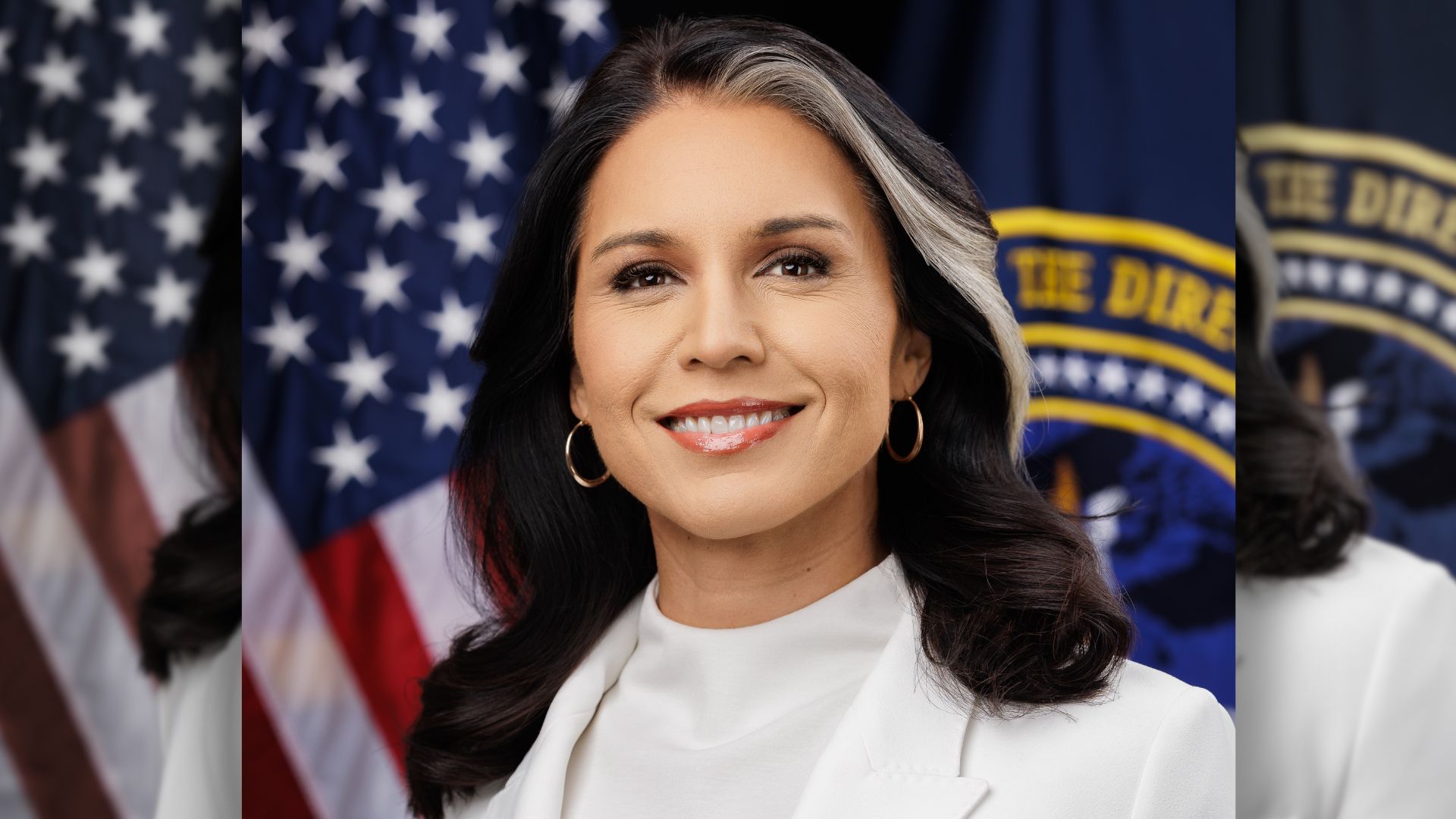
WASHINGTON (Diya TV) — Tulsi Gabbard is resigning as Director of National Intelligence, ending one of the most unusual and closely watched chapters in President Donald Trump’s second-term Cabinet.
Gabbard is expected to leave office June 30 after her husband, Abraham Williams, was diagnosed with an extremely rare form of bone cancer. The decision brings her public role to an abrupt pause after more than a year at the center of Trump’s intelligence operation.
For Gabbard, the resignation is deeply personal. Williams has been beside her through military service, campaigns, political reinvention and the pressures of national office. Now, after years in which he often stood just outside the frame of her public life, Gabbard is stepping away from one of Washington’s most demanding jobs to stand beside him.
The timing, however, also gives the resignation a much larger political weight.
Just days ago, Gabbard was still moving aggressively through her intelligence agenda. Her office had launched a sweeping review of U.S.-funded foreign biological laboratories, following earlier moves on declassification, election security, intelligence restructuring and investigations into what the administration described as politicization inside federal agencies.
Then came the resignation.
That sudden turn makes her departure feel bigger than a standard Cabinet exit. It ends a tenure that was historic, polarizing and at times visibly strained.
Gabbard entered the administration as one of Trump’s most unconventional picks. She was a former Democratic congresswoman from Hawaii, a 2020 presidential candidate, an Army Reserve officer, a Hindu American and a longtime critic of U.S. military intervention. By the time Trump brought her into his Cabinet-level national security team, she had become a symbol of political realignment, moving from Democratic presidential politics into the heart of a Republican administration.
Her appointment was always meant to send a message. Trump wanted someone who would challenge the intelligence establishment. Gabbard wanted to prove that the intelligence community could be reshaped, reduced and refocused.
Inside ODNI, she moved quickly. Her office pushed what it called ODNI 2.0, a major restructuring plan that aimed to cut staff, reduce bureaucracy and save hundreds of millions of dollars each year. She moved against DEI programs, launched internal reviews, supported declassification efforts and elevated issues such as cartel activity, election security, biological research and alleged government weaponization.
Supporters saw her as a long-overdue disruptor. They believed she was willing to confront a national security bureaucracy that had become too political, too insulated and too comfortable operating away from public scrutiny.
Critics saw the opposite. They argued that Gabbard brought too much ideology into a role that depends on trust, discretion and steady coordination across agencies. Her moves delighted Trump allies, but they also deepened concern among Democrats and some intelligence veterans who questioned whether reform had become political retaliation.
That tension followed her through the job.
One of the clearest signs came during the administration’s Venezuela planning. Earlier this year, reports said Gabbard had been left out of months of high-level discussions tied to pressure against Venezuelan President Nicolás Maduro. The White House denied that she had been sidelined, but the episode still raised questions about her standing inside Trump’s national security circle.
For the nation’s top intelligence official, the optics were damaging. Gabbard held one of the most powerful intelligence titles in the federal government. But the Venezuela episode suggested that, at least in some major foreign policy decisions, others had the president’s ear more directly.
The same dynamic appeared around Iran, where Gabbard’s long-standing anti-interventionist instincts sat uneasily beside an administration moving through a more aggressive foreign policy posture. Her career had been built in part on warning against foreign wars. Her Cabinet role required her to serve inside a government where those debates were no longer theoretical.
That contradiction became one of the defining features of her time in office.
Gabbard was never a conventional Trump Republican. She was never a traditional intelligence figure either. That made her compelling, but it also made her vulnerable. She had the résumé of a political outsider and the title of an institutional insider. She was asked to lead an intelligence community she had spent years criticizing. She was also asked to serve a president whose foreign policy team did not always appear aligned with her own instincts.
Her resignation now removes one of the most visible women in Trump’s Cabinet-level national security orbit. It also comes after a series of high-profile departures by women from Trump’s broader Cabinet ranks, adding to scrutiny over turnover inside the administration’s senior leadership.
Still, Gabbard’s exit is different. She is not leaving under the cloud of a single scandal. She is not leaving after a public firing. She is leaving because of a family crisis, but she leaves behind a role already surrounded by questions about influence, access and internal trust.
That is what makes the moment so human and so political at the same time.
On paper, Gabbard’s resignation letter is about her husband’s health. In Washington, her departure will also be read as the end of a difficult experiment: placing a deeply anti-establishment figure at the top of the intelligence community and asking her to both reform it and operate within it.
Her supporters will remember the declassification drives, the staffing cuts, the push against what they saw as bureaucratic excess and her willingness to take on institutions most politicians avoid. Her critics will remember the controversies, the accusations of politicization, the friction with other national security officials and the repeated questions about whether she had real influence inside the White House.
Both versions are part of the story.
Gabbard came into the job with unusual symbolic power. She was a combat veteran, the first Hindu American elected to Congress, a former Democrat turned Trump ally and one of the most recognizable women in the administration. She leaves with an equally complicated legacy: part reformer, part outsider, part loyalist, part dissenter.
For Trump, her resignation creates another major vacancy in a national security team already shaped by internal pressure and foreign policy crises. For ODNI, it means another transition at an agency Gabbard had been trying to remake from the inside.
For Gabbard, the next chapter is no longer about hearings, briefings or classified assessments. It is about her husband, his treatment and the private life that public office often pushes to the side.
Her resignation closes a term that never stopped feeling unsettled. It began with a political shock, unfolded through reform and conflict, and ended with a personal crisis that forced one of Trump’s most watched Cabinet figures to walk away.