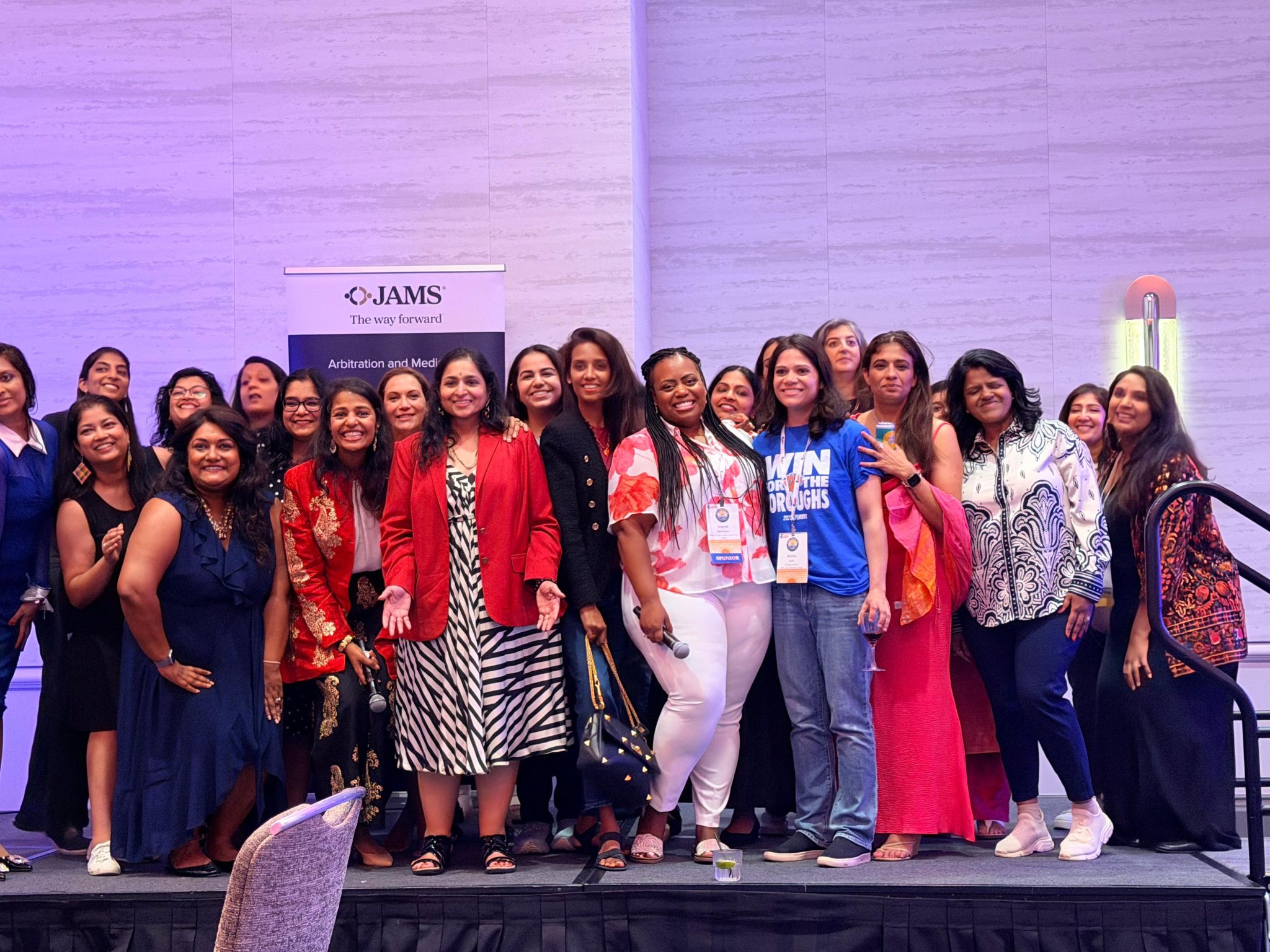
SAN DIEGO, Calif. (Diya TV) — The South Asian Bar Association of North America held its 2026 Annual Conference in San Diego, California, from June 18 to 21, bringing together attorneys, judges, law students, in-house counsel and legal professionals from across the United States and Canada for a four-day gathering focused on legal developments, professional advancement, community engagement and issues facing the South Asian legal community.
The conference drew hundreds of attendees for a weekend of continuing legal education panels, networking receptions, leadership programming, wellness events and community-building. Signature events included the SABA Foundation Gala, professional development sessions, networking receptions and the organization’s annual awards ceremony.
A major moment of the conference came during remarks by Congressman Raja Krishnamoorthi, who addressed the gathering with a message centered on belonging, civic participation and the role of South Asian lawyers in defending democratic institutions. Speaking shortly after Juneteenth, Krishnamoorthi said the American story has always involved the unfinished work of building “a more perfect union” and expanding freedom, dignity and belonging.
Krishnamoorthi reflected on the growth of the South Asian legal community, saying the profession has expanded from roughly 200 South Asian lawyers four decades ago to about 25,000 today. He also noted the rise in South Asian representation on the bench, saying there are now 15 Article III judges and about 100 judges at all levels. He framed that growth as evidence of the community’s progress, while also warning that representation and belonging cannot be taken for granted.
In his remarks, Krishnamoorthi said being American has never been defined by ancestry, ethnicity or “the number of letters in your name.” Instead, he said it rests on values including freedom, equality, opportunity and the principle that no one is above the law. He connected that idea to his own family’s immigrant experience, saying he was born in India and came to the United States with his family when he was three months old.
The congressman also addressed rising anti-immigrant and anti-South Asian rhetoric. He referenced a recent incident in Frisco, Texas, where demonstrators outside City Hall ripped an Indian flag and shouted anti-Indian slogans during an immigration-related protest. He said the incident reflected a broader pattern of xenophobic rhetoric targeting South Asian communities, especially immigrants.
Krishnamoorthi said the response to such challenges should be continued legal advocacy and civic engagement. He praised the attorneys in the room for fighting for immigrants, refugees, civil liberties and equal protection, and urged more South Asians to run for public office. Calling himself one of six members of Congress of South Asian descent, he joked that the “Samosa Caucus” needs more “pakoras” at every level of government, from city councils and state legislatures to Congress.
His speech closed with a broader call to action, warning that democracy does not sustain itself automatically. Krishnamoorthi said every generation must decide whether opportunity will expand or narrow, and encouraged attendees to keep fighting for the rule of law and for a more inclusive country.
The 2026 agenda featured 24 continuing legal education panels spanning a broad range of practice areas and current legal debates. Sessions addressed the reshaping of federal institutions under the second Trump administration, including immigration enforcement, executive power, antitrust and regulatory shifts, trade tariffs and sanctions, and the rule of law under the current White House. One panel, titled “The Rule of Law Under Trump II,” convened former government officials, nonprofit advocates and legal practitioners to assess how administration policies are reshaping regulatory oversight, prosecutorial discretion, agency independence and the role of courts in checking executive authority.
Immigration law was another major focus. Ravi Jain, founder and principal lawyer of Jain Immigration Law, said he spoke at the conference alongside Shafiqa Qureshi, Lalitha Alladi and Tejas Shah on recent developments in Canadian and U.S. immigration law. According to his post, the panel examined how evolving policies and reforms are affecting individuals, families, employers and broader communities.
Technology and emerging markets also featured prominently in the conference programming. A panel on cryptocurrency examined high-stakes lawsuits, regulatory crackdowns and landmark court decisions redefining digital assets, blockchain and Web3. Another session focused on artificial intelligence, including autonomous agents, governance frameworks, bias audits, transparency obligations and how AI is reshaping contractual and liability models across industries, including healthcare.
Another timely discussion focused on prediction markets and digital wagering. Maria Cannizzo and Aalok Sharma were among the speakers who posted about the panel, titled “FinTech Meets the Bet: Prediction Markets, Digital Wagering & Regulatory Risk in the U.S. and Canada.” The discussion examined the fast-moving intersection of fintech, gaming, prediction markets and cross-border regulatory risk.
The conference also included SABA North America’s Annual Awards ceremony, recognizing outstanding contributions across categories including the Pioneer Award, Corporate Counsel Achievement Award, Public Interest Achievement Award, Cornerstone Award, Diversity and Inclusion Champion Award, Rising Star Award and the SABA NA Foundation/SABA NA Hero Award.
Among the honorees was Neel Chatterjee, who received the Pioneer Award. Chatterjee is an internationally recognized technology litigator and trial lawyer who has handled major technology disputes, represented prominent Silicon Valley clients and helped shape law in the technology industry. The organization also highlighted his community service, including board work with Vanderbilt University Law School, the Law Foundation of Silicon Valley, the Asian Pacific Fund, the Humane Society of Silicon Valley, the South Asian American Justice Collective and AccessLex.
Leadership transition was another major moment at the conference. Lalitha Alladi was sworn in as President of SABA North America alongside a new executive committee that includes Tarina Mand as President-Elect, Asha Scielzo as Secretary, Raj Mahadass as Treasurer, Rachna Malkana as VP Conference, Shivan Mehta as VP Sponsorship, Neha Shah as VP Advocacy-U.S., Devin Persaud as VP Advocacy-Canada, Krishan Thakker as VP Membership, Komey Vishakan as VP Professional Development, Avani Patel as VP Affiliate Relations, Aastha Madaan Farr as VP Programming and Akriti Bhargava as VP Young Lawyers Division.
In her remarks, Alladi thanked the board and said the year ahead would center on “relationships,” with a focus on strengthening membership engagement, empowering chapters, expanding collaboration across regions, advancing SABA World, and partnering with the SABA Foundation and the South Asian American Justice Collaborative.
The SABACares community service component also returned at the San Diego conference, continuing a tradition launched in 2019 of organizing attendees to give back to the local community. The SABAWellness program offered physical wellness sessions including organized runs, Bollywood dance and yoga.
SABA North America operates through 32 chapters across the United States and Canada and is dedicated to strengthening the South Asian legal community while promoting civil rights and access to justice for South Asian and other underserved communities. Diya TV was the exclusive media partner of the event.