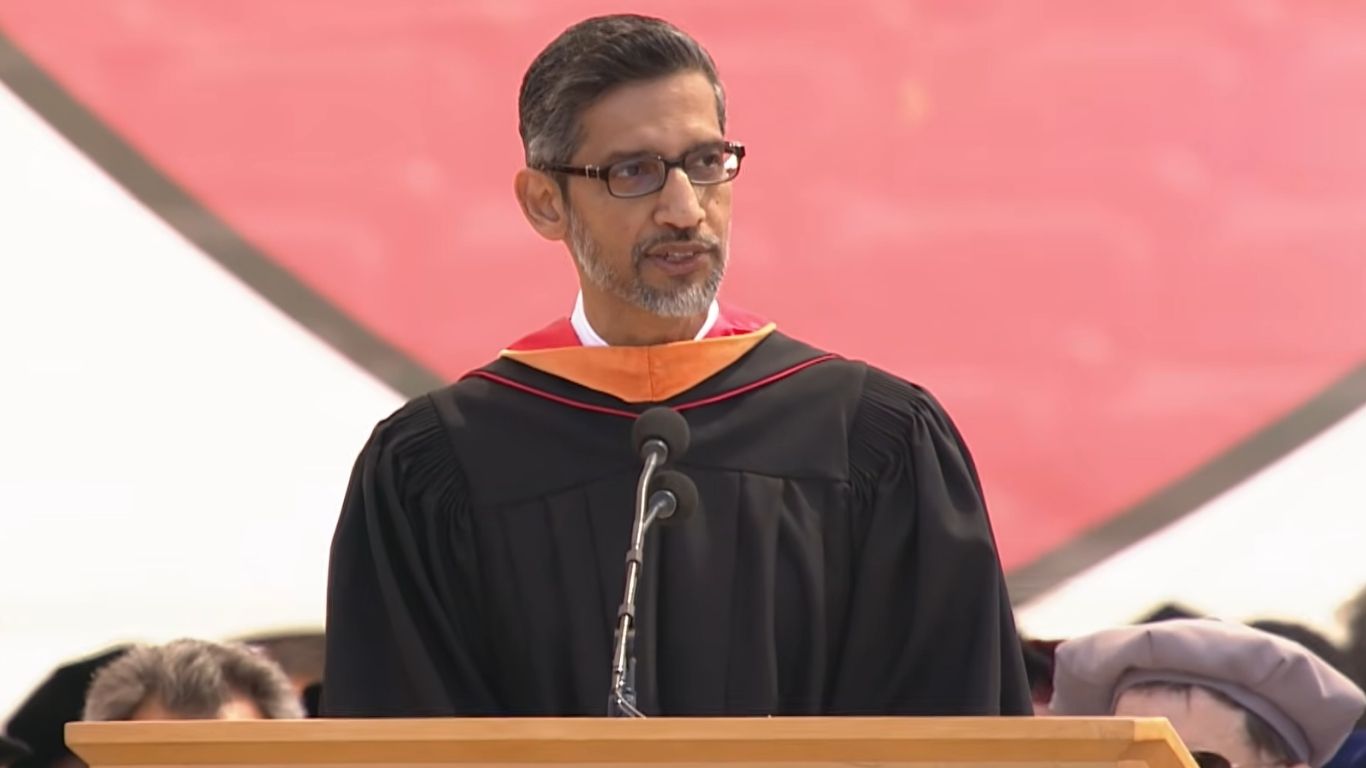
PALO ALTO, Calif. (Diya TV) — Hundreds of students staged a walkout during Google CEO Sundar Pichai’s commencement speech at Stanford University on Sunday, highlighting ongoing tensions over the tech giant’s ties to Israel and growing activism on college campuses.
The protest took place during Stanford’s 135th Commencement ceremony, which drew more than 20,000 attendees, including about 3,600 graduates. As Pichai began addressing the Class of 2026, groups of students stood up, waved Palestinian flags and banners, and exited the venue while chanting “Free Palestine.”
The demonstration marked the latest in a series of pro-Palestinian protests at university events across the United States.
According to reports, organizers included Students for Justice in Palestine and No Tech for Apartheid. Protesters criticized Google’s involvement in Project Nimbus, a $1.2 billion cloud-computing contract signed with the Israeli government in 2021.
Many activists have argued that the project supports Israeli military operations. Protesters at Stanford said they wanted to draw attention to the war in Gaza and Google’s business relationship with Israel.
A video shared on social media showed students carrying Palestinian flags and banners as they left the ceremony. Some groups also blew whistles and displayed signs during the speech. Reports estimated that around 200 students participated in the walkout. Stanford University has not released an official count.
Despite the protest, Pichai continued his address, focusing on lessons from his personal and professional journey. The Google CEO reflected on his childhood in Chennai, India, where his family faced challenges such as water shortages and limited access to technology.
“It’s easy to look at the news of the day and think that we’re living in uniquely challenging times,” Pichai told graduates. “We don’t get to choose the world we graduate into, but we do get to choose how we frame our circumstances.”
Pichai said his parents encouraged him to dream beyond the limits of his surroundings. He recalled how his father spent the equivalent of a year’s salary to pay for his first flight to the United States after he was admitted to Stanford.
The executive also discussed a major turning point during his time at the university. He arrived intending to pursue a doctorate but later left his Ph.D. program and completed a master’s degree instead. Pichai said setbacks helped shape his career. He encouraged graduates to embrace challenges and remain open to change.
The walkout quickly sparked debate online.
Indian American venture capitalist Vinod Khosla criticized the students in a post on X. He called the protest short-sighted and argued that Google’s work has helped improve lives around the world.
U.S. Rep. Ro Khanna responded by defending the students’ right to protest. Khanna said peaceful demonstrations and challenges to authority remain important parts of free expression, regardless of where people stand on Google’s contracts. The exchange reflected broader disagreements over the role of technology companies in global conflicts and the responsibilities of corporate leaders.
The Stanford demonstration comes amid a growing trend of protests during commencement speeches by technology leaders. In recent months, graduates at several universities have interrupted speakers while expressing concerns about artificial intelligence, job security, and the influence of major tech companies.
Former Google CEO Eric Schmidt faced boos during a commencement speech at the University of Arizona after discussing AI. Similar reactions greeted speakers at the University of Central Florida and Middle Tennessee State University when they addressed artificial intelligence.
At Stanford, however, much of the attention centered on Google’s relationship with Israel and the ongoing conflict in Gaza. While Pichai largely avoided discussing AI during his remarks, he briefly joked about the topic. Referring to the initials “AI,” he told graduates that people assumed the subject would be difficult for him because the letters appear at the end of his last name.
The moment drew laughs, but it did little to overshadow the protest that unfolded around him.