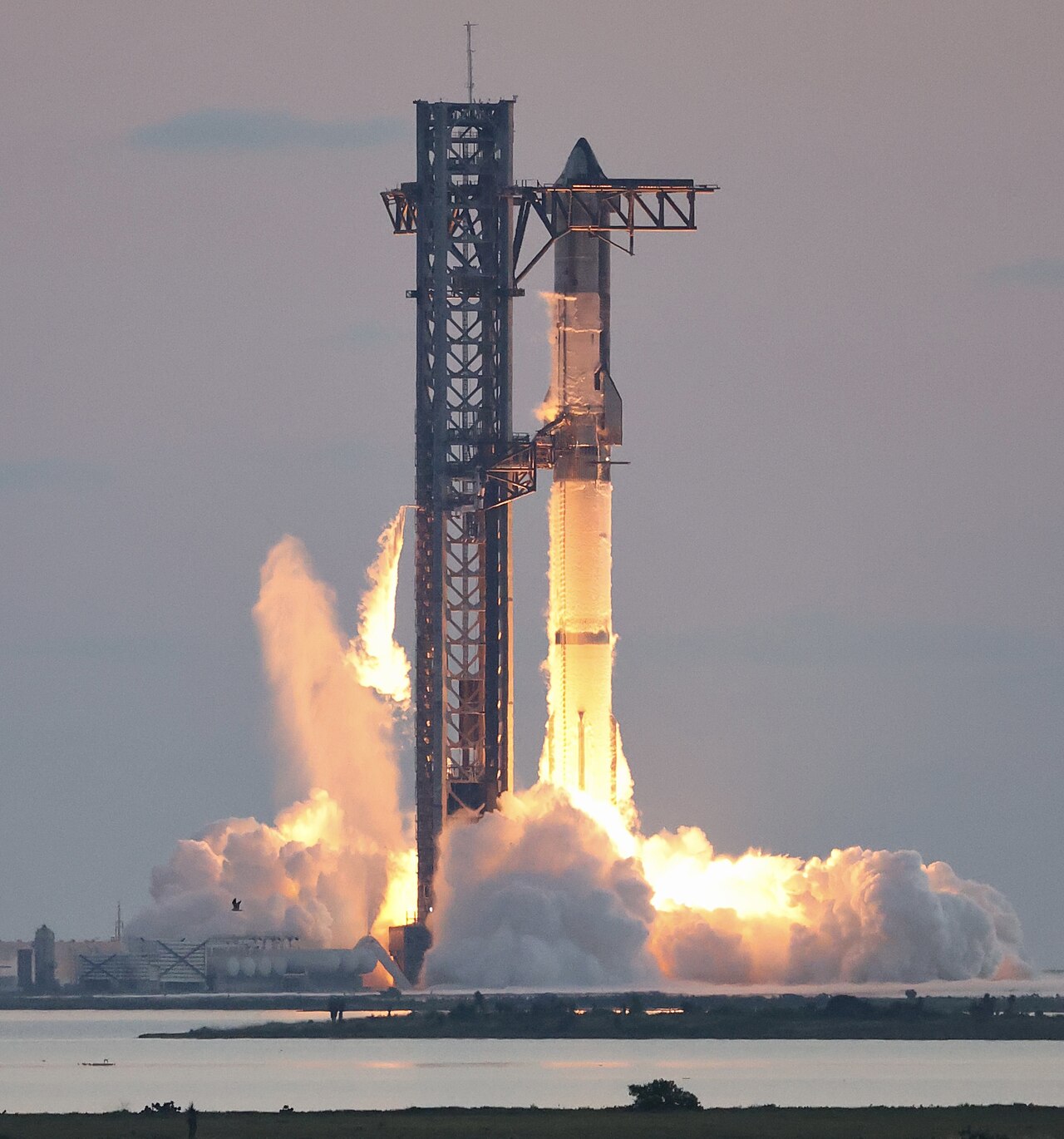
STARBASE, Texas (Diya TV) — SpaceX plans to launch its Starship megarocket on its 13th test flight Wednesday, targeting a 90-minute launch window that opens at 6:45 p.m. EDT from the company’s Starbase site in South Texas.
The mission marks Starship’s second flight of 2026 and follows the May 22 debut of Starship Version 3 (V3), an upgraded iteration of the vehicle that had been in development for months. Standing more than 400 feet tall, Starship consists of a first-stage booster called Super Heavy and an upper-stage vehicle known as Ship, both built from stainless steel and designed to be fully and rapidly reusable. The stacked vehicle can carry more than 110 tons to Earth orbit. Starship V3 is intended to be the first operational version of the rocket and is slated to support NASA’s Artemis III mission to lunar orbit in 2027 and land Artemis IV astronauts on the moon the following year, if development stays on schedule.
During Flight 12 in May, Ship successfully deployed 22 payloads — 20 dummy Starlink satellites and two functional Starlinks equipped with imaging sensors — through its “PEZ dispenser” mechanism before splashing down as planned off the coast of Western Australia. However, the mission encountered a setback when Super Heavy suffered engine issues during its return and crashed into the Gulf of Mexico rather than achieving a controlled splashdown, prompting a temporary grounding by the Federal Aviation Administration. SpaceX said it has made hardware and software modifications to address the issues seen on that flight.
For Flight 13, SpaceX is targeting a similar profile: Super Heavy is expected to execute a boostback burn and controlled splashdown in the Gulf of Mexico roughly seven minutes after launch, while Ship will aim for a splashdown in the Indian Ocean off Western Australia about 65 minutes after liftoff. The company has successfully caught the Super Heavy booster with the launch tower’s “chopstick” arms three times in the vehicle’s history, though not since Flight 8 in March 2025; it has never attempted a chopsticks catch with Ship. Eventually, SpaceX intends to catch both stages directly at the pad after every flight to enable rapid, multiple-times-daily reuse.
Flight 13 will break new ground in one key respect: for the first time, Ship will deploy 20 actual V3 Starlink satellites — next-generation broadband spacecraft that SpaceX says will “greatly expand the network’s capacity and user speeds.” Each V3 satellite weighs roughly 4,400 pounds, considerably heavier than earlier generations. The satellites will extend their solar arrays and antennas and attempt to connect with the broader Starlink constellation via laser links before being intentionally destroyed upon reentry about 20 minutes after deployment, following the same suborbital trajectory as Ship itself. SpaceX has said it ultimately wants to operate up to 100,000 V3 Starlink satellites in low Earth orbit, compared with the roughly 10,800 spacecraft currently in the existing constellation — the largest satellite network ever assembled.
Six of the 20 satellites carry cameras that will be used to study Ship’s heat-shield tiles during reentry, part of SpaceX’s effort to gather more data on the heat shield’s performance ahead of eventual chopsticks-catch attempts with Ship. The shield will also be fitted with load-sensing tiles to measure stress on tile attachments as the vehicle experiences higher dynamic pressure during ascent than on previous flights, a tradeoff SpaceX says is intended to increase the rocket’s payload-to-orbit capacity.
The launch falls on the 57th anniversary of NASA’s Apollo 11 moon landing mission.