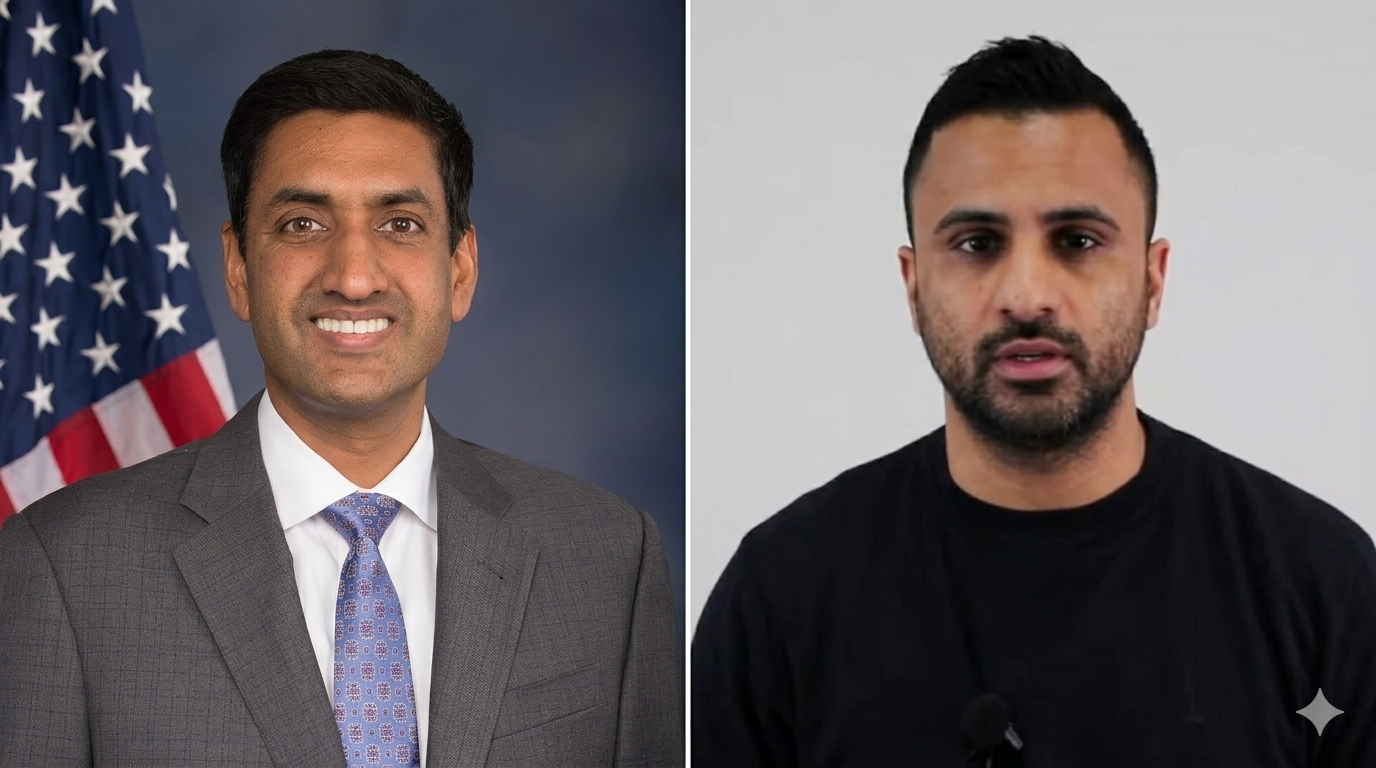
SANTA CLARA, Calif. (Diya TV) — The Democratic primary fight between Rep. Ro Khanna and tech entrepreneur Ethan Agarwal is no longer just a policy argument. It has become an intensely personal Silicon Valley feud, playing out in real time on X and pulling in questions about stock trades, family wealth, business lawsuits and even divorce. Agarwal entered California’s 17th Congressional District race this month after abandoning a gubernatorial bid, setting up a June 2 primary challenge to Khanna in a district that has become ground zero for the backlash against the congressman’s support for a billionaire wealth tax.
At the center of the fight is Agarwal’s effort to cast Khanna as a progressive populist whose own household has prospered from the kind of concentrated wealth he criticizes. Agarwal has branded the congressman “Trader Ro,” pointing to the huge volume of stock trades reported by Khanna’s family trusts and arguing that Khanna’s ethics message does not match his home life. Khanna has pushed back publicly, saying, “I don’t trade stocks and never will,” and insisting the assets are held in an independent trust tied to his wife and children, not managed by him.
The numbers make clear why the issue has political bite. A recent NOTUS analysis of financial disclosures found Khanna’s median net worth at roughly $232.7 million, and reported that his family made 4,284 stock trades at a volume of more than $59 million in 2025, with most of the assets held in trusts. Earlier reporting in the Los Angeles Times and Business Insider tied a large share of the family’s earlier reported wealth to assets belonging to Khanna’s wife, Ritu Khanna, whose father, Monte Ahuja, founded auto-parts giant Transtar Industries.
Agarwal, though, is hardly running as a man outside that affluent world. His exact personal net worth is not publicly pinned down the way Khanna’s House disclosures are, but he built and sold Aaptiv after raising about $70 million for the company, then went on to co-found The Coterie, which announced a $50 million funding round led by Andreessen Horowitz and was reported by Bloomberg to have been valued at more than $100 million in 2022. In other words, this is not a race between Silicon Valley wealth and some anti-wealth outsider. It is a clash between two wealthy, well-connected figures arguing over who gets to define economic fairness in one of the country’s richest districts.
Over the last several days, that broader argument has turned even uglier online. In one X post, Agarwal alleged that Khanna allies tried to pressure him out of the race, claiming that “Ro had three people reach out” and suggest that if he stepped aside, Khanna would endorse him in 2028. Khanna responded on X that “attacking a person’s spouse is not the best look,” then defended his family’s money by saying his father-in-law built a successful transmission business and that neither he nor his wife controls the trust being attacked.
That exchange has opened the door to tougher scrutiny of Agarwal’s own record. San Jose Spotlight reported that New York court records showed Agarwal confessed in 2020 to owing $2 million to Universal Music Group in a licensing dispute connected to Aaptiv, and that later filings alleged he failed to pay $300,000 of that settlement. The landlord of One World Trade Center also sued Agarwal’s company in 2023 for $2 million over alleged unpaid rent. Agarwal said on X those matters were settled. Court records show he was married for nearly a decade before filing for divorce in 2025. He has declined to comment publicly on the separation.
As criticism intensified, Agarwal tried to get ahead of the story himself. In a lengthy X post, he acknowledged what he called embarrassing details from his past, including that he had downloaded pornography, was accused of IP infringement by a production company, and settled the matter. Search snippets of that post also show him referencing other youthful mistakes, including using a fake ID. The effect was unusual: instead of simply denying or ignoring the attacks, Agarwal tried to neutralize them by laying them out himself before opponents could do it for him.
What makes the feud more than gossip is what it says about where this race is headed. Khanna’s reelection fight began as a dispute over his support for wealth taxes, AI regulation and his increasingly national political profile. It has now become a referendum on hypocrisy, personal credibility and who gets to claim the moral high ground in Silicon Valley. Khanna still has the advantages of incumbency, national stature and a massive campaign war chest. But Agarwal has succeeded in dragging the race onto terrain that is messier, more personal and harder for either side to fully control.
Whether the online feud ultimately helps Ro Khanna or Ethan Agarwal remains to be seen. But it has already revealed the core fight shaping California’s 17th Congressional District: a race that began as a debate over wealth taxes, stock trading and Silicon Valley priorities is now also becoming a test of credibility, judgment and political temperament. With months still to go before voters head to the polls, both campaigns are making clear that this contest is only intensifying.