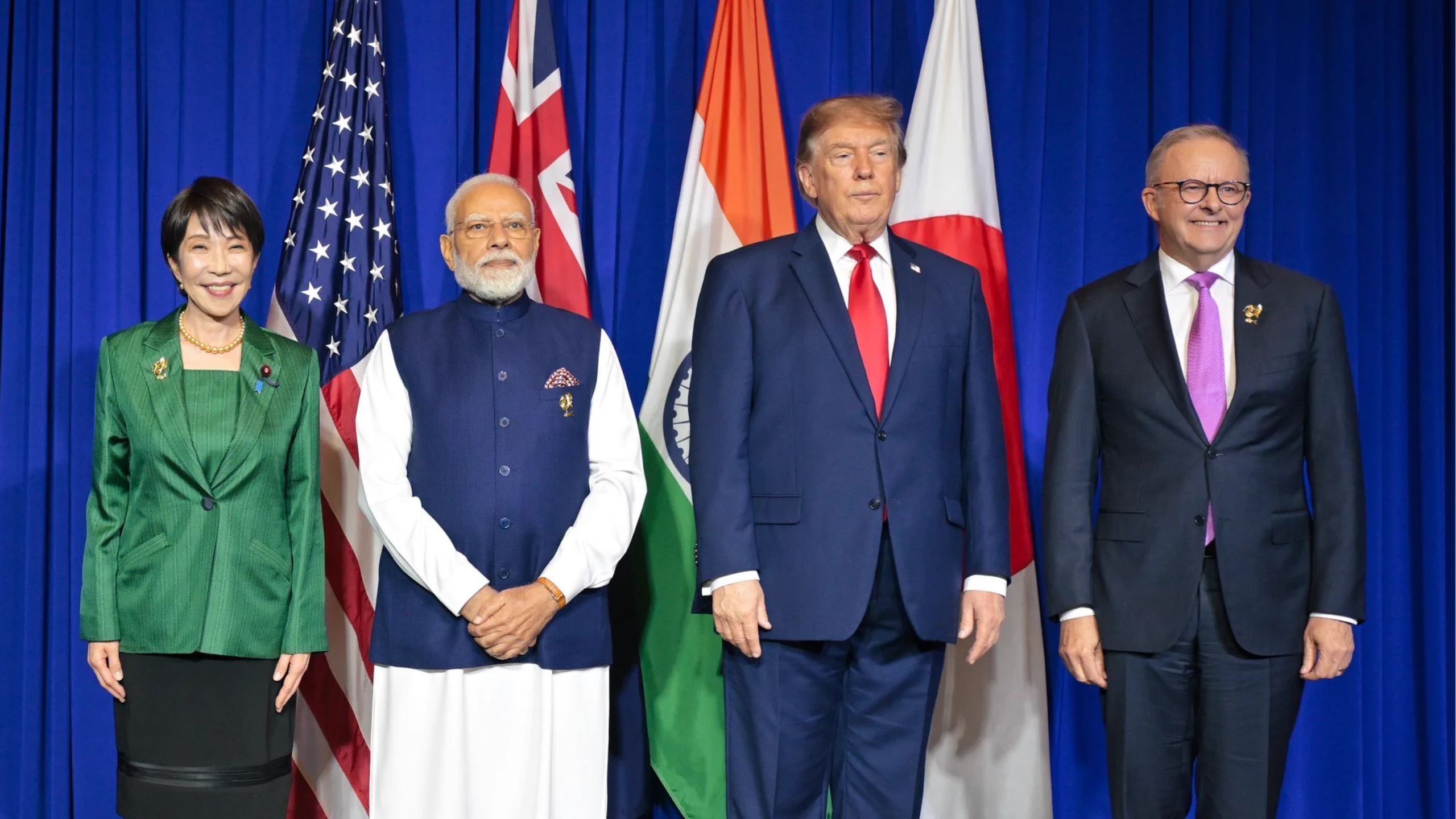
MANILA, Philippines (Diya TV) — Leaders from the United States, Australia, India and Japan pledged to strengthen security, economic cooperation and regional stability during the Quad Leaders’ Summit in Manila on Tuesday. The meeting brought together President Donald Trump, Australian Prime Minister Anthony Albanese, Indian Prime Minister Narendra Modi and Japanese Prime Minister Sanae Takaichi.
The four leaders discussed ways to protect the Indo-Pacific, improve maritime security, strengthen critical supply chains and expand cooperation in emerging technologies. They also announced several new initiatives aimed at supporting regional growth and addressing shared security challenges.
The summit comes nearly 10 years after the four countries revived the Quadrilateral Security Dialogue, widely known as the Quad. It also marks the 10th anniversary of the Free and Open Indo-Pacific vision, which former Japanese Prime Minister Shinzo Abe introduced in 2016.
During the meeting, the four leaders renewed their commitment to a free, open, safe and prosperous Indo-Pacific. They said the region needs peace, stability and strong partnerships to support long-term economic growth.
The leaders also opposed unilateral actions that could change the regional status quo through force or coercion. They warned that such actions could increase tensions and threaten regional stability. Additionally, the countries raised concerns about economic pressure, including arbitrary restrictions on exports. They stressed the importance of reliable supply chains and open maritime routes.
Through these efforts, the Quad aims to strengthen cooperation with regional partners and deliver practical benefits to countries across the Indo-Pacific. One major announcement was the launch of the first Quad Business Leaders’ Forum, scheduled for early 2027.
The forum will bring together business executives, government officials and policy experts from the four member countries. It will provide a platform to build stronger commercial relationships and encourage investment.
Furthermore, the initiative aims to promote business deals and partnerships across key industries. The four countries expect closer private-sector cooperation to create economic opportunities and support prosperity throughout the Indo-Pacific.
The leaders also highlighted the Super Intelligence Accelerator, an initiative announced earlier by their foreign ministers in Atlanta.
The program aims to coordinate funding and technical support for trusted Super Intelligence (SI) access and deployment across the Indo-Pacific.
In Australia, India and Japan, the term Super Intelligence refers to artificial intelligence. The initiative reflects the Quad’s growing interest in emerging technologies and their role in economic development.
Moreover, the partnership aims to help regional countries access and use trusted AI technologies. It also seeks to encourage cooperation on technical support and future technology development.
Maritime security remained another major focus of the summit. The leaders welcomed the Indo-Pacific Maritime Surveillance Collaboration, a new initiative designed to improve information sharing and maritime awareness.
Under the plan, the four countries will strengthen their ability to monitor maritime activity and respond to regional challenges.
In addition, the initiative includes a planned maritime exercise in 2027. For the first time in a Quad context, P-8 and P-3C patrol aircraft from the participating countries will take part in a joint maritime exercise.
The leaders said better coordination will help protect important sea routes and support safe maritime transportation across the Indo-Pacific.
The four countries also welcomed progress under the Quad Partnership for Cable Connectivity and Resilience. The partnership aims to expand access to secure communications infrastructure across the region.
Australia will increase its contribution to the initiative, with a new focus on electricity cables. This expansion aims to strengthen regional energy security and improve connectivity.
Meanwhile, upcoming undersea cable projects in the Indian Ocean will help improve communication links between countries.
The leaders also announced enhanced Quad Cybersecurity Cooperation. They expressed concern about the growing number and scale of cyber incidents across the region.
Through stronger coordination, the four countries aim to protect digital networks and support an open and secure cyberspace.
The leaders strongly condemned terrorism and violent extremism in all forms, including cross-border terrorism. They also pledged to strengthen ongoing cooperation to address these threats.
Finally, the four countries reaffirmed their support for ASEAN centrality and unity. They emphasized the importance of working with regional partners to address shared challenges.