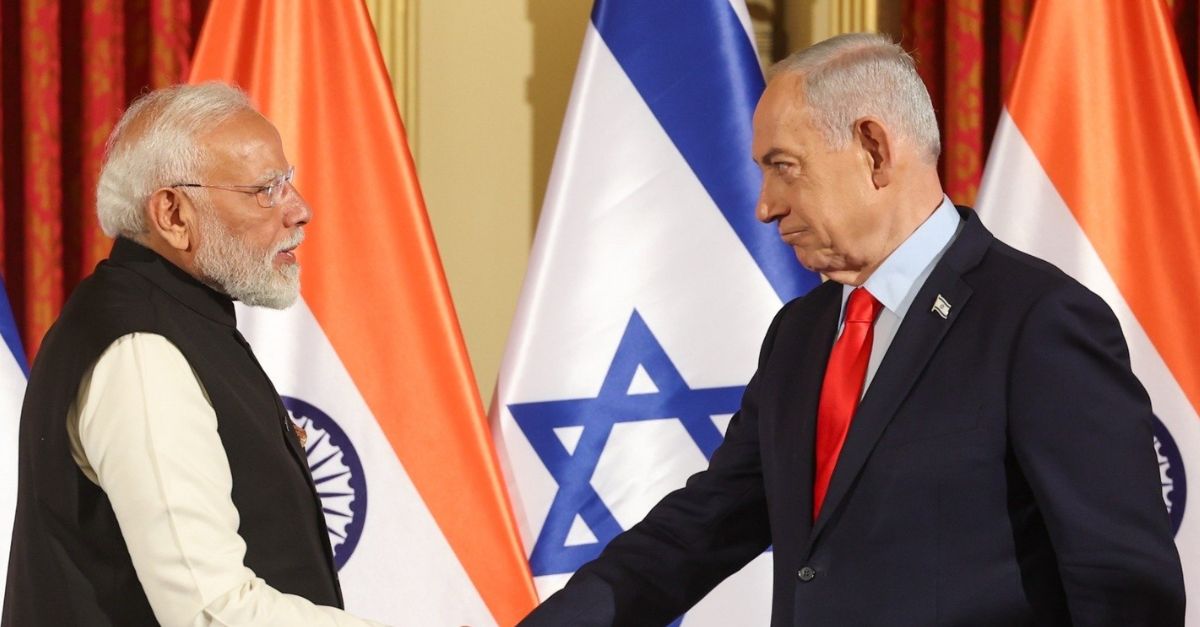
JERUSALEM, Israel (Diya TV) — India and Israel agreed Thursday to jointly produce weapons and push for an early conclusion of a long-pending free trade agreement, signaling deeper strategic and economic ties between the two nations. Indian Prime Minister Narendra Modi and Israeli Prime Minister Benjamin Netanyahu announced bilateral talks in Jerusalem. The leaders highlighted growing cooperation in defense, trade, technology, and regional connectivity projects, even as tensions rise in West Asia.
Modi and Netanyahu said their countries will strengthen defense production through joint manufacturing initiatives. The move builds on years of close security cooperation between India and Israel.
“The future belongs to those who innovate, and Israel and India are bent on innovation,” Netanyahu said, standing alongside Modi. “We are absolutely determined to seize the future,e and we can do it better together.”
India has emerged as one of Israel’s key defense partners. The decision to jointly produce weapons reflects India’s push to boost domestic manufacturing under its self-reliance strategy. It also highlights Israel’s role as a major supplier of advanced defense technology. The leaders described their relationship as a “special strategic partnership.” They also directed officials to speed up negotiations for an early signing of a free trade agreement.
Both sides expressed optimism about concluding the India-Israel Free Trade Agreement soon. Negotiations have progressed in recent months, officials said. The agreement aims to expand trade and investment across sectors such as energy, space, cybersecurity, critical technologies, agriculture, and innovation. Officials believe the trade pact will increase bilateral commerce and open new opportunities for businesses in both countries.
India and Israel also signed multiple memoranda of understanding. One agreement focuses on geophysical exploration and mineral development. It will promote cooperation in mineral exploration using advanced geophysical and artificial intelligence technologies. The project will also support sustainable resource development.
The two leaders discussed advancing the India-Middle East Economic Corridor and the I2U2 initiative. The I2U2 grouping includes India, Israel, the United Arab Emirates, and the United States. Modi said India and Israel will move forward with “renewed momentum” on both projects. These initiatives aim to strengthen connectivity, digital public infrastructure, and food security across the region.
Foreign Secretary Vikram Misri said regional tensions have affected progress on the economic corridor. However, he noted that several countries continue to work on parts of the project in their national capacities. The corridor has faced uncertainty due to strained relations between Israel and Saudi Arabia. Talks between those nations remain stalled over the issue of Palestinian statehood.
Modi stressed that peace and stability in West Asia directly affect India’s security interests. The Gulf region plays a critical role in India’s energy supply. It is also home to more than 10 million Indian workers in Gulf Cooperation Council countries.
“Peace and stability in West Asia are directly linked to India’s security interests,” Modi said. He called for dialogue and peaceful solutions to ongoing regional tensions.
The visit took place amid growing friction between Iran and the U.S.-Israel coalition. The United States has increased its military presence in the region over concerns related to Iran’s nuclear program. Misri confirmed that tensions between Iran and the United States came up during talks. He said Modi reiterated India’s strong belief in dialogue and peaceful resolution of disputes. Modi also offered India’s support for any initiative that promotes peace.
On terrorism, Modi took a firm stand. “Terrorism has no place in the world,” he said. “In any form and in any manifestation, terrorism cannot be accepted.” He added that India and Israel will continue to stand shoulder to shoulder against terrorism and those who support it.
During his two-day visit, Modi met with Israeli President Isaac Herzog. He planted a tree in the President’s garden to mark the occasion. Modi also visited the Yad Vashem Holocaust Museum in Jerusalem. He paid tribute to the victims of the Holocaust during the Nazi era in Germany. The visit carried symbolic weight, underscoring shared values and historical awareness. Modi’s trip marked his first visit to Israel in nine years. His last visit came in 2017, when he became the first Indian prime minister to travel to Israel.
Thursday’s announcements reflect stronger India-Israel relations at a time of shifting geopolitical dynamics in West Asia. With plans for joint defense production and a free trade agreement, both countries aim to expand cooperation across strategic and economic fronts.