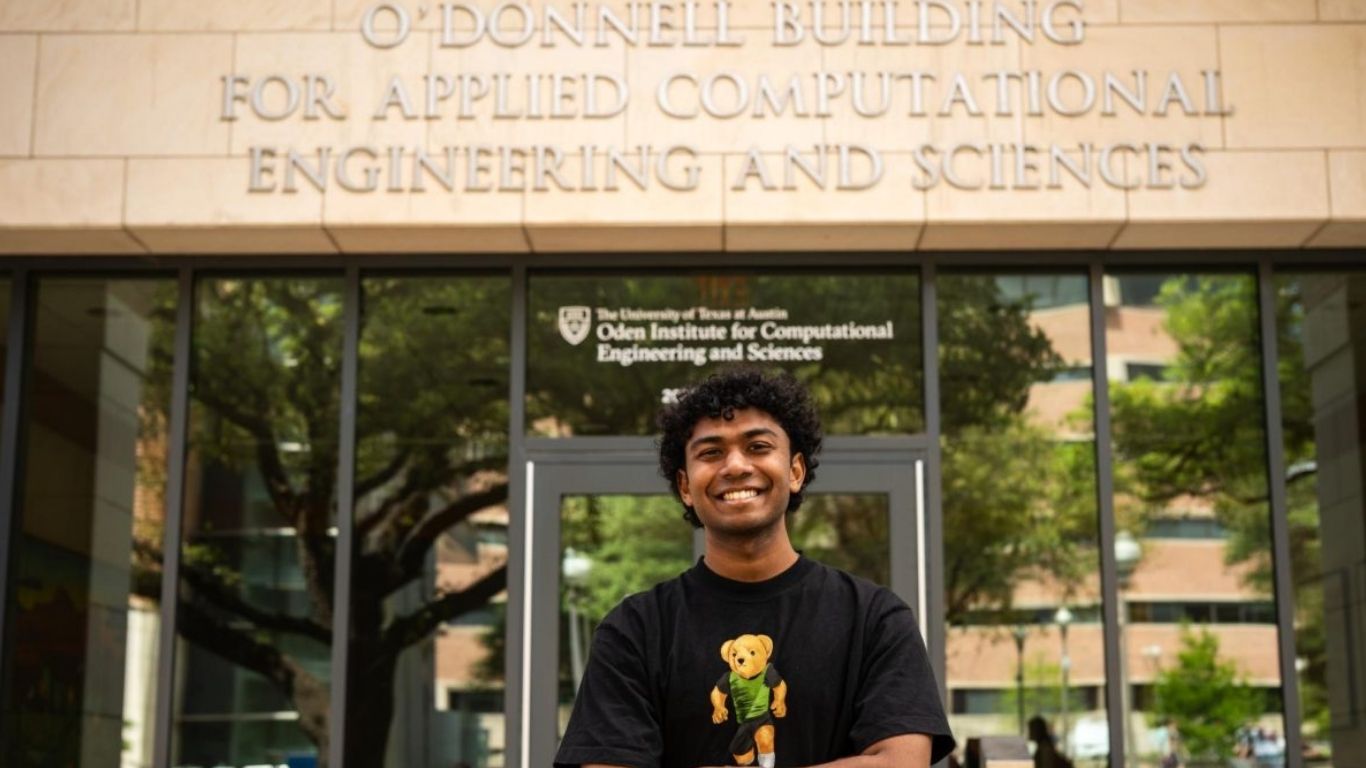
AUSTIN, Texas (Diya TV) — A University of Texas senior has earned one of the most prestigious academic honors in the United States. Krithik Vishwanath, who studies computational engineering, chemistry, and mathematics, received the highly competitive Churchill Scholarship. The award funds a year of master’s study in the United Kingdom and recognizes top students in science, technology, engineering, and math.
Vishwanath is the first UT student in 36 years to win the scholarship. His work in computational medicine and artificial intelligence helped set him apart in a pool of top applicants nationwide.
Vishwanath developed a strong interest in math and problem-solving during high school. He wanted to apply those skills in a meaningful way. That goal led him to explore research opportunities at UT. He found his direction at the Center for Computational Oncology. The lab uses math to model diseases like breast and pancreatic cancer. Researchers use these models to guide treatment decisions and improve patient outcomes.“I wanted to see if I could use what I enjoy in a more impactful way,” Vishwanath said. His work focused on building models that help doctors understand how cancer behaves. These models can support better and more personalized treatment plans.
Vishwanath expanded his research during a summer at NYU Langone Health. There, he worked on projects involving artificial intelligence and large language models. His team focused on creating tools that could assist medical decision-making. One key project involved building a small AI model that could run on a smartphone. The model processes data locally instead of relying on cloud systems. This design improves privacy and speeds up performance.
“We wanted something that could live on your phone and still have medical knowledge,” Vishwanath said. This work reflects a growing trend in health care technology. Researchers aim to make AI tools more accessible, efficient, and secure.
Vishwanath will continue his studies in the United Kingdom next year. At Cambridge, he plans to deepen his work in artificial intelligence and health care systems. He hopes to improve hospital operations using predictive models. His research will focus on estimating how long patients will stay in the hospital and when they may be ready for discharge.“Our goal is to predict discharge readiness and patient stay length based on key factors,” he said. Such tools could help hospitals manage resources better. They could also improve patient care by reducing delays and overcrowding.
Faculty members who worked with Vishwanath praised his curiosity and drive. Research scientist Ernesto Lima said Vishwanath constantly looks for new ways to solve problems.“He tries to find new tools and methods,” Lima said. “He is eager to find solutions.”
Thomas Yankeelov, director of the Center for Computational Oncology, said Vishwanath’s success did not surprise him.“I would have been surprised if he was not selected,” Yankeelov said. “His skills are extraordinary.”Their support highlights the importance of mentorship in academic success. It also shows how strong research environments can shape future innovators.
The Churchill Scholarship awards only 18 students each year. It supports graduate study in science and engineering fields. Winners receive full funding, including tuition, travel, and living expenses. The scholarship also connects students with leading researchers and institutions. It offers a unique opportunity to expand both knowledge and impact. For Vishwanath, the award represents more than personal achievement. It provides a platform to scale his research and reach more people.
Vishwanath said he felt excited and surprised when he learned he had won. He quickly began thinking about how to use the opportunity to grow his work.“My first instinct was how we can broaden the impact,” he said.
He plans to use advanced electronic health record systems in Cambridge to build on his current research. His goal is to create tools that improve efficiency and decision-making in hospitals. As health care systems face increasing challenges, innovations like these could play a key role. Vishwanath’s work shows how combining math, technology and medicine can lead to meaningful change. His journey reflects the growing role of AI in health care. It also highlights how young researchers can shape the future of medicine.