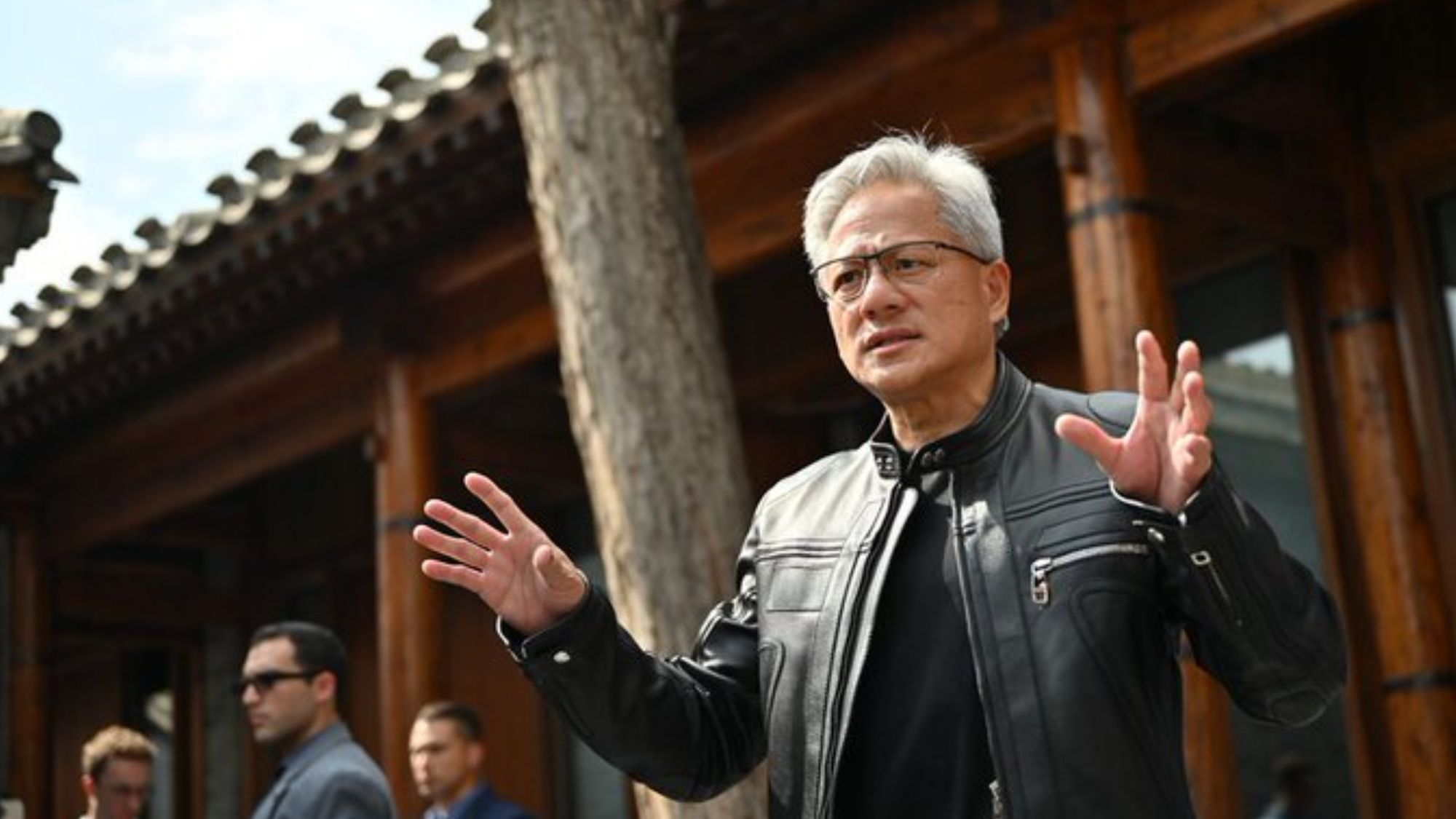
SANTA CLARA, Calif. (Diya TV) — Nvidia CEO Jensen Huang is making billionaires out of his leadership team. As the company’s value soars past $4 trillion, Huang’s fortune has grown to $151 billion. But he isn’t climbing alone—he says he’s taking his top staff with him.
Huang recently claimed he’s minted “more billionaires on my management team than any CEO in the world.” His success comes as demand for artificial intelligence chips and data-center technology pushes Nvidia’s stock to record highs.
Nvidia’s rapid growth and dominance in the AI chip market have made it one of the most valuable companies in the world. The company has become a key supplier of graphics processing units (GPUs), which power everything from AI models to gaming.
But behind the scenes, Huang runs a demanding operation. He expects a lot, but rewards even more.
“I review everybody’s compensation up to this day,” Huang said during a recent panel hosted by the All-In podcast. “I sort through all 42,000 employees, and 100% of the time, I increase the company’s spend on operating expenses. You take care of people, everything else takes care of itself.”
While other tech giants like Meta and OpenAI fight over top talent, Huang says his team is already well taken care of. “Don’t feel sad for anybody at my layer,” he said. “My layer is doing just fine.”
That includes generous stock-based compensation. Nvidia employees can contribute up to 15% of their salaries to buy discounted company shares. One mid-level worker reportedly bought stock consistently for 18 years and retired with $62 million. It’s a perk so valuable that insiders call it “golden handcuffs.”
Nvidia’s turnover rate was just 2.7% in 2023, far below the semiconductor industry average of 17.7%. That shows just how strong employee retention is, thanks in large part to those financial incentives.
Even though Nvidia employs tens of thousands, Huang believes the future belongs to small, focused AI teams. He pointed to companies like DeepSeek and Moonshot AI, each with around 150 researchers, as examples of how compact teams can drive huge innovation.
“OpenAI was about 150 people. DeepMind, too,” Huang said. “There’s something about the elegance of small teams.”
Nvidia uses this approach internally. The company’s AI groups are highly selective, nimble, and deeply funded.
Still, life inside Nvidia isn’t easy. Huang runs what many describe as a tough and demanding workplace. Some former employees have spoken of a culture where constant meetings, shouting, and extreme expectations are the norm.
One former staffer said she attended up to 10 meetings a day. Others described an “always-on” work culture. But Huang defends the grind, saying it drives people to achieve more than they thought possible.
“I’d rather torture you into greatness because I believe in you,” he said last year during a conversation with Stripe CEO Patrick Collison. Though he claimed he was joking, he also added: “Coaches that believe in their team torture them into greatness.”
Huang’s comments come at a time when competition for AI experts is heating up. Companies like Meta are reportedly offering $100 million signing bonuses to lure away engineers from rivals, including OpenAI.
But Huang insists Nvidia doesn’t have to compete that way. With stock options, wage bumps, and the company’s massive success, employees are already winning big.
Nvidia shows no signs of slowing down. As AI adoption accelerates, the company’s GPUs remain critical for building and deploying machine learning models.
And with Huang personally reviewing paychecks and building wealth among his leadership team, the company’s formula for success seems to be working—intense pressure paired with unmatched rewards.
As Huang told 60 Minutes last year: “If you want to do extraordinary things, it shouldn’t be easy.”