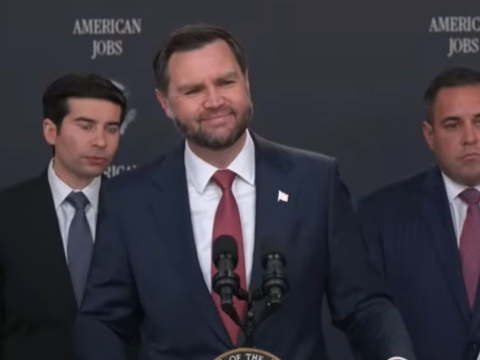
WASHINGTON (Diya TV) — Vice President JD Vance says his wife, Usha Vance, played a major role in his return to Christianity, helping shape his views on love, family, and commitment after years of atheism and spiritual doubt.
Speaking in an interview with New York Times columnist Ross Douthat, Vance reflected on his personal faith journey while discussing his new memoir, “Communion: Finding My Way Back to Faith.” The book details his path from a difficult childhood and loss of religious belief to his eventual conversion to Catholicism.
Vance, 41, said his relationship with Usha Vance marked a turning point in his life. He explained that falling in love changed how he viewed relationships and gave him a deeper understanding of faith.
“I had this epiphany — which is overstating it — but I realized that falling in love with Usha made me realize that there was actually something sacramental to love,” Vance said.
His comments highlight the important role that family and personal relationships played in his spiritual journey. Rather than returning to religion through theological debates, Vance said he found meaning through the people closest to him.
Vance explained that his connection to Christianity weakened after the death of his grandmother, whom he described as the foundation of his religious life. Her passing left a significant void and eventually led him away from faith.
“When my grandma died, that was my anchor to Christianity,” Vance said. “It’s really no coincidence that my grandma died and, like, two years later, I called myself an atheist.”
For several years, Vance focused on education, career success, and personal achievement. However, he said those pursuits failed to provide lasting fulfillment.
“The thing I realized is that this kind of striving had made me pretty hollow,” he said.
As a result, he began searching for a deeper sense of purpose. Over time, that search led him back toward Christianity.
Vance said Usha Vance, a lawyer and the daughter of Indian immigrants, offered steady support throughout that process. Although she does not share his Christian faith, he said she encouraged his spiritual exploration and supported the family’s religious practices.
He recalled feeling uncertain about returning to religion because of the responsibilities that come with faith. Still, he said his wife never resisted that decision.
Describing their family routine, Vance spoke about attending church with Usha and their three children. He noted that Sunday mornings can be hectic, especially with young children. Even so, he praised his wife for her patience and understanding.
“But she does it with incredible patience,” Vance said. “Her being not just OK with that but supportive of that journey was like almost confirmation or a sign that it was OK for me to go down this pathway.”
Furthermore, Vance said Usha changed how he viewed marriage itself. He argued that many millennials grew up in a culture that often treated romance as temporary or transactional. However, his relationship with Usha challenged that perspective.
“The thing about relationships, and I think all millennials experience this, because we all grew up in the same culture, is there was this sense in which there was nothing sacred about romance,” he said.
According to Vance, their relationship helped him see marriage as something deeper and more meaningful. He said that understanding aligned closely with Christian teachings, even though Usha is not a Christian.
“Usha, even though she’s not a Christian, she really changed how I thought about the union of man and woman together,” he said.
In addition to his wife’s influence, Vance credited Christian friends and families for helping guide him back to faith. He said their actions demonstrated the value of religious belief in everyday life.
“At some basic level, I had some really good friends who were really good people,” Vance said. “They showed me the truth of faith by the way that they conducted themselves in the world.”
Today, Vance says that marriage and fatherhood continue to shape his understanding of purpose and responsibility. Those experiences, he added, encouraged him to ask deeper questions about life and meaning.
As he shares his story in his new memoir, Vance presents faith as a journey shaped by relationships, family support, and personal reflection. His account also underscores the influence that loved ones can have on major life decisions, even across different religious traditions.