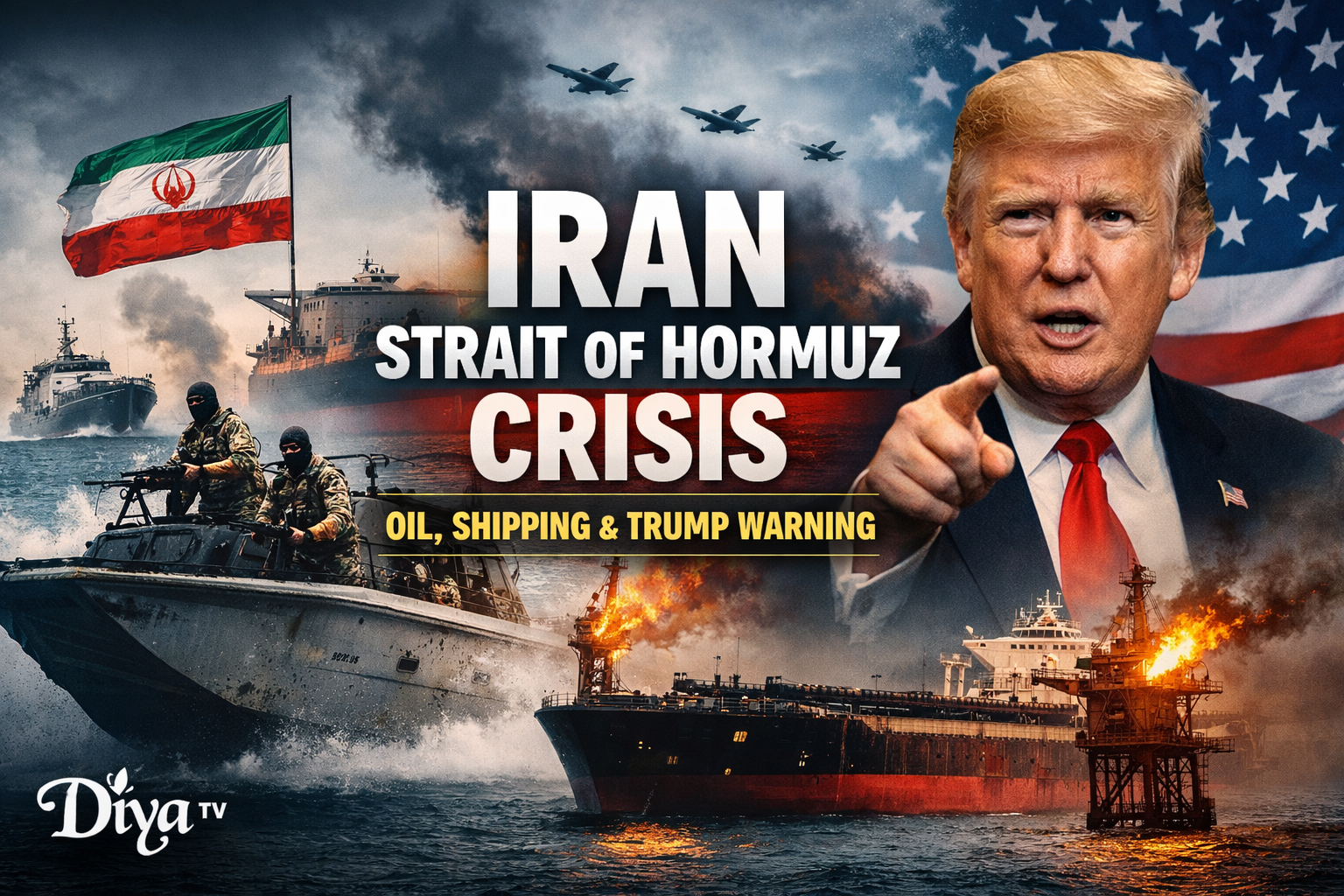
TEHRAN, Iran (Diya TV) — Iran reimposed strict control over the Strait of Hormuz on Saturday, sharply escalating tensions with the United States and renewing fears of a broader energy and shipping crisis across the Gulf. Tehran said it was tightening military control over the strait in response to what it described as a continued U.S. blockade of Iranian ports, which Iranian officials called a violation of the current ceasefire framework. President Donald Trump, meanwhile, said Iran would not be allowed to “blackmail” the United States by threatening the waterway, even as he insisted talks with Tehran were still making progress.
The reversal came just one day after signs of a possible breakthrough. On Friday, Iran had temporarily allowed limited shipping to resume through the strait, and a convoy of tankers began moving through the passage for the first time since the U.S.-Israeli war on Iran began on February 28. But that opening proved short-lived. By Saturday, shipping sources said Iranian naval units had again warned vessels that no ships were allowed through, and Reuters reported that at least two vessels trying to transit the waterway came under fire. India later summoned Iran’s ambassador after two Indian-flagged ships were reportedly hit in the strait.
The Strait of Hormuz is not just another regional shipping lane. It is one of the most important energy chokepoints in the world. The International Energy Agency says roughly 20 million barrels per day of crude oil and petroleum products moved through the strait in 2025, accounting for around 25% of the world’s seaborne oil trade. The same passage is also vital for global gas markets: about 19% of worldwide LNG trade, including the vast majority of Qatar’s LNG exports, travels through Hormuz. Any prolonged disruption there would have immediate consequences for oil prices, shipping insurance, supply chains, and inflation far beyond the Middle East.
That is why even a limited closure has already rattled world markets and the maritime industry. Reuters reported that hundreds of vessels and about 20,000 seafarers remain stranded in the Gulf awaiting safe passage. Western shipping firms have been cautious about sending vessels back through the strait, citing uncertainty over security conditions, including the possibility of mines and armed interference. While some older, non-Western-owned tankers were able to pass during the brief reopening, large-scale commercial confidence has not returned.
Iran has framed its latest move as both a security response and a political message. According to Reuters, Tehran said its control over the strait now includes charging for security, safety, and environmental protection services, and Iranian officials warned that traffic would remain under strict military oversight unless the United States guarantees full freedom of navigation, including for vessels traveling to and from Iran. Britain’s foreign secretary, Yvette Cooper, said Saturday that shipping through Hormuz has still not returned to normal and urged Tehran to fully restore passage, warning that the global economy is effectively being held hostage by continued restrictions. She also said more than 50 countries support efforts to protect freedom of navigation, with over a dozen prepared to assist maritime operations once the conflict ends.
The shipping confrontation is unfolding alongside fragile diplomacy that still has not produced a durable deal. Talks between Washington and Tehran, mediated in part by Pakistan, have shown some movement, but major disputes remain over Iran’s nuclear program and the terms of any long-term settlement. Reuters reported that the U.S. proposed a 20-year suspension of all Iranian nuclear activity, while Iran countered with a three- to five-year halt. Key sticking points also include what happens to Iran’s stockpile of highly enriched uranium and how any final agreement would be enforced. Iranian and U.S. officials have both signaled that some progress has been made, but no new round of talks had been formally scheduled as of Saturday.
Trump has tried to project optimism while also raising the pressure. He said there had been “pretty good news” on Iran and described recent conversations as “very good,” but offered few specifics. At the same time, he defended the U.S. maritime blockade and warned that military action could resume if a broader agreement is not reached before the ceasefire expires on Wednesday, April 22. Iran’s leadership responded with its own hardline message, saying the navy was ready for further confrontation if Washington continued what Tehran called repeated violations and “piracy” under the cover of enforcement.