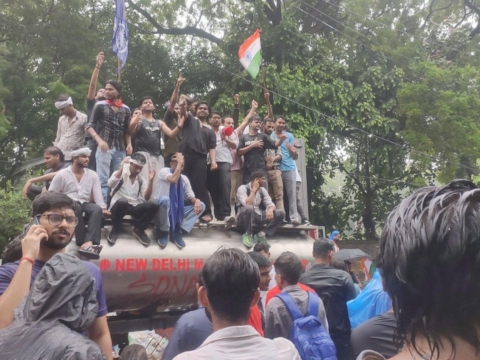

NEW DELHI (Diya TV) — Indian television news has taken an unusually strong stand on environmental issues, challenging the government on air pollution and the protection of the Aravalli hills. Prime-time debates and live coverage are now openly questioning policies from the Narendra Modi administration.
This change is striking because many of these channels and anchors have long been seen as supportive of the ruling party. Yet, in recent days, networks are reporting aggressively and even calling out each other by name.
The controversy stems from a recent Supreme Court decision accepting a new definition of the Aravalli range. The Aravallis, one of the world’s oldest geological formations, stretch across Rajasthan, Haryana, Gujarat, and Delhi.
Under the new definition, a hill must rise at least 100 meters above the surrounding land to qualify as part of the Aravalli range. Two or more such hills within 500 meters are treated as a range. Environmental groups warn this could leave smaller, scrub-covered hills unprotected. Critics say this opens these lands to mining and construction.
Protests have erupted across northern India. Activists argue that even the lower hills play a crucial ecological role. They help recharge groundwater, act as barriers against desertification, and support rural communities.
The government has defended the move. The Ministry of Environment says no new mining leases will be granted anywhere in the Aravallis from Delhi to Gujarat. Existing mines will operate only under strict environmental safeguards. Officials say the goal is to protect the ecosystem while creating uniform regulations.
Television coverage has intensified the debate. Channels like Times Now, India Today, News18 India, and ABP News have aired live protests and studio debates questioning the policy.
Republic TV anchor Arnab Goswami, a known Modi supporter, has launched a vocal campaign against the redefinition. He claims the new rule benefits powerful business interests and endangers the Aravalli hills. Goswami has accused the government of “legalizing mining” and criticized other anchors for avoiding the issue. The coverage is unusual. Analysts note that anchors who usually support the government are now taking a confrontational stance on environmental issues.
Parallel to the Aravalli debate, television networks are giving wall-to-wall coverage of air pollution in Delhi and the surrounding areas. Daily updates show the Air Quality Index (AQI) reaching hazardous levels, with near-zero visibility at landmarks like India Gate.
Even Union Minister Nitin Gadkari admitted he felt sick after spending two days in Delhi. His statement went viral, with CNN News18 calling it a “bold admission.” Anchors are using these reports to press for urgent government action.
The coverage has drawn public attention to both air pollution and land protection. Social media is filled with discussions about government policies, environmental protection, and public health.
Experts warn that without strong action, the Aravallis could face long-term ecological damage. They say unchecked mining and construction in smaller hills may harm biodiversity, worsen desertification, and reduce groundwater recharge.
The Modi government is in a delicate position. Officials stress that environmental protection remains a priority while balancing development and regulatory clarity.