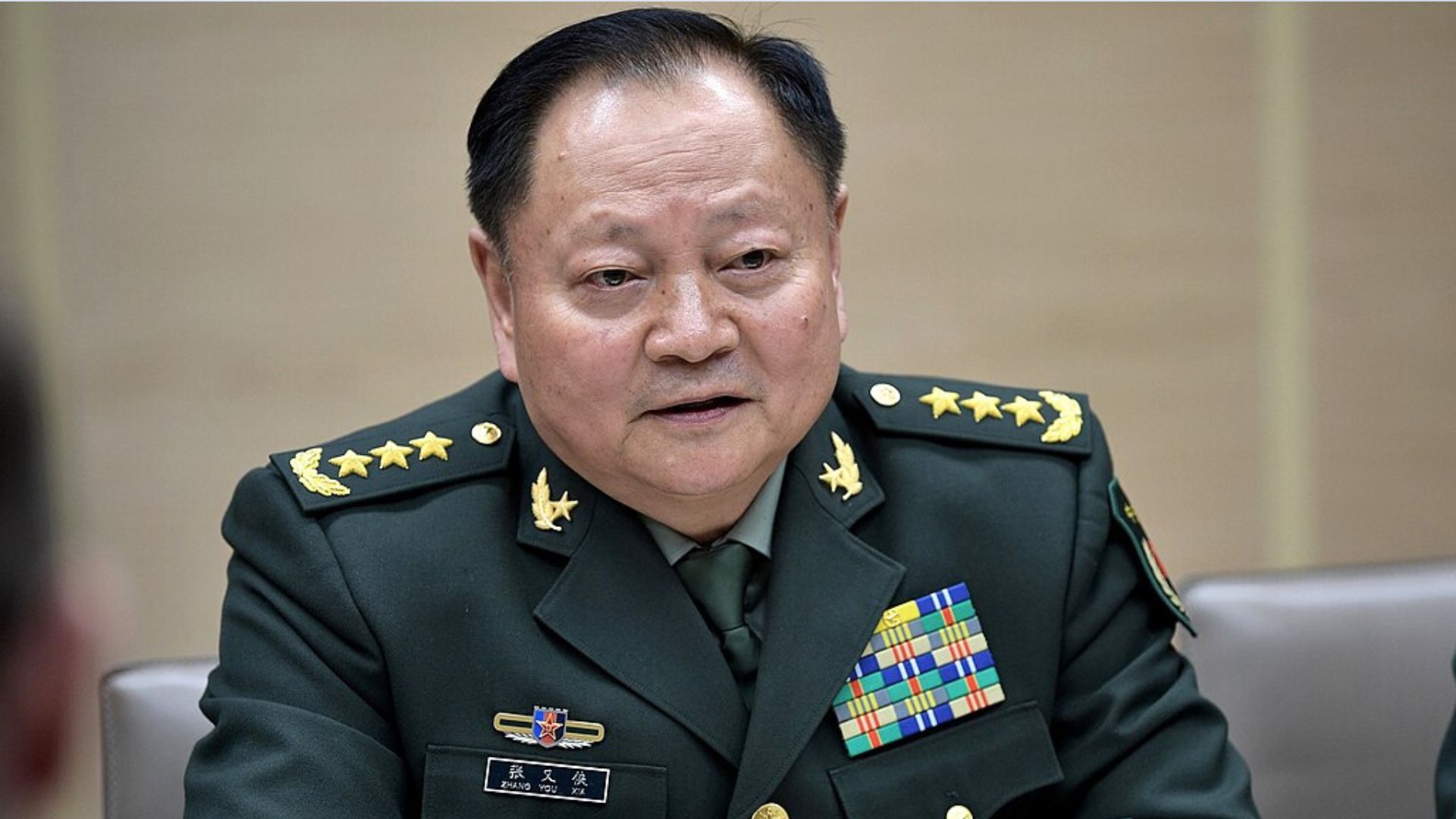
BEIJING, China (Diya TV) — China’s most senior general, Zhang Youxia, vice-chair of the Central Military Commission (CMC), is under investigation for corruption, political disloyalty, and allegedly leaking sensitive nuclear-weapon information to the United States, in what analysts are calling the most sweeping purge of the People’s Liberation Army (PLA) in decades. The probe, announced Saturday by China’s Ministry of National Defense, also targets Gen. Liu Zhenli, chief of staff of the CMC’s Joint Staff Department, and has raised concerns about the readiness of China’s armed forces amid ongoing modernization and regional tensions.
According to sources familiar with a high-level briefing, Zhang, 75, once considered one of President Xi Jinping’s closest military allies, is accused of forming political cliques, accepting bribes for promotions—including the elevation of former Defense Minister Li Shangfu—and mishandling oversight of China’s military procurement system. The most serious allegation involves leaking core technical data on China’s nuclear weapons to the United States. Some of the evidence reportedly came from Gu Jun, former general manager of the China National Nuclear Corp., who is also under investigation.
The purge marks a sharp escalation in Xi’s campaign to root out corruption and enforce loyalty in the military, analysts say. “This move is unprecedented in the history of the Chinese military and represents the total annihilation of the high command,” said Christopher Johnson of the China Strategies Group, a political-risk consultancy. Since 2023, China has removed more than 50 senior officers from the army, navy, air force, strategic-missile units, and key defense-industry posts, including the ouster of Li Shangfu and former CMC vice-chair He Weidong.
Zhang’s prominence within the PLA was longstanding. A “princeling” and combat veteran, he fought in border conflicts with Vietnam in 1979 and 1984 and served as commander of the Shenyang Military Region from 2007 to 2012. Despite reaching retirement age in 2022, Xi retained him on the CMC, reflecting prior trust in his expertise. Yet the current probe underscores that political loyalty now outweighs seniority or battlefield credentials.
Analysts emphasize that the investigation serves a dual purpose: Xi is consolidating control over the PLA while signaling zero tolerance for corruption that could undermine party authority or the handling of sensitive programs like nuclear weapons. “Highlighting such violations suggests that Zhang had too much power outside of Xi himself,” said Lyle Morris of the Asia Society Policy Institute. Scholars note that while Xi previously avoided purging active-duty generals, the current action reflects his determination to eliminate even close allies who might challenge the chain of command.
The purge also has operational implications. With only one active professional military officer remaining on the six-member CMC, Gen. Zhang Shengmin, the PLA faces a leadership vacuum at a critical time. Experts warn that short-term combat readiness could be affected, potentially delaying complex operations such as any contemplated action against Taiwan, which Beijing claims as its territory.
Despite the upheaval, analysts caution that the PLA remains capable. “It would be a major mistake to assume the Chinese military lacks senior officers or is less likely to act against Taiwan due to this shake-up,” said Lyle Goldstein, director of the Asia Program at Defense Priorities. Interim appointments of loyal officers may actually ensure greater alignment with Xi’s strategic directives.
The broader implications extend beyond the military. By targeting princelings like Zhang, Xi is asserting that party control supersedes personal relationships, reinforcing the Communist Party’s dominance over state institutions. Scholars predict that further investigations will likely follow, potentially ensnaring additional senior figures in the PLA and defense industry.
Zhang and Liu could not be reached for comment. In Washington, a Chinese embassy spokesperson said the investigations underscore a “full-coverage, zero-tolerance approach to combating corruption”.