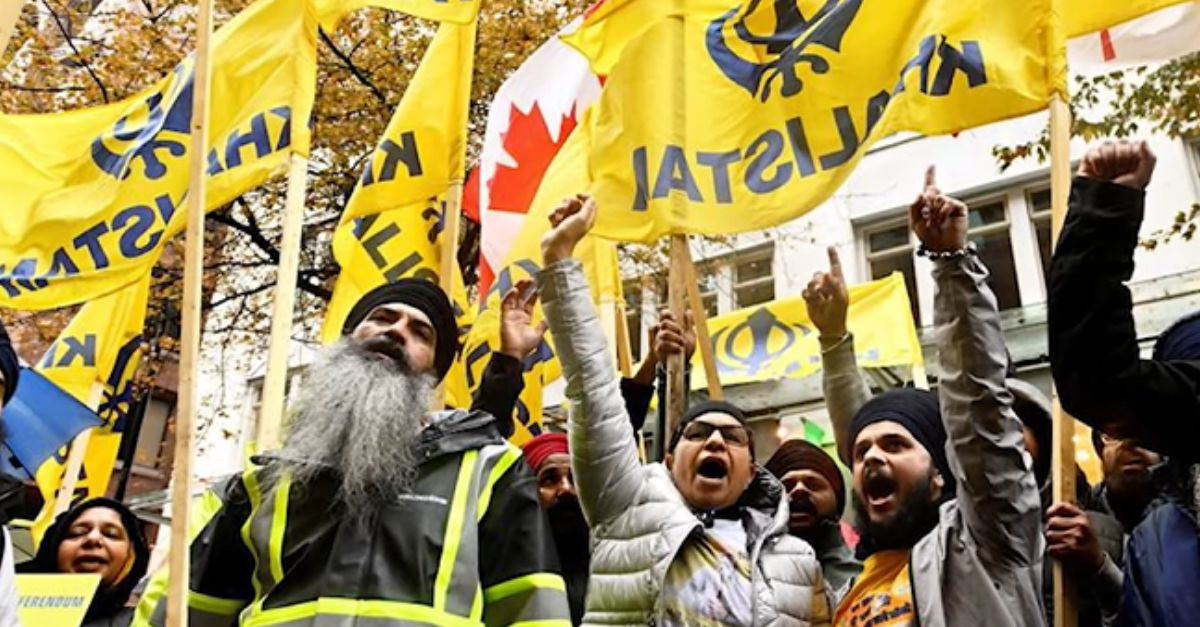
TORONTO (Diya TV) — Canada has, for the first time, admitted that Khalistani terror groups have been operating from its soil and receiving financial support. The acknowledgment comes in a new government report that highlights the growing threat of terror financing within the country.
The Canadian Finance Department released an assessment on money laundering and terrorist financing risks. The report directly links Khalistani extremist groups to financial networks in Canada. It states that these groups, including Babbar Khalsa International, the International Sikh Youth Federation, and Sikhs for Justice, have raised money inside Canada and abroad.
The document also names Hamas and Hezbollah under the same risk category. Canadian law enforcement and intelligence agencies observed that all of these groups received funds originating from Canadian sources.
The report warns that Canada has become a hub for terrorist financing. It outlines how extremist groups misuse both legal and illegal channels to collect money. These include charitable donations, crowdfunding, cryptocurrency, and even organized crime, such as drug trafficking and auto theft.
Officials say that extremist organizations are exploiting gaps in the non-profit sector. Many charities and community groups have unknowingly been used as cover for terror fundraising.
The Finance Department’s findings add weight to long-standing claims that Canada has provided a safe space for Khalistani groups. While India has repeatedly raised concerns about these networks, Ottawa had not previously admitted to the problem.
The report notes that Khalistani groups once had large fundraising operations in Canada. Today, they rely on smaller groups of individuals who remain loyal to the cause. These supporters often operate without formal ties to any single organization but continue to provide money and resources.
By using modern tools like digital crowdfunding and cryptocurrency, these groups make it harder for authorities to track the flow of funds. Law enforcement agencies face challenges in shutting down these complex networks.
The Canadian government now faces mounting political pressure. For years, critics accused former Prime Minister Justin Trudeau of ignoring evidence of Khalistani extremism. His government often faced criticism from India for failing to act against groups that openly threatened Indian interests.
The focus has now shifted to Trudeau’s successor, Mark Carney. Observers are watching closely to see if Carney will take stronger action to curb terror financing. His government will need to decide whether to confront the issue head-on or risk further diplomatic tension with India.
Canada’s admission could reshape its relations with India. New Delhi has long pushed Ottawa to act against Khalistani separatists. The Indian government accuses these groups of spreading violence and instability, with their networks stretching across Canada, the United States, and Europe.
The new report gives India a stronger case to demand action. Analysts believe that if Ottawa follows through with concrete steps, ties between the two countries may improve. But if Canada fails to act, it could deepen mistrust and widen the diplomatic rift.
The Finance Department’s findings are the first official acknowledgment of the scale of the problem. While the report highlights risks, it also offers an opportunity for the Canadian government to address long-standing security concerns.
Experts say that stronger oversight of charities, tighter rules on cryptocurrency, and better cooperation with international partners are key to fighting terror financing. For Canada, the challenge now is to balance domestic freedoms with the urgent need to stop extremist groups from using the country as a haven.