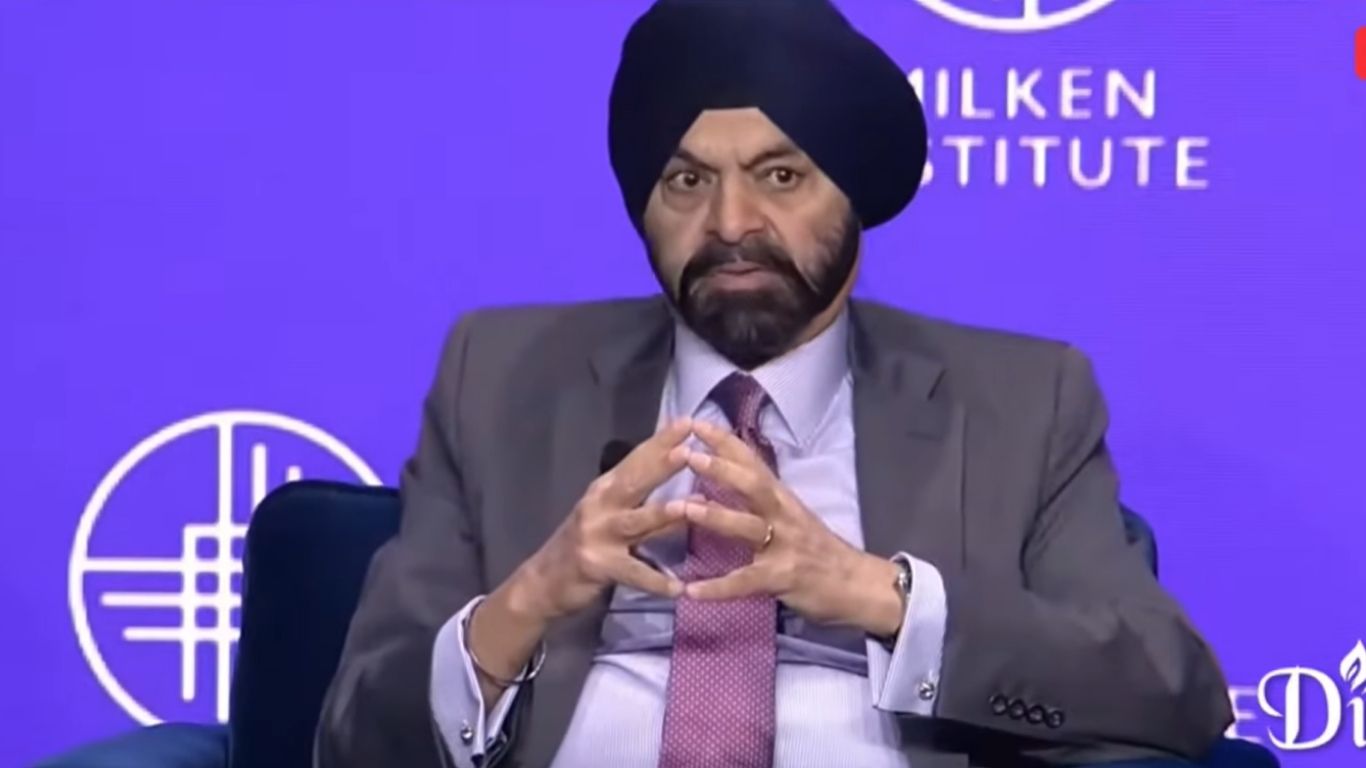
CHANDIGARH, India (Diya TV) — World Bank President Ajay Banga has raised concerns about the changing economic landscape in Punjab, saying many young people who sell family farmland often struggle to build long-term financial security despite receiving large sums of money.
Speaking about broader shifts in urban and rural economies, Banga pointed to Punjab, once known as India’s agricultural powerhouse, as an example of how traditional growth centers are undergoing significant change. He said some young landowners sell their farms, gain substantial wealth for a short period, and then face economic uncertainty after spending much of their money.
“I come from Punjab, which was India’s agricultural centre,” Banga said. “Today, you’ll find young kids there who have just sold their farms. They have been rich for four years and have bought an SUV, smoke, and drink a lot. Soon they are broke and end up trying to find gig jobs.”
Banga added that gig work itself is not a problem. However, he argued that greater productivity and stronger agricultural support systems could create better opportunities for young people. He stressed the need for cooperatives and modern farming technology. He also said farmers need better access to high-quality seeds and fertilizers to improve long-term income and productivity.
His remarks come as Punjab’s agricultural sector faces growing challenges despite its historic role in India’s food security. The state led the Green Revolution during the 1960s and 1970s. As a result, Punjab became the country’s most productive agricultural region and helped transform India from a food-deficient nation into a major food producer.
Today, however, many farmers say they face rising costs, mounting debt, and uncertainty over future earnings. Consequently, farmer organizations across Punjab continue to press both state and central governments for policy changes.
In recent weeks, farmers have organized demonstrations and submitted memorandums to authorities over a range of concerns. These include delayed sugarcane payments, shortages of key farm inputs such as urea, and proposals involving the transfer and sale of cooperative sugar mills.
At the same time, farmer groups continue to pursue long-standing demands. A legally guaranteed Minimum Support Price, or MSP, remains one of their top priorities. They also seek comprehensive debt relief and reforms to crop insurance programs.
Earlier in May, thousands of farmers gathered near the Chandigarh border under the banner of the Samyukt Kisan Morcha, or SKM. The protesters assembled in Mohali and planned to march toward Lok Bhavan to highlight their demands.
During the demonstration, some participants crossed barricades. Reports also indicated that a young protester attempted to move through the barriers with a tractor. Despite those incidents, organizers maintained their focus on policy issues affecting Punjab’s farming community.
Water rights remain another major point of contention. Farmer groups argue that river water distribution should follow the riparian principle, which gives priority to states through which rivers flow. Therefore, they contend that Punjab should retain stronger control over its water resources.
The protesters are also demanding the repeal of Sections 78, 79, and 80 of the Punjab Reorganisation Act, 1966. According to farmer leaders, these provisions place control of Punjab’s river waters under the central government and reduce the state’s authority over a critical resource.
In addition, farmer organizations want the government to withdraw the Dam Safety Act and the Water Amendment Act 2024. They argue that both measures weaken states’ rights over water management.
Farmers have also voiced concerns about international trade policy. They have urged the central government to reconsider any free trade agreement with the United States that they believe could negatively affect Indian agriculture. Furthermore, they claim that recent changes to the rules governing the Bhakra Beas Management Board could reduce Punjab’s permanent representation in the organization.