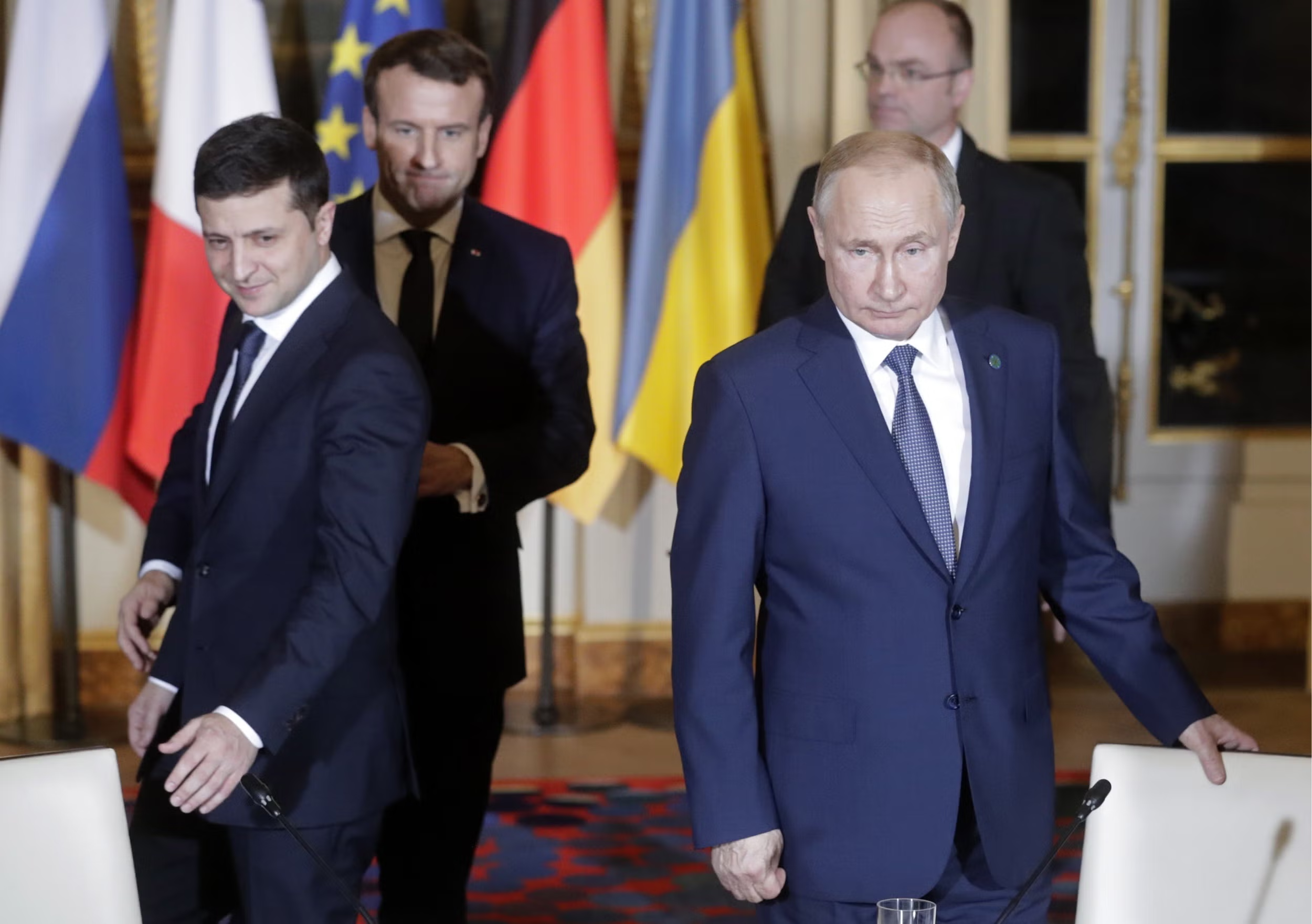
WASHINGTON (Diya TV) — Just two weeks after President Donald Trump’s high-profile summits with Russian President Vladimir Putin and Ukrainian President Volodymyr Zelensky, senior White House officials now believe key European allies are quietly working to sabotage progress toward ending the war in Ukraine.
According to internal assessments, officials in the Trump administration claim that while Europe has outwardly supported Trump’s push for a ceasefire and negotiations, several countries have privately pressured Ukraine to demand unrealistic territorial concessions—stalling momentum achieved during the Alaska talks earlier this month.
In response, the White House has asked the Treasury Department to compile a list of Russian sanctions that Europe could—and should—be prepared to implement. These include a total halt to oil and gas purchases from Moscow and the introduction of secondary tariffs targeting India and China, similar to U.S. measures already in place.
“The Europeans don’t get to prolong this war and backdoor unreasonable expectations while expecting America to foot the bill,” a senior White House official said. “If Europe wants to escalate this war, that will be their decision—but they’ll be snatching defeat from the jaws of victory.”
Officials within the administration argue that several European nations—excluding the UK and France, whom they view as more constructive—are pressuring Zelensky to hold out for a “better deal” that includes sweeping territorial demands. Trump’s aides say this idealistic strategy has only prolonged hostilities, allowing Russia to continue airstrikes on Kyiv while Ukraine escalates attacks on Russian oil infrastructure.
“Getting to a deal is an art of the possible,” the official added. “But some Europeans continue to operate in a fairy-tale land that ignores the fact that it takes two to tango.”
During a recent Cabinet meeting, President Trump appeared visibly irritated by the lack of progress. “Everybody is posturing. It’s all bullshit,” he said, according to sources in the room.
The president has repeatedly emphasized the need for a direct summit between Putin and Zelensky. However, both sides have thus far refused to meet, and the Ukrainians have rejected the idea of discussing any territorial compromises without Russian engagement.
Despite early optimism, the recent diplomatic stagnation—combined with renewed violence—has prompted Trump to consider stepping back from peace efforts altogether.
“We are going to sit back and watch,” a top official said. “Let them fight it out for a while and see what happens.”
Trump’s circle is now increasingly convinced that European leaders are playing a double game: backing Washington’s peace efforts in public, while undermining them behind closed doors. The administration is especially frustrated by the lack of firm European sanctions targeting Russia, viewing their reluctance as proof of geopolitical ambivalence.
Meanwhile, at a meeting in New York on Friday, Trump’s envoy Steve Witkoff and Zelensky’s chief of staff Andriy Yermak discussed the possibility of a future Putin–Zelensky meeting. Yermak invited Witkoff to visit Kyiv, but according to sources with knowledge of the conversation, no tangible breakthrough was achieved.
White House Press Secretary Karoline Leavitt summarized the administration’s growing disillusionment: “Perhaps both sides of this war are not ready to end it themselves. The president wants it to end, but the leaders of these two countries need it to end—and must want it to end as well.”
As tensions rise across European capitals and Washington, the Trump administration appears to be recalibrating its role in the peace process—frustrated with allies it now views as obstacles rather than partners.
The road to peace in Ukraine, once paved with cautious optimism, now appears more uncertain than ever.