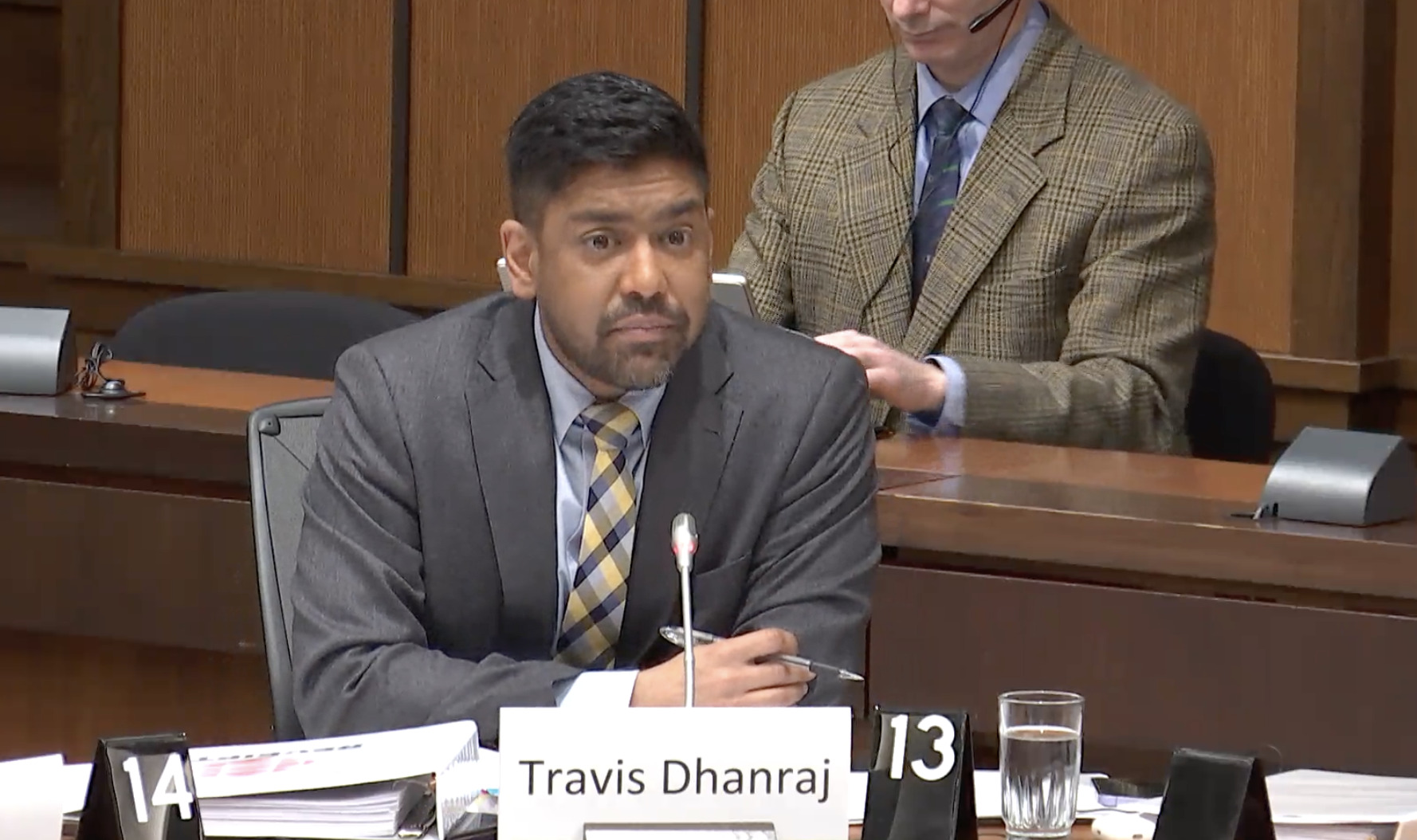
OTTAWA, Canada (Diya TV) — Former Canada Tonight host Travis Dhanraj took his grievances with the CBC to Parliament on Tuesday, testifying before the Standing Committee on Canadian Heritage as part of its ongoing study into fairness in the media.
“After 25 years in journalism, my career ended,” Dhanraj told the committee. “I raised concerns. I challenged centralized control and bias. I fought for real diversity — of thought. Within months I was pulled off the air, disciplined, and eventually out altogether.”
The appearance marked one of the most high-profile moments in a months-long public dispute between Dhanraj and Canada’s national public broadcaster, a conflict that has ignited a broader debate about editorial independence, racial tokenism, and the internal culture at the CBC.
Dhanraj’s 25-year broadcasting career included stints at CP24, CTV News, and Global News before he returned to the CBC in 2021 as a senior parliamentary reporter. He went on to co-host Marketplace before being named host of Canada Tonight in January 2024, a role he said he accepted on the understanding that he would shape the show’s editorial direction.
According to his formal complaint filed with the Canadian Human Rights Commission (CHRC) last fall, Dhanraj says he “quickly realized that diversity was not a true practice of the CBC and would never be a part of their agenda,” and that he was “met with resistance at every point” when attempting to book guests with differing political viewpoints.
The first public sign of tension surfaced in April 2024, when Dhanraj posted on X that then-CBC president Catherine Tait had declined an interview on Canada Tonight following a federal budget announcement of new funding for the broadcaster. He called her refusal “unfortunate.” Shortly afterward, he was pulled from the air.
By late 2024, Canada Tonight was quietly replaced by Ian Hanomansing’s Hanomansing Tonight. Dhanraj was listed as being on leave. In July 2025, he sent a viral all-staff email denouncing what he called “dysfunction at the highest level,” describing a workplace defined by “retaliation, exclusion, and psychological harm” — and announcing he had no choice but to resign.
In September 2025, Dhanraj filed a formal complaint with the CHRC alleging discrimination on the basis of race, colour, and disability. His legal team, led by lawyer Kathryn Marshall, also announced a civil lawsuit against the broadcaster for discrimination and retaliation.
The CHRC complaint is pointed in its accusations. Dhanraj alleges that CBC management selected him to host Canada Tonight not for his editorial vision, but to serve as what he describes as the “token” brown journalist, a role he says carried an implicit expectation of compliance, not leadership.
“CBC’s stated commitment to diversity contrasted with the realities of tokenism,” Dhanraj told the committee Tuesday.
When he requested a Diversity, Equity, and Inclusion investigation in February 2024, he says management told him he was on a “crusade” and instructed him to “work within the system.”
His complaint also names two prominent on-air colleagues, anchors David Cochrane and Rosemary Barton. He alleged they bullied and harassed him, which was “enabled” by the management. He also alleges the CBC attempted to coerce him into signing a non-disclosure agreement while he was on medical leave.
The CBC has denied all allegations. Spokesperson Kerry Kelly said the broadcaster “categorically rejects” Dhanraj’s version of events, adding: “We are dismayed by these attacks on our hosts and newsroom leaders. We will vigorously defend against false claims.”
Adding a layer of irony to Tuesday’s proceedings, Dhanraj publicly dared the CBC to livestream his parliamentary testimony on its own YouTube channel. The national broadcaster declined.</span>
Dhanraj’s challenge was seen by many observers as a pointed test of the CBC’s stated transparency values. Critics noted that a broadcaster claiming editorial independence and openness chose not to air testimony directly concerning its own conduct.
Dhanraj’s case has become a flashpoint in a wider national conversation about the CBC’s political neutrality and workplace culture, particularly regarding journalists of colour.
His lawyer, Kathryn Marshall, previously represented Jamil Jivani, now a Conservative MP, in a similar complaint against Bell Media. At the time, Jivani alleged he was pushed out because he was not the “kind of Black man” his employer expected. Marshall’s involvement in both cases has drawn attention to what some observers describe as a pattern in Canadian media.
“It’s not that he’s bitter, and it’s not a personal vendetta,” Marshall said when the CHRC complaint was filed. “He truly wants to see the CBC improve — to be a supportive, great work environment where you could really debate issues.”
Dhanraj is seeking damages for past and future wage loss, pain and suffering, and has asked the CHRC to order a comprehensive review of the CBC’s DEI and workplace harassment policies, as well as the implementation of a formal whistleblower policy.
He told the committee Tuesday that while his ongoing legal proceedings limit what he can publicly disclose, he came prepared to “paint a better picture about what happened inside the CBC.”
The Standing Committee on Canadian Heritage is expected to continue its study on fairness in the media in the coming weeks.