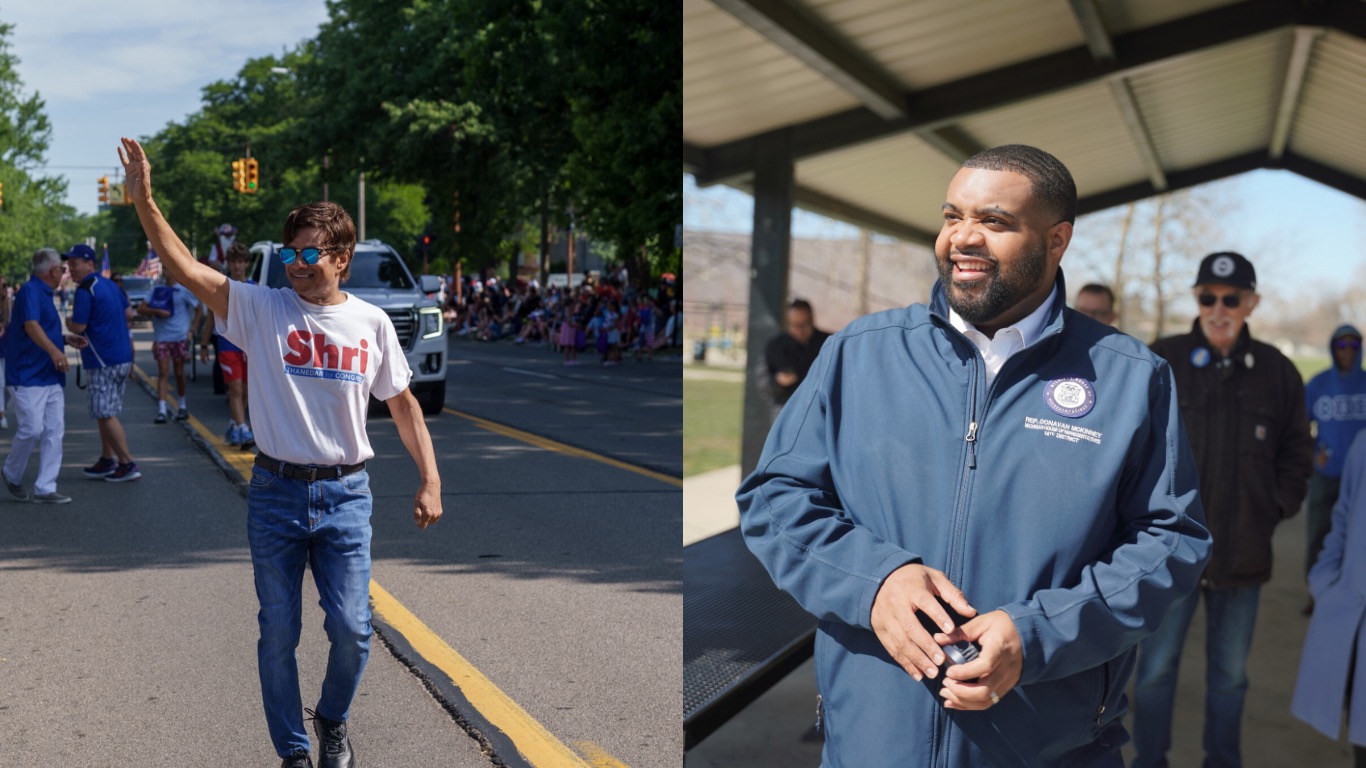
DETROIT (Diya TV) — Two-term Congressman Shri Thanedar’s loss in Tuesday’s Democratic Primary marks a significant shift within Michigan’s 13th Congressional District, as voters declare the need for change in representation. Thanedar was defeated by progressive State Representative Donavan McKinney, a younger Bernie Sanders- and Ilhan Omar-backed, self-described democratic socialist. He previously worked as a union organizer, national political director for Climate Power, and political director for SEIU Healthcare in Michigan. On the campaign, he positioned himself as a working-class alternative to a wealthy incumbent.
The race drew national attention, as it raises broader questions about the Democratic Party’s direction. Is the party continuing to shift toward younger progressive candidates? Or is this simply a district-specific shift? The outcome adds to a broader conversation about the strength of progressive and democratic socialist candidates in Democratic primaries and calls into question the viability argument previously used for electing progressive candidates. Thanedar’s defeat offers insight into the changing dynamics of the Democratic Party platform and what voters are demanding from their candidates.
Thanedar’s campaign included immense self-funding and outside spending. Outside groups, including the cryptocurrency-backed super PAC Protect Progress, spent heavily in support of Thanedar. Although he had pledged not to accept corporate PAC contributions, the independent expenditures highlighted the growing role of outside spending in congressional primaries. Despite those financial advantages, McKinney’s grassroots campaign ultimately prevailed at a time when Democratic primary voters have become increasingly skeptical of corporate PAC influence and have rewarded candidates who emphasize independence from major outside interests.
McKinney’s campaign also benefited from a more unified coalition, one that Thanedar had not previously faced. In his earlier congressional victories, particularly his initial election, multiple challengers divided the opposition vote, which eventually helped carry him to victory. This cycle, however, major progressive organizations and several high-profile Democratic figures rallied behind a single candidate, allowing McKinney to consolidate support among voters.
Beyond campaign organization, Thanedar entered the primary facing questions about his connection with the district’s Democratic electorate. Critics argued his wealth, self-funded campaign, and unconventional style of politics created distance between himself and the working-class voters he represented. McKinney’s campaign, in contrast, capitalized on those concerns by emphasizing his Detroit roots, labor background, and focusing on community-level representation. One candidate represented entrepreneurial success, while the other represented grassroots organizing and held a closer connection to local communities.
Born on February 22, 1955, in Chikkodi, Karnataka, India, Thanedar earned a bachelor’s degree from Karnatak University, along with a master’s degree from the University of Mumbai, before immigrating to the United States in 1979 to pursue a Ph.D in chemistry at the University of Akron, which he later completed in 1982. He thereafter conducted postdoctoral research at the University of Michigan and became a naturalized U.S. citizen in 1988.
Before entering politics, he built a career in the chemical testing and pharmaceutical research industry. He founded Avomeen Analytical Services and grew three other companies, Chemir Analytical Services, Azopharma, and Industrial Testing Labs & Gateway Chemical; the latter three eventually went under during financial crashes. In 2016, he sold a majority stake in Avomeen, and according to his official congressional biography, distributed approximately $1.5 million from the sale among the company’s 50 employees.
Thanedar first sought elected office in the 2018 Michigan gubernatorial primary. As a political outsider trying to make a name for himself, he pledged not to accept corporate PAC contributions and contributed approximately $10.6 million of his own money to his campaign. He ultimately finished third in the Democratic primary race, receiving more than 200,000 votes, losing to only Gretchen Whitmer, who would go on to win the election, and Abdul El-Sayed, the now-Democratic nominee for the U.S. Senate in Michigan.
Rather than leaving politics after his loss in the primary, he ran for the Michigan House of Representatives in 2020. He won the Democratic primary and general election, representing Michigan’s 3rd House District from 2021 to 2023. During his tenure, he served on the House Appropriations Committee before seeking higher office.
In 2022, Thanedar was elected to represent Michigan’s 13th Congressional District in the U.S. House of Representatives, taking office on January 3, 2023. During his time in Congress, he served on the House Committee on Homeland Security and the House Committee on Agriculture. He was also the founder of the bipartisan Congressional Dharma Caucus in 2023, promoting the understanding of Dharmic faith traditions, including Hinduism, Buddhism, Sikhism, and Jainism.
Thanedar’s election was historically notable, as he became the first Indian American to represent a majority-Black congressional district.
During Thanedar’s congressional service, he advocated for issues including increased economic development, affordable healthcare, public education, immigration reform, and support for small businesses. His district encompassed much of Detroit and western Wayne County communities.
Thanedar also attracted national attention in his 2025 efforts, introducing articles of impeachment against President Donald Trump. The effort received little support from Democratic leadership and was later withdrawn before a House vote occurred. This drew criticism from both political opponents and fellow members within his own party.
In the 2026 Democratic Primary, Thanedar sought a second full term in Congress, but was defeated by Michigan State Representative Donavan McKinney. McKinney successfully positioned himself as a working-class alternative to wealthy incumbents.
Thanedar’s career has reflected an uncommon path from an immigrant scientist and businessman to a state legislator and member of Congress. After his recent election loss on August 4, 2026, he stated that although he doesn’t have a Plan B, he stated that he would continue to stay involved and help serve the people of his district.
The outcomes in Michigan raise questions about whether Democratic voters are increasingly prioritizing grassroots organizations, local ties, and ideological alignment over incumbency and financial resources. While Thanedar’s defeat may not determine the future direction of the entire Democratic Party, the race presents another example of the progressive wing successfully competing against established candidates within Democratic primaries.