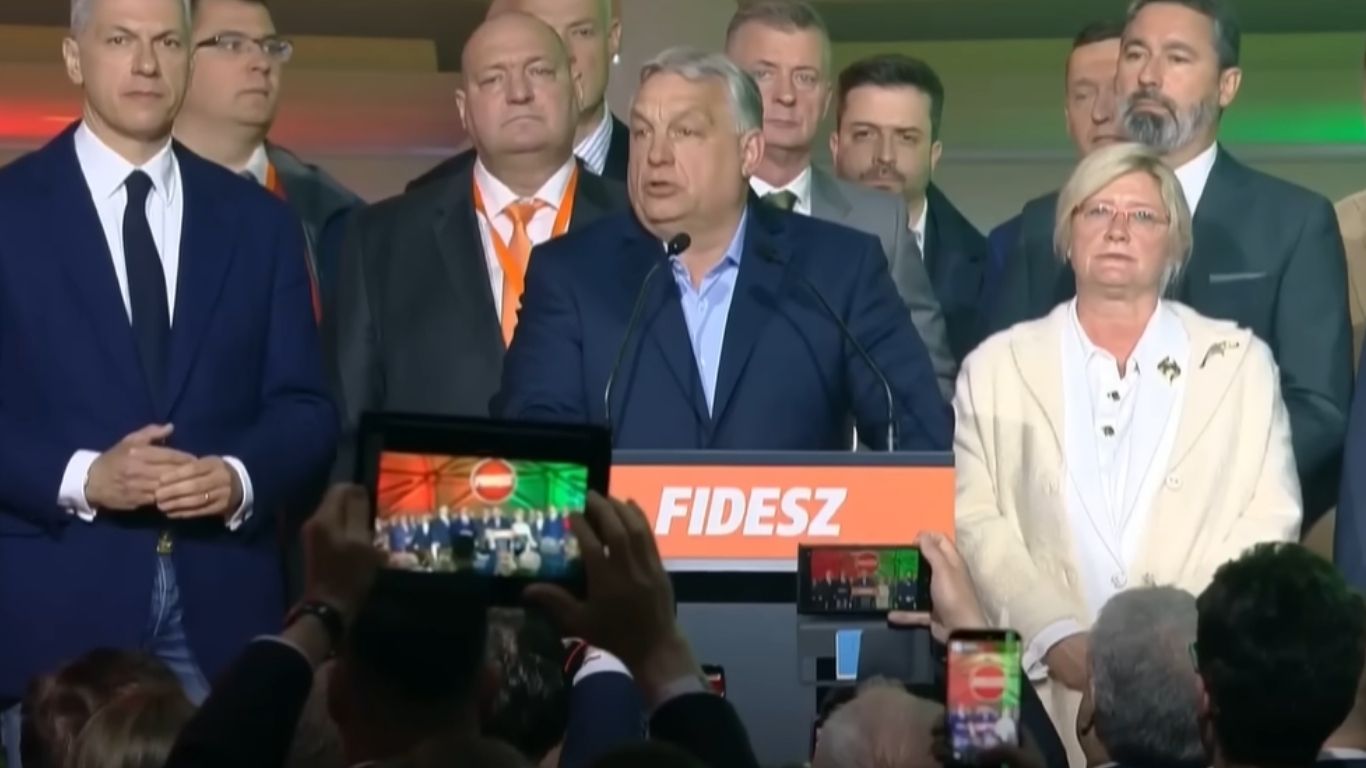
BUDAPEST, Hungary (Diya TV) — In a stunning political upset, Viktor Orbán conceded defeat after 16 years in power, marking a dramatic shift in Hungary’s leadership and political direction. Opposition leader Péter Magyar secured a decisive victory, ending what critics often described as an “electoral autocracy.”
Hungary’s parliamentary election delivered a clear and swift result. Preliminary counts with more than 98% of votes showed Magyar’s Tisza party winning 138 seats. Orbán’s Fidesz party trailed far behind with 55 seats, while the far-right Our Homeland party secured six.
The outcome gives Magyar a two-thirds majority in the 199-seat parliament. This margin allows him to amend the constitution and push through major reforms. Voter turnout reached a record 79.5%, signaling strong public engagement. Orbán acknowledged the loss shortly after early results emerged. “The result of the election is clear and painful,” he said. He thanked his supporters and called for unity in the days ahead.
Magyar, 45, built his campaign on promises of reform and transparency. A former insider in Orbán’s political circle, he spent two years traveling across Hungary. He spoke in villages, town squares, and major cities. His message focused on ending corruption and restoring democratic institutions.
“We did it,” Magyar told cheering supporters in Budapest. “Together we overthrew the Hungarian regime.”
His campaign attracted a broad coalition. Many supporters were not traditional opposition voters. Some had backed Orbán in the past but grew frustrated with rising corruption and economic concerns.
Magyar has outlined an ambitious agenda. He plans to overhaul Hungary’s education and health systems. He also aims to restore judicial independence and dismantle the patronage network known as NER, which critics say benefited political allies. He has pledged to reform state media. Channels like M1 have faced criticism for pro-government coverage. Magyar says he will promote independent journalism and media freedom. His victory gives him the power to act quickly. With a constitutional majority, he can implement structural changes without relying on coalition partners.
The election result could reshape Hungary’s global position. Orbán built close ties with Donald Trump and maintained strong relations with Vladimir Putin. He often clashed with European Union leaders and slowed support for Ukraine. Magyar has promised a different approach. He supports closer ties with the European Union and stronger cooperation with Ukraine. He also aims to reduce Hungary’s reliance on Russia.
Russia responded cautiously. Kremlin spokesman Dmitry Peskov said Moscow respects the election outcome and hopes to maintain pragmatic relations. European leaders welcomed the result. Donald Tusk praised Magyar’s victory and expressed hope for stronger regional cooperation.
Celebrations erupted across Budapest after the results became clear. Supporters gathered near the Danube River, waving Hungarian flags and cheering. Cars honked in the streets as crowds celebrated what many called a historic moment.
Magyar compared the victory to key moments in Hungarian history, including the 1848 revolution and the 1956 uprising against Soviet rule. Supporters echoed chants of “Russians go home,” reflecting frustration with Hungary’s recent foreign policy. At the same time, uncertainty remains. Some voters expressed cautious optimism. They support change but remain unsure about Magyar’s long-term leadership.
Orbán will remain in a caretaker role until the transition completes. He has not stepped down as leader of Fidesz, leaving questions about the party’s future. For now, Hungary enters a new political chapter. Magyar’s government faces high expectations at home and abroad. His ability to deliver reforms and rebuild trust in institutions will shape the country’s future. The election marks a turning point. Hungary now moves from a long period of centralized power to a new era of political change and renewed democratic hopes.