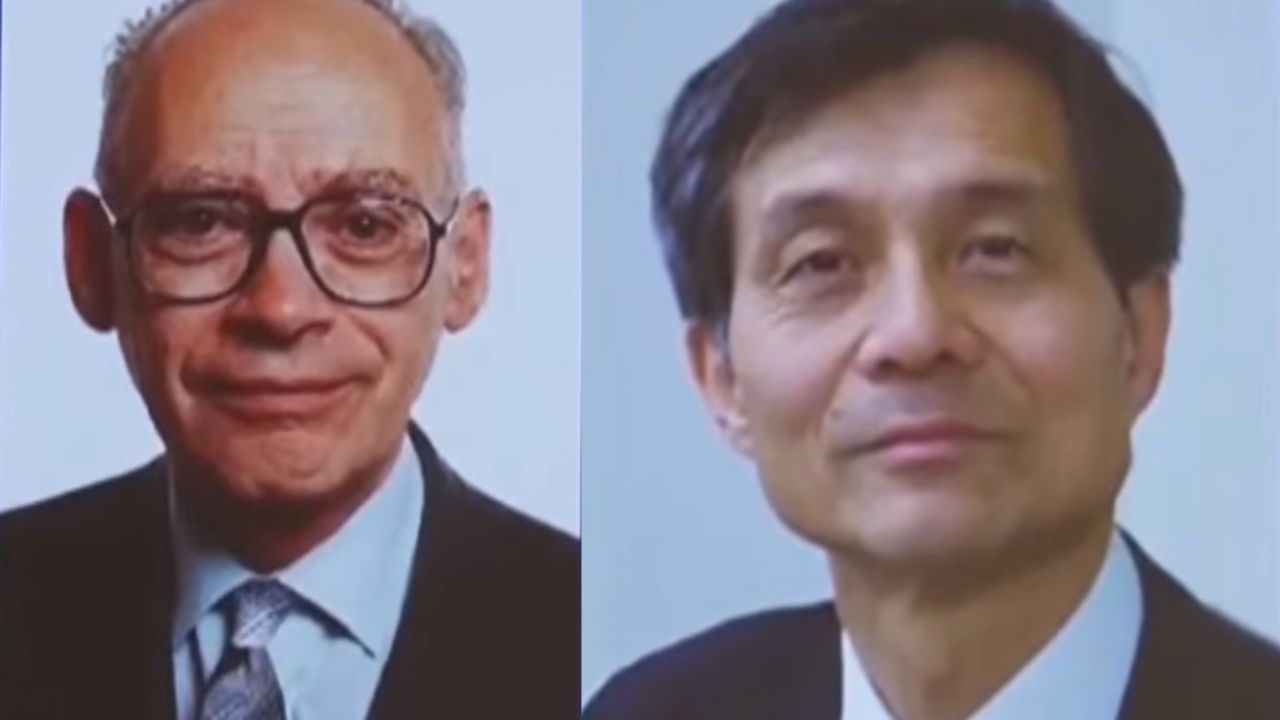
STOCKHOLM, Sweden (Diya TV) — French chemist Henri B. Kagan and Japanese chemist Kenso Soai won the Nobel Prize in Chemistry on Wednesday for discoveries that help chemists produce one molecular form over its mirror image.
The Royal Swedish Academy of Sciences recognized their work on “non-linear effects and autocatalysis in asymmetric organic synthesis.” Their discoveries have helped researchers design reactions for pharmaceutical manufacturing.
Many molecules exist in mirror-image forms, much like left and right hands. Chemists call this property chirality. Although the forms contain the same atoms, they can interact differently with biological systems—a distinction that matters when developing medicines.
Kagan discovered that chemical reactions could amplify a preference for one mirror-image form beyond what scientists previously expected.
Soai subsequently developed reactions in which a product helps catalyze the formation of more molecules with the same handedness. His research demonstrated how a small initial imbalance could grow until a reaction overwhelmingly favored one form.
The discoveries also address a longstanding question about life’s chemistry: how molecules with predominantly one handedness can emerge. They demonstrate a possible chemical mechanism rather than establish exactly how the process occurred when life began.
Both scientists are professors emeritus: Kagan at the former Université Paris-Sud in France and Soai at Tokyo University of Science.
“This is the most exciting day in my life,” Soai told the announcement news conference by phone, according to Reuters. He said he had been grocery shopping when he received the news.
American Chemical Society President Rigoberto Hernandez said their research gave chemists greater control over molecular handedness, supporting advances in medicines and materials.
The laureates will share the prize equally.