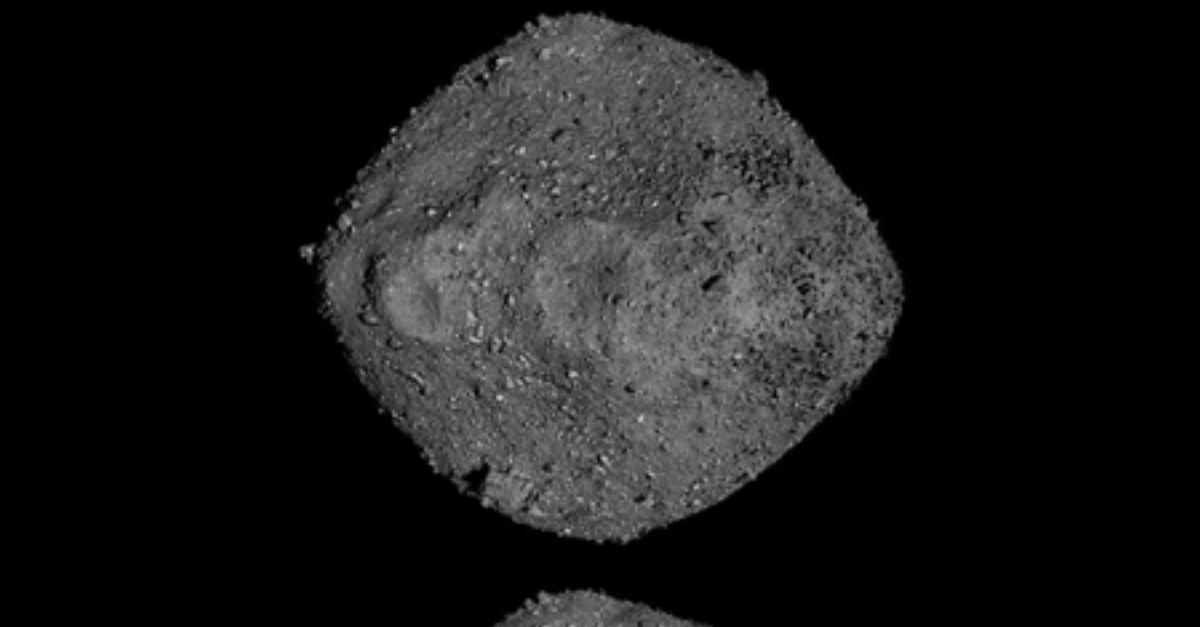
HOUSTON (Diya TV) — New research from NASA’s OSIRIS-REx mission has revealed sugars and other complex organic materials inside pristine samples from the asteroid Bennu, offering fresh clues about how life’s building blocks formed in the early solar system.
Scientists announced the findings in three new papers published in Nature Geoscience and Nature Astronomy. The results highlight the presence of biological sugars, a strange gum-like substance never seen before in space rocks, and dust grains that predate the solar system. Together, these discoveries deepen our understanding of planetary formation and the origins of life on Earth.
Researchers led by Yoshihiro Furukawa of Tohoku University in Japan discovered ribose and glucose inside the Bennu material. Ribose is a five-carbon sugar essential to RNA. Glucose is a key energy source for life on Earth. The detection of glucose marks the first time this sugar has been found in an extraterrestrial sample.
Furukawa said the sugars strengthen the idea that the basic ingredients for life were common in the young solar system. Scientists had already detected amino acids, nucleobases, and phosphates in the OSIRIS-REx samples. All five nucleobases required to build DNA and RNA were also found earlier in the mission.
The team did not find deoxyribose, the sugar used in DNA. That absence suggests that ribose may have been more abundant than deoxyribose in the solar system’s earliest environments. This supports the “RNA world” hypothesis, which proposes that early life relied on RNA to store genetic information and drive chemical reactions. Many scientists believe RNA existed before DNA and proteins evolved into more complex roles.
A second research team, led by Scott Sandford of NASA’s Ames Research Center and Zack Gainsforth of the University of California, Berkeley, studied a strange organic substance inside the samples. The gum-like material is rich in nitrogen and oxygen. It formed early in Bennu’s history, when its parent asteroid began to warm.
The material was once soft and flexible. Over billions of years, it hardened, but scientists say it likely played a role in forming early chemical precursors that supported life’s emergence on Earth. Sandford described the discovery as a window into “the beginning of the beginning.”
The team used advanced tools at Lawrence Berkeley National Laboratory to examine tiny particles of the material. They found that it behaved like a primitive “space plastic,” with chemical groups similar to those found in polyurethane. The particles were layered on mineral and ice grains, suggesting they formed before the asteroid experienced liquid water. Gainsforth said the material looked unlike anything scientists had seen before in space samples.
A third paper, led by Ann Nguyen of NASA’s Johnson Space Center, detailed the presence of presolar grains inside the Bennu samples. These grains formed in stars that existed before the solar system. Bennu contains six times more supernova dust than any other studied sample from an asteroid or meteorite.
The high levels of supernova material suggest that Bennu’s parent body formed in a region of the early solar nebula rich in the remains of dying stars. Some parts of the samples also escaped alteration by water, preserving fragile silicate grains that usually break down in such environments.
Nguyen said the findings show that Bennu’s parent asteroid collected diverse materials as it formed. Some of these materials survived intact for more than 4.5 billion years.
The OSIRIS-REx mission delivered Bennu’s samples to Earth in 2023. Scientists continue to study the material for clues about how planets formed and how life may have emerged. The sugars, organic compounds, and ancient dust grains found so far suggest that asteroids delivered key ingredients to the early Earth.
Bennu’s samples offer a rare look at untouched material from the solar system’s first days. As research continues, scientists hope the findings will help explain how chemical building blocks spread across space and eventually supported life on Earth.