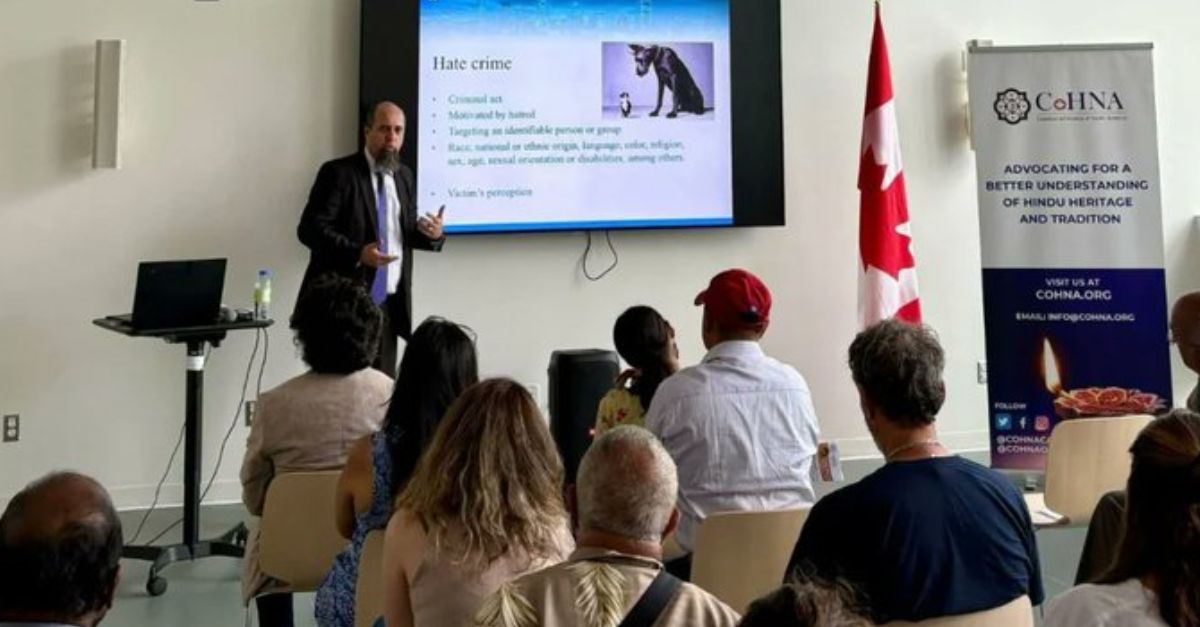
MONTREAL, Canada (Diya TV) — Montreal’s Hindu community turned out in large numbers for a civic-education workshop on combating Hinduphobia and reporting hate crimes, despite calls for the event’s cancellation. The session, hosted at the Centre Sanaaq library in partnership with the Service de Police de la Ville de Montréal (SPVM), drew strong community support and underscored the growing challenges faced by Canada’s minority Hindu population.
The event, titled “Suraksha: Combating Hinduphobia, Addressing Hate Crimes,” was organized by the Coalition of Hindus of North America (CoHNA). “Suraksha,” which means safety in Sanskrit, is CoHNA’s national series of workshops designed to teach Hindu communities how to recognize, report, and respond to hate crimes.
Montreal police officers spoke directly with participants, emphasizing the importance of timely reporting. Marc Bellerose of the SPVM Hate Crimes Unit explained how the unit investigates hate crimes and incidents, stressing that all complaints must be documented. He also noted that surveillance footage is often erased within 72 hours, making quick reporting essential.
SPVM reaffirmed its commitment to impartial protection of all communities. The department highlighted its dedicated hate crimes and hate incidents unit, which specializes in working with cultural and religious minorities across the city.
The workshop came at a critical time. Reports of anti-Hindu hate have been on the rise across Canada. Statistics Canada has documented an increase in hate crimes targeting South Asians, many of whom are Hindu. Independent researchers have also flagged online disinformation campaigns spreading anti-Hindu slurs and memes. Experts warn that such rhetoric often spills into real-world violence.
CoHNA has already hosted similar Suraksha sessions in Toronto and Calgary, with more planned nationwide. The program is part of a broader effort to build cooperation between law enforcement and Hindu communities across Canada.
While the event aimed to educate and empower, it also revealed the resistance Hindu Canadians often face when raising concerns about discrimination. Opponents questioned the very need for a workshop on Hinduphobia. Some accused CoHNA of representing “foreign interests” or promoting “Hindutva,” a claim strongly rejected by organizers.
In response, more than 40 organizations across religious and civic lines came together within 24 hours to defend the workshop. Hindu, Jewish, Muslim, and interfaith allies signed a joint letter of solidarity, condemning attempts to silence the community. The letter emphasized that Hinduphobia is a lived reality in Canada, citing temple vandalism, physical assaults, and threats calling for Hindus to “leave Canada.”
The statement also rejected efforts to portray Hindus as a foreign monolith. Hindu Canadians, it stressed, come from diverse backgrounds, with roots in the Caribbean, Africa, South Asia, and beyond. Many are Canadian-born. Painting the entire community as tied to one foreign state, it argued, is harmful and exclusionary.
Shawn Binda, a Hindu educator and member of CoHNA’s Advisory Council, shared his frustration. Born in Canada with roots in the Caribbean, he said it was painful to be accused of representing another government simply for practicing his faith openly. “The opposition to what should have been a simple civic education event revealed the lengths to which some activist groups will go to fight against Hindus,” he said. “These attacks only highlight why it is important to recognize and name Hinduphobia in Canada.”
Rishabh Saraswat, president of CoHNA Canada, echoed that message. He pointed out that dismissing Hinduphobia or portraying Hindus as outsiders is itself a form of bigotry. “Our community has the same right as others to safety, dignity, and civic voice,” Saraswat said. “The opposition to this event galvanized support and underscored the urgent need for Hindus to equip themselves with knowledge and tools to report hate.”
What began as a straightforward civic event became a clear illustration of the challenges minorities face when advocating for themselves. Hindu Canadians say their efforts to secure the same civic education and protections offered to other groups are often met with denial, dismissal, or suspicion.
Still, the Montreal workshop ended as a success story of resilience. A full house of participants left with tools to report and respond to hate. Police reaffirmed their partnership with the community. And interfaith allies stood in solidarity against attempts to erase Hindu voices.
For CoHNA, the message was clear: Hindus in Canada will not be silenced, and their right to safety and dignity will continue to be defended in civic spaces across the country.