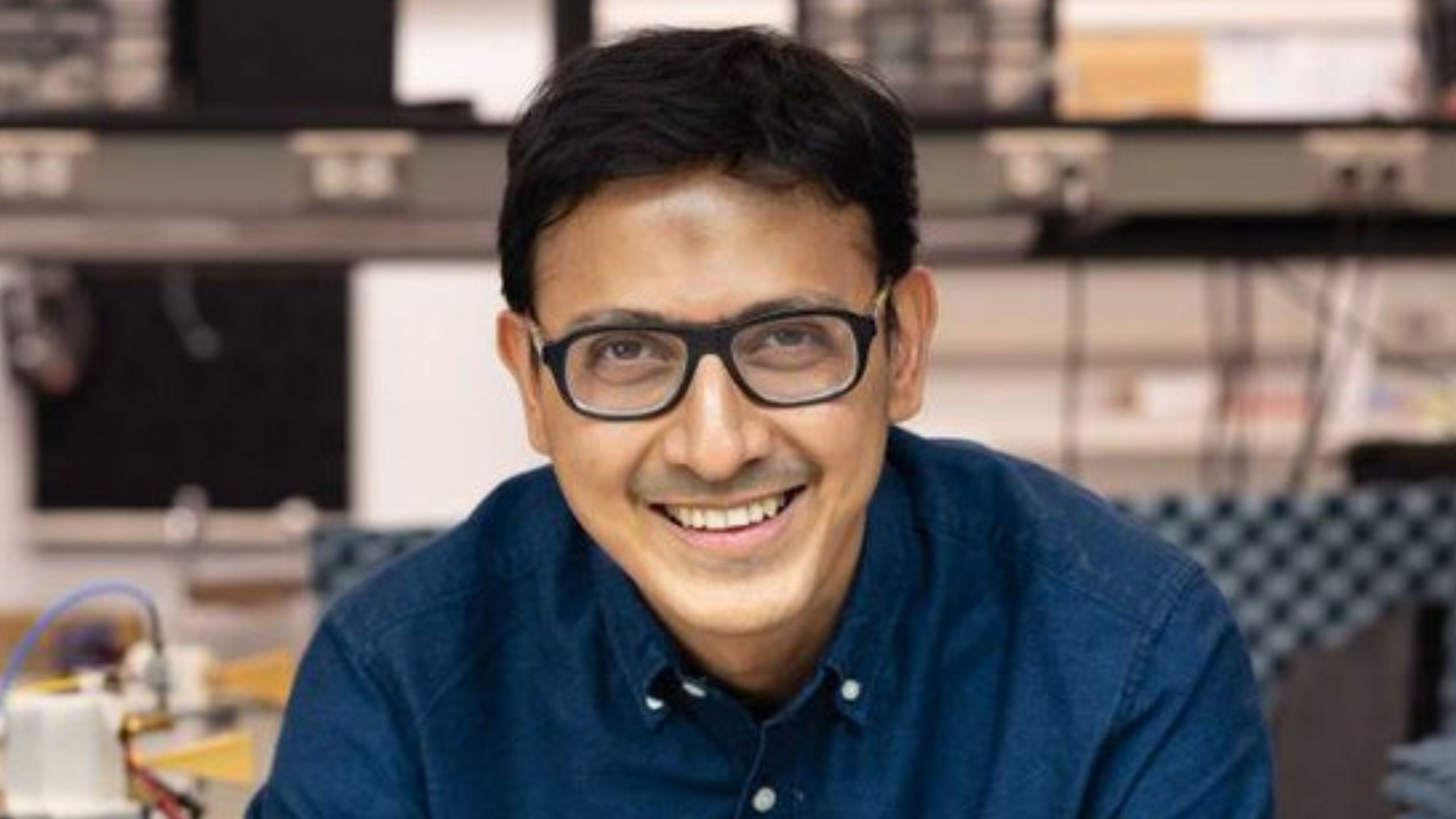
PRINCETON, N.J. (Diya TV) — Kaushik Sengupta, an Indian American professor at Princeton University, is leading a $10 million joint government-industry effort to revolutionize wireless chip design using artificial intelligence. The project aims to speed up the development of advanced semiconductors critical for technologies like 6G networks, satellite communication, self-driving cars, and smart medical devices.
Sengupta, who teaches electrical and computer engineering at Princeton and is an alumnus of the Indian Institute of Technology Kharagpur, will direct a team focused on automating the design of microchips used in radio-frequency (RF) wireless communication.
The National Semiconductor Technology Center (NSTC), a public-private consortium managed by the National Center for the Advancement of Semiconductor Technology (Natcast), awarded the nearly $10 million grant. The NSTC announced the initiative as part of a broader U.S. effort to maintain global leadership in semiconductor innovation.
“Embracing AI for radio frequency design is paramount for maintaining the United States’ leadership in technological innovation,” said Natcast CEO Deirdre Hanford. “Leveraging AI not only accelerates our research capabilities but also ensures the U.S. remains at the cutting edge of communication infrastructure.”
Wireless chips allow devices like laptops, smartphones, car sensors, and satellites to communicate through high-speed, low-power signals. But as demand for faster data continues to grow, traditional chip design methods can’t keep up.
Designing wireless chips is a time-consuming and costly process that requires deep expertise in overlapping technical areas. Unlike chips used in computers and data centers, which benefit from highly automated design tools, wireless chips still rely on manual, handcrafted techniques.
“They are fundamentally handcrafted,” Sengupta said. “But if you could get to a point where the manual labor-intensive aspects of design can be automated out and you can start discovering new architectures or new functionality, there lies a window of opportunity.”
Sengupta’s team is flipping the traditional design approach. Instead of starting with known circuits and tweaking them, they begin with the end goals—such as speed, power efficiency, or signal quality—and use AI to reverse-engineer the best chip designs.
This AI-driven method has already shown promising results. In 2022, graduate students Emir Ali Karahan and Zheng Liu, both advised by Sengupta, presented their work at the IEEE International Microwave Symposium. Their design caught the attention of experts and won the event’s top award. A related paper won the 2023 Best Paper Award from the IEEE Journal of Solid-State Circuits.
Sengupta said these AI-designed chips often surprise engineers with creative layouts that outperform traditional ones. “You’re sort of limited to the human imagination,” he said. “It’s a very bottom-up approach.” His method replaces that with a top-down strategy led by AI.
By automating chip design, the project aims to cut development costs, shorten lead times, and increase innovation. It could also level the playing field for smaller companies and research labs by reducing the need for deep technical specialization.
The team hopes this work will drive advances across multiple industries. Wireless chips play a critical role in emerging technologies, from connected vehicles and telemedicine to the growing Internet of Things (IoT).
The Princeton-led effort also aligns with national priorities. U.S. lawmakers have increasingly focused on semiconductor leadership, especially as global competition heats up. Advanced chip design is central to economic growth, national security, and technological independence.
Sengupta’s project highlights how academic research, government funding, and private-sector partnerships can drive technological breakthroughs. The AI-powered tools developed through this initiative could redefine how wireless chips are built—and who gets to build them.
As technology races forward, Sengupta believes AI can unlock creative solutions to complex engineering challenges. “There’s a tremendous opportunity here,” he said. “We’re just scratching the surface.”