
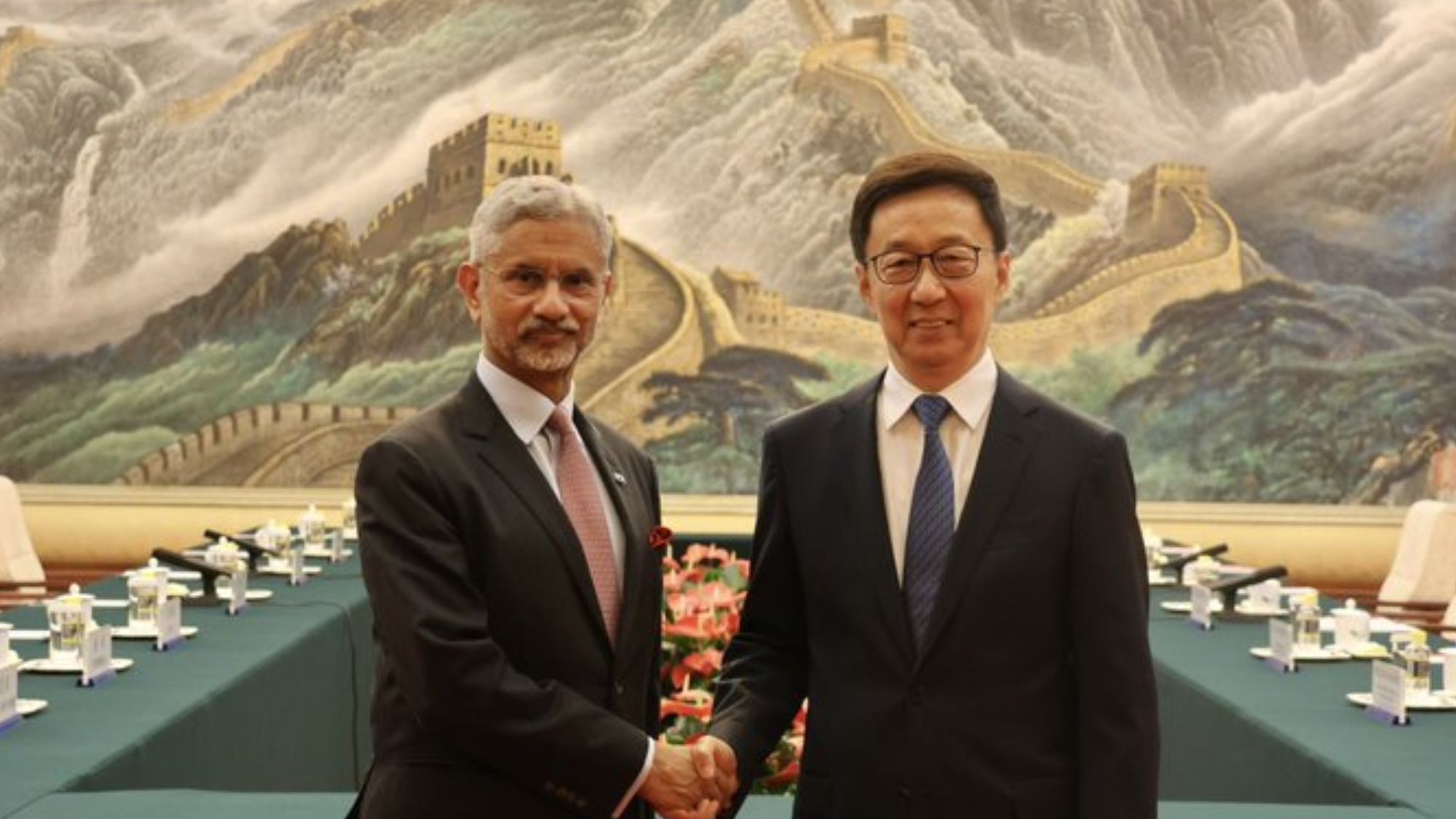
BEIJING (Diya TV) — India’s External Affairs Minister S. Jaishankar met with Chinese Vice President Han Zheng in Beijing on Monday. The meeting marked a key step toward improving relations between the two Asian neighbors. Jaishankar’s visit to China comes after nearly five years and follows a period of strained ties after the 2020 Galwan Valley clash.
Soon after arriving in Beijing, Jaishankar expressed India’s support for China’s presidency of the Shanghai Cooperation Organisation (SCO). He shared this in a post on the social media platform X, saying, “Pleased to meet Vice President Han Zheng soon after my arrival in Beijing today. Conveyed India’s support for China’s SCO Presidency. Noted the improvement in our bilateral ties. And expressed confidence that discussions during my visit will maintain that positive trajectory.”
The SCO, a key regional security and economic forum, includes both India and China. Jaishankar’s endorsement of China’s leadership in the group signals a desire for deeper cooperation within the multilateral body.
During the meeting, Jaishankar noted that ties between India and China have shown signs of improvement. He referred to the October 2023 meeting between Prime Minister Narendra Modi and President Xi Jinping in Kazan as a turning point.
“Our bilateral relationship has been steadily improving since the meeting between Prime Minister Modi and President Xi Jinping in Kazan,” Jaishankar told Han Zheng. “I am confident that my discussions in this visit will maintain that positive trajectory.”
He stressed that continued normalization of ties could lead to mutually beneficial outcomes.
Jaishankar highlighted a significant milestone — the 75th anniversary of diplomatic ties between India and China. He also mentioned the resumption of the Kailash Mansarovar Yatra, a religious pilgrimage route to Tibet that was paused after the 2020 military standoff.
“The resumption of the Kailash Mansarovar Yatra is widely appreciated in India,” he said. “Continued normalization of our ties can produce mutually beneficial outcomes.”
The minister also discussed the broader international context. He said that cooperation and communication between major neighboring economies like India and China are essential in today’s complex global environment.
“As neighboring nations and major economies, an open exchange of views and perspectives between India and China is very important,” he noted. “I look forward to such discussions during this visit.”
Jaishankar is expected to meet Chinese Foreign Minister Wang Yi later Monday for a formal bilateral meeting. The two last met in February during a G20 gathering in Johannesburg. At that meeting, both sides called for greater mutual trust and cooperation.
Wang Yi is also expected to visit India next month. He will meet National Security Advisor Ajit Doval as part of the Special Representatives (SR) mechanism. The goal of the talks will be to move forward on the long-standing boundary dispute between the two countries.
Jaishankar will also attend the SCO Council of Foreign Ministers’ Meeting in Tianjin on July 15. India’s Ministry of External Affairs confirmed his participation and noted that he will hold additional bilateral meetings on the sidelines of the event.
This visit follows recent trips to China by other top Indian officials, including Defence Minister Rajnath Singh and NSA Ajit Doval in June for SCO-related meetings.
Jaishankar’s visit is his first to China since the deadly 2020 clash in eastern Ladakh’s Galwan Valley. The military standoff, the worst border confrontation between the two countries in over four decades, led to casualties on both sides and caused a sharp drop in diplomatic relations.
Since then, efforts have been underway to ease tensions through diplomatic and military-level talks. The current visit reflects a cautious but hopeful shift toward restoring stability and cooperation in bilateral ties.
As India and China navigate their complex relationship, Jaishankar’s visit signals a renewed effort to build trust. With ongoing discussions and planned future engagements, both nations appear committed to keeping dialogue open and constructive.