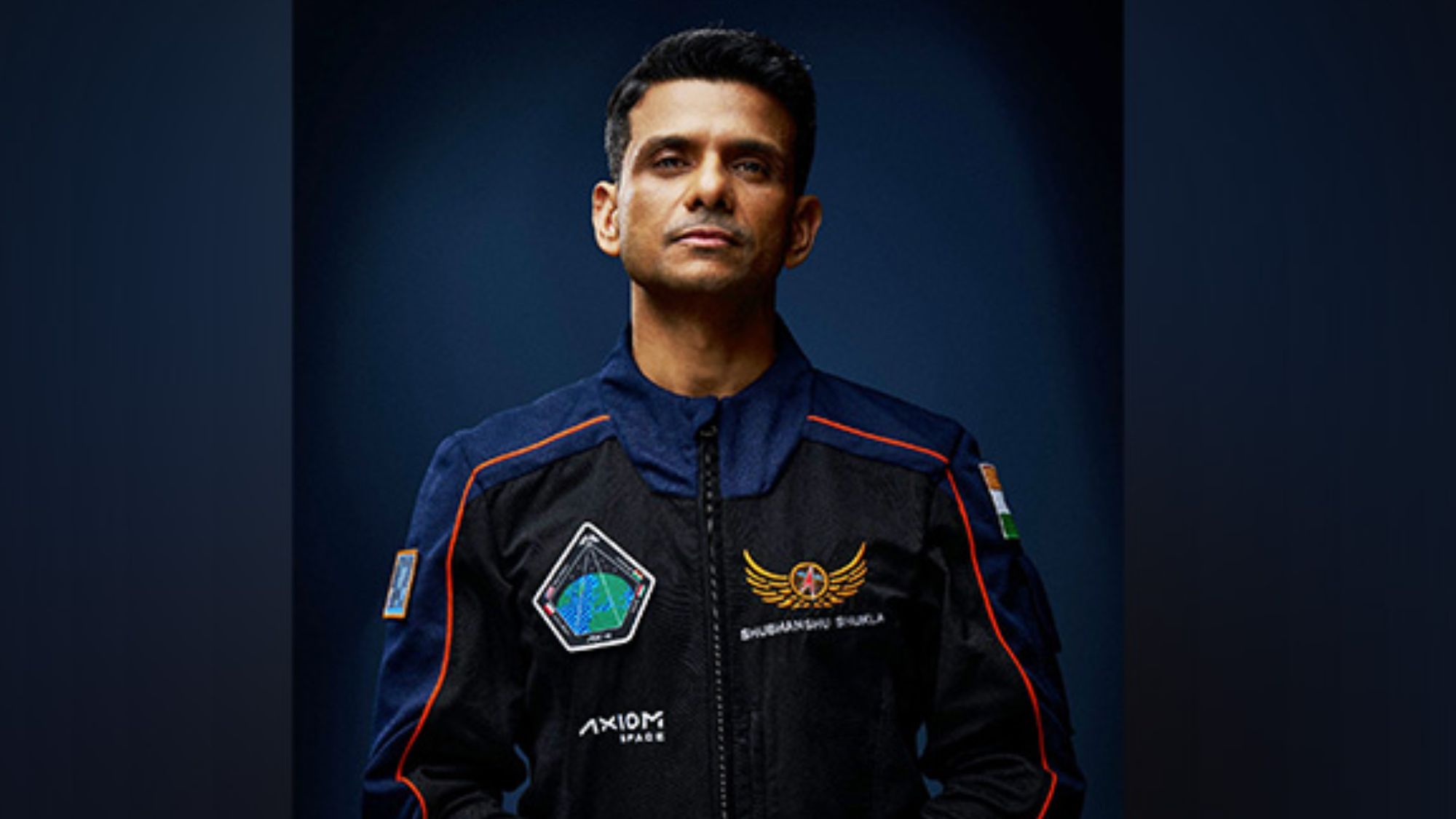
HOUSTON (Diya TV) — Indian astronaut Group Captain Shubhanshu Shukla started his return journey to Earth on Monday, July 14, after spending 18 days aboard the International Space Station (ISS). This mission was a historic milestone for India, as Shukla became the first Indian to board the ISS and the country’s second astronaut in space, following Wing Commander Rakesh Sharma.
Shukla’s spaceflight was part of the Axiom Mission 4 (Ax-4), a private mission organized by Axiom Space and SpaceX. The Lucknow-born Air Force officer served as the mission pilot. He traveled with three international crew members: Commander Peggy Whitson from the United States, Mission Specialist Sławosz Uznański-Wiśniewski from Poland, and Mission Specialist Tibor Kapu from Hungary.
The Ax-4 crew undocked from the space station’s Harmony module at 4:45 p.m. IST on Monday. The journey back to Earth will take about 22.5 hours, with splashdown expected in the Pacific Ocean off the California coast on Tuesday, July 15, around 3 p.m. IST.
Before undocking, the crew suited up and closed the hatch between the Dragon spacecraft and the ISS at 2:37 p.m. IST. After final checks, the spacecraft separated slightly later than scheduled due to a brief delay. Axiom Space confirmed the crew completed 288 orbits around Earth and traveled nearly 7.6 million miles since their arrival at the station.
While in space, Shukla conducted seven scientific experiments developed by the Indian Space Research Organization (ISRO), the Department of Biotechnology, and NASA. These studies are crucial for India’s upcoming Gaganyaan mission, which is the country’s first planned human spaceflight.
One of the main experiments, “Sprouting Salad Seeds in Space” (SPROUTS), focused on growing green gram and fenugreek seeds, which are dietary staples in India. Scientists aim to understand how space affects seed germination, nutrition, hormone behavior, and microbes.
NASA highlighted the importance of this research. As space agencies plan for longer missions, the ability to grow food in space becomes essential. SPROUTS could lead to self-sustaining plant-based food systems, reducing dependence on Earth-based resupply.
“Plant-based food systems can help meet long-term human spaceflight goals,” NASA stated. “Sprouted seeds are more nutritious per unit mass than fully grown plants.”
NASA also noted that this experiment could help create salad crops suited for Indian diets in space. Insights gained may also improve food production on Earth, especially in difficult environments.
Alongside his scientific work, Shukla interacted with students from Kerala and Lucknow through video calls. He answered questions about astronaut life, sleeping in zero gravity, space diets, and how astronauts deal with illness. He described the ISS experience as “amazing” and “dynamic,” even joking about the fun of floating in a place with no ceiling or floor.
After undocking, the Dragon spacecraft began a seven-phase descent. These steps include a series of engine burns to align with the landing zone, followed by a deorbit burn scheduled for 2:07 p.m. IST on July 15. After discarding its trunk, the Dragon will re-enter Earth’s atmosphere, facing intense heat and drag.
At 55 kilometers above the Pacific, two drogue parachutes will deploy. Then, four main parachutes will open at 2 kilometers, slowing the spacecraft to a final splashdown speed of 27 kilometers per hour.
Once in the water, a SpaceX recovery vessel will retrieve the capsule and the crew. Medical teams onboard will conduct initial health checks. Later, the crew will board helicopters back to land and head to Houston.
ISRO confirmed that Shukla will enter a weeklong rehabilitation program. Flight surgeons will help him readjust to Earth’s gravity after nearly three weeks in space.