OTTAWA, Canada (Diya TV) — Jagmeet Singh announced Tuesday he will step down as leader of Canada’s New Democratic Party (NDP), following a stunning loss in the country’s federal elections that saw him defeated in his own riding and his party stripped of official status in Parliament.
Singh, who has led the left-leaning NDP since 2017, lost his Burnaby Central seat in British Columbia—a riding reshaped by redistribution ahead of Monday’s vote. It marked a dramatic fall for a politician once hailed for making history as the first person of an ethnic minority to lead a major federal party in Canada. Singh finished third in his district, ending a run in the House of Commons that began in 2019.
“It’s been the honor of my life to lead the NDP and to represent the people of Burnaby Central,” Singh said in a post on X, formerly Twitter. “I know this night is disappointing for New Democrats. I am disappointed that we could not win more seats. But I am not disappointed in our movement.”
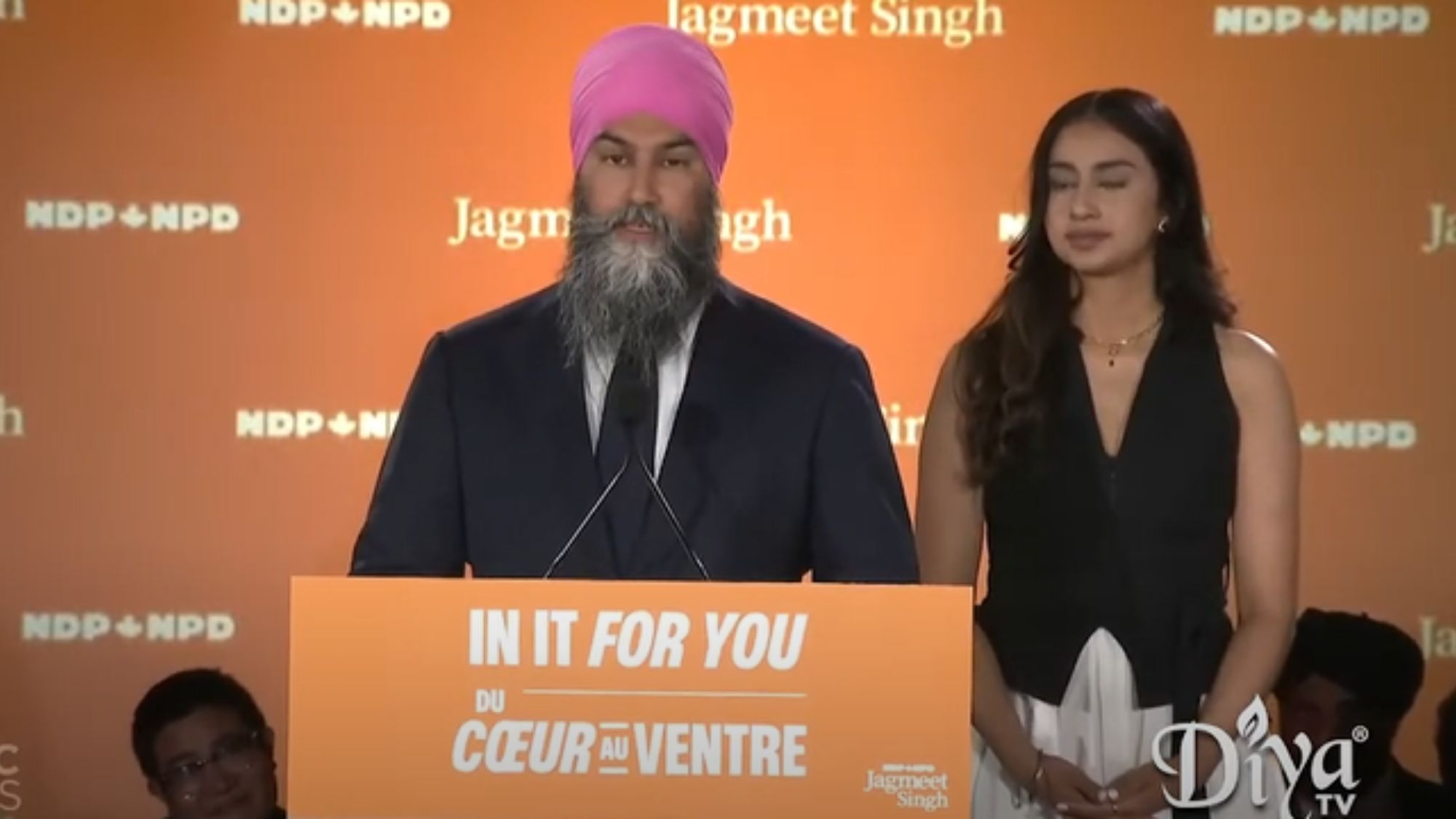
In his emotional concession speech, Singh congratulated Liberal leader Mark Carney on his victory and said Carney had “an important job to do” in protecting Canada from the threats of Donald Trump.” Singh appeared visibly emotional, at one point pausing to compose himself before thanking his supporters and wife, Gurkiran Kaur. “I gotta keep it together here, folks,” he said.
The election delivered a narrow win for Carney’s Liberal Party over the opposition Conservatives, though early results suggested the Liberals may still need the backing of the NDP—or other smaller parties—to maintain a working majority. Singh had previously supported Prime Minister Justin Trudeau’s minority government for four years, providing critical parliamentary support in exchange for increased social spending.
But Monday’s poor showing leaves the NDP in political limbo. The party failed to win the minimum 12 seats needed to retain official party status in Parliament, a threshold that comes with financial and procedural benefits such as dedicated research funding and guaranteed speaking time in the House of Commons.
Singh said he would remain as leader temporarily until an interim successor is appointed.
The loss marks the end of a high-profile and often polarizing chapter in Canadian politics. Singh became a familiar face on the national and international stage for his progressive stances on healthcare, housing, and income inequality—but also drew controversy for his sharp criticism of India’s government and vocal support for pro-Khalistan activists in Canada.
India has repeatedly expressed concern over Singh’s rhetoric, particularly his calls to ban the Rashtriya Swayamsevak Sangh (RSS), the ideological parent of India’s ruling Bharatiya Janata Party (BJP). His position on the Khalistan movement, which advocates for an independent Sikh homeland, further strained Canada-India relations and drew criticism from some members of the Indian diaspora.
Singh’s departure is being viewed by some political observers as a significant shift in Canada’s progressive movement. While the NDP under Singh did manage to influence key policy initiatives—particularly during Trudeau’s minority government—its failure to connect with a broader electorate ultimately led to its collapse in this election cycle.
Carney, a former Bank of Canada and Bank of England governor, is now set to become Canada’s next prime minister, succeeding Trudeau. His path forward may depend in part on whether the remaining NDP members choose to support the Liberal agenda in a hung Parliament.