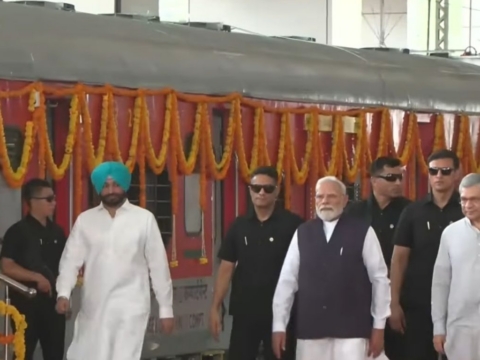
NEW DELHI (Diya TV) — Indian Prime Minister Narendra Modi and Mark Carney on Monday announced a series of major agreements aimed at resetting strained India-Canada relations. The deals include a landmark uranium supply pact, expanded cooperation on critical minerals and clean energy, and a renewed push for a free-trade agreement.
The announcements mark a significant step forward after nearly three years of diplomatic tensions. Both leaders described the moment as a fresh start built on mutual trust and shared economic goals.
Modi said the two countries struck a “landmark” agreement for long-term uranium supply to support India’s nuclear power expansion. Energy security remains a top priority for India, the world’s most populous nation with 1.4 billion people.
India plans to increase its nuclear power capacity from eight gigawatts to 100 gigawatts by 2047. The uranium supply agreement, valued at 2.6 billion Canadian dollars ($1.9 billion), will help fuel that growth.
Carney said Canada is well-positioned to serve as a reliable supplier of uranium and liquefied natural gas. He added that both nations launched a strategic energy partnership with strong long-term potential. The partnership also covers small modular reactors and advanced nuclear technology.
Nuclear energy cooperation forms a key pillar of the broader India-Canada energy partnership. Both countries also pledged to expand collaboration in renewable energy and clean technology.
The leaders agreed to strengthen cooperation in critical minerals. India needs steady access to these resources for manufacturing, clean-tech industries, and nuclear plants. Canada holds large reserves of key minerals and aims to expand exports to trusted partners.
Carney stressed the need to diversify Canada’s trade beyond the United States. In 2024, more than 75% of Canadian exports went to the U.S., with total two-way trade exceeding $900 billion. Carney has made trade diversification central to his foreign economic policy.
India and Canada resumed negotiations last year on the proposed Comprehensive Economic Partnership Agreement. Modi set a target of reaching $50 billion in bilateral trade. He said the agreement would reduce barriers and create new investment and job opportunities in both countries.
Carney said he hopes to finalize the trade deal by the end of the year. He described it as an ambitious agreement that will increase certainty for businesses.
Canadian pension and wealth funds have already invested $73 billion in India. Officials expect fresh agreements to boost cross-border investments further.
India-Canada ties collapsed in 2023 after Ottawa accused New Delhi of involvement in the killing of Hardeep Singh Nijjar, a naturalized Canadian citizen linked to the Khalistan movement. India rejected the allegations. Both countries expelled senior diplomats in 2024, which deepened the rift.
Relations began to improve after Carney took office in March 2025. The two governments restored envoys and increased diplomatic engagement over the past year. Carney said the renewed partnership reflects a shared commitment to chart an independent course for the future.
The leaders also agreed to renew security cooperation through a new defense partnership. They said stronger coordination will support stability in the Indo-Pacific region.
After concluding his visit to India, Carney will travel to Australia and Japan as part of a broader Indo-Pacific tour.
In Australia, he will meet Prime Minister Anthony Albanese in Canberra. Talks will focus on trade expansion, defense cooperation, and emerging technologies. Carney will also address both houses of Australia’s Parliament, marking the first such speech by a Canadian prime minister in nearly 20 years.
His final stop will be Tokyo, where he is scheduled to meet Prime Minister Sanae Takaichi. Discussions will center on clean energy, advanced manufacturing, food security, and critical minerals.
Carney’s trip underscores Canada’s effort to deepen partnerships across Asia. He aims to reduce Canada’s heavy reliance on the U.S. market while strengthening ties with key democratic partners.
Analysts describe the latest agreements as a strategic reset in India-Canada relations. The uranium supply deal, critical minerals cooperation, and free-trade negotiations signal a shift toward economic pragmatism.
Both governments now appear focused on shared priorities such as energy security, clean technology, and economic growth. If talks progress as planned, the renewed partnership could reshape bilateral trade and strengthen strategic cooperation in the Indo-Pacific region.
For India and Canada, the latest agreements represent more than diplomatic repair. They mark a new chapter in a partnership driven by energy security, trade expansion, and long-term strategic alignment.