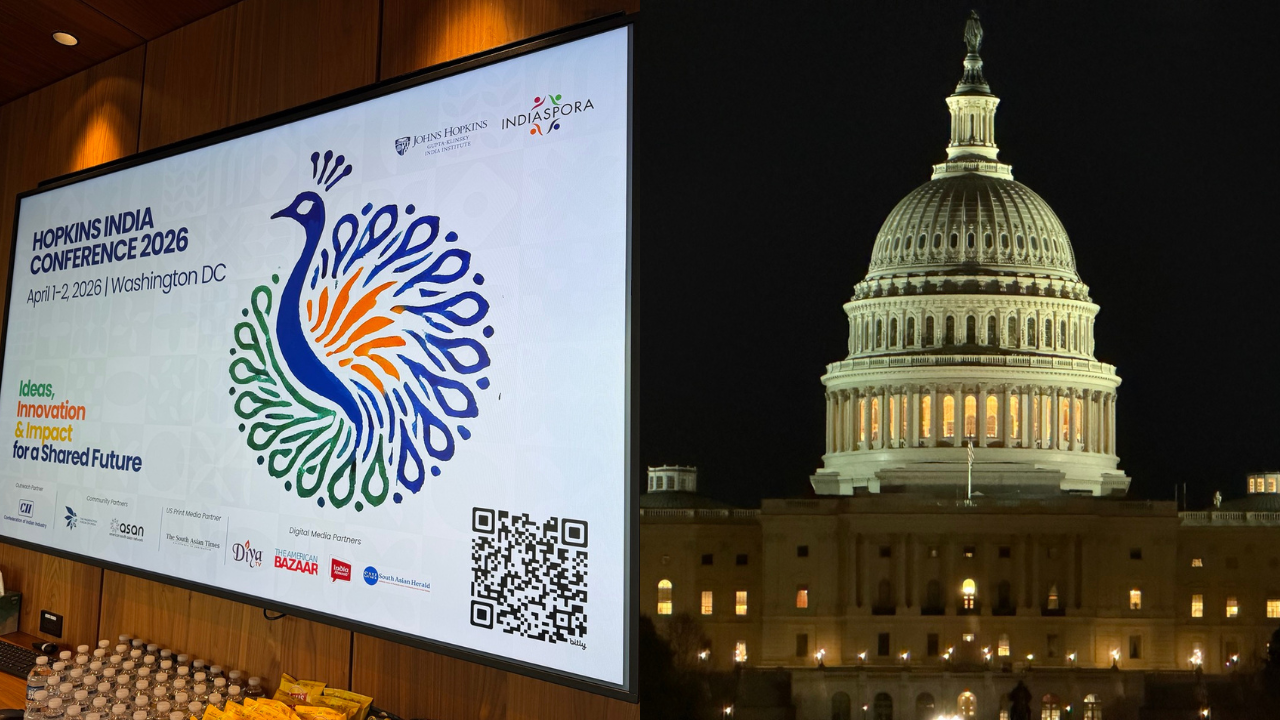
WASHINGTON (Diya TV) — The Hopkins India Conference 2026, held April 1–2 at the Johns Hopkins University Bloomberg Center in Washington, D.C., brought together leaders from India and the United States to deepen collaboration across some of the most consequential areas of bilateral engagement — technology, health, education, and the global economy. Organized by the Gupta-Klinsky India Institute at Johns Hopkins University, the conference has quickly established itself as one of the most important forums for U.S.–India dialogue in the academic and policy world.
Building on a successful inaugural edition in 2025, this year’s gathering expanded in scope, ambition, and format. “We designed this conference to move beyond conversation to collaboration and action,” said Dr. Amita Gupta, faculty co-chair of the Institute and co-founder of the conference. “The expanded structure for 2026 reflects our commitment to convening interdisciplinary expertise and amplifying voices across institutions and sectors.” Participants from government, academia, industry, and civil society engaged not just in public debate but in the kind of sustained, cross-sector exchange that produces lasting outcomes.
The 2026 theme, “Ideas, Innovation & Impact for a Shared Future,” framed the conference’s central question: how can India’s scientific, technological, and policy strengths be harnessed to address the most pressing challenges of our time. Four thematic tracks organized the conversation: Technology and Innovation, The Future of Health, Education and Talent Transformation, and India and the World.
Day One opened with a keynote by Ambassador Namgya C. Khampa, Deputy Chief of Mission at the Embassy of India in Washington, D.C., which set a tone of strategic optimism about the bilateral relationship. Ambassador Vinay Kwatra reinforced that spirit, describing the India–U.S. partnership as a defining relationship of the 21st century, rooted in trust, shared democratic values, and deepening cross-sector collaboration. The day drew voices from some of the most respected institutions in global policy — Brookings, CSIS, the Hudson Institute, and the Center for a New American Security — alongside industry leaders from Wadhwani AI, General Atomics Global Corporation, and Cognite, creating an unusually rich mix of perspectives under one roof.
Among the most anticipated discussions was a wide-ranging conversation on India’s economic trajectory. Dr. V. Anantha Nageswaran, India’s Chief Economic Advisor, offered a compelling vision of how the country intends to reach a $30 trillion economy, pointing to digital infrastructure, demographic strength, and a new wave of structural reforms as the engines of that growth. Political thinker Yogendra Yadav offered a more searching counterpoint, pressing the audience to consider whether India’s development path adequately centers equity, sustainability, and democratic deepening — a tension that ran productively through much of the day’s programming.
Conversations on climate resilience brought together Anshu Gupta, the Magsaysay Award-winning founder of Goonj, alongside experts from Americares and the Johns Hopkins Institute for Planetary Health, grounding the discussion in community-level realities rather than abstract policy. A complementary photo exhibition by Gupta, drawn from more than two decades of documenting disaster-affected communities across India, gave the conference a rare humanistic dimension. Author Megha Majumdar, a 2025 National Book Award finalist and Oprah’s Book Club selection, added yet another layer, using her work to probe the ethical dimensions of power, institutional failure, and climate vulnerability.
The Gupta-Klinsky India Institute was founded in 2020 with a mandate to anchor and expand Johns Hopkins’ engagement with India across research, education, and policy. The Confederation of Indian Industry served as a key partner for the 2026 edition. As geopolitical pressures continue to test the international order, that kind of sustained, multi-layered engagement between the world’s two largest democracies may matter more than ever.