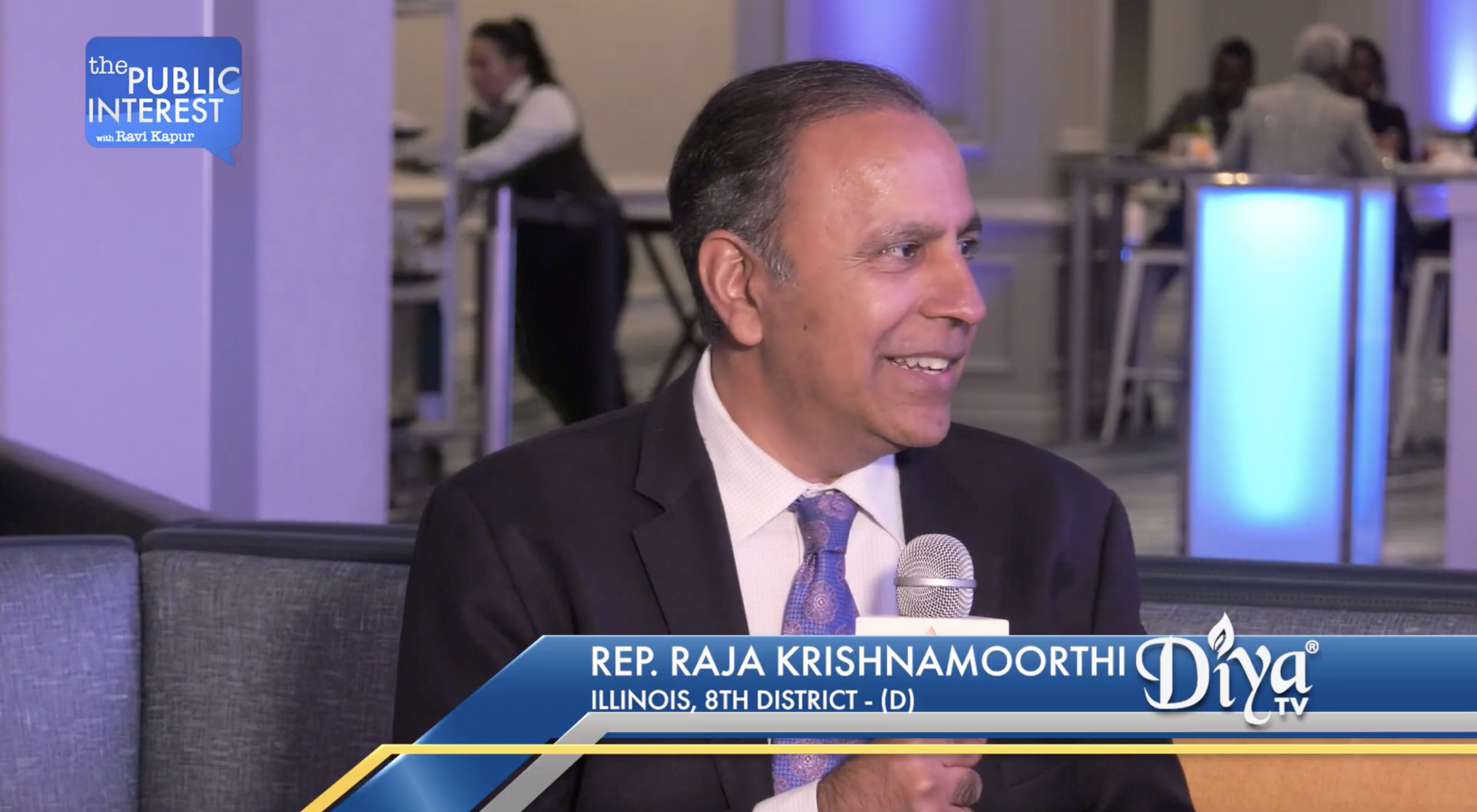
SAN DIEGO, Calif. (Diya TV) — U.S. Rep. Raja Krishnamoorthi said he remains committed to public service after falling short in Illinois’ Democratic U.S. Senate primary, using an interview with Diya TV’s Ravi Kapur to reflect on the race, the state of Congress and rising hostility toward South Asian Americans.
Krishnamoorthi, a Democrat representing Illinois’ 8th Congressional District, spoke with Kapur on The Public Interest during the South Asian Bar Association of North America’s annual conference in San Diego. The conversation followed Krishnamoorthi’s keynote remarks to South Asian attorneys, judges, law students and legal professionals gathered for the four-day conference.
Asked about his Senate campaign, Krishnamoorthi said it was “an honor” to run statewide and said he was grateful for the support he received across Illinois. He acknowledged that he expected to win on election night, but said he accepted the result.
“The most important poll is the one that’s on Election Day,” Krishnamoorthi said, adding that he would not question the outcome.
Illinois Lt. Gov. Juliana Stratton won the March 2026 Democratic primary for the Senate seat being vacated by retiring Sen. Dick Durbin. Krishnamoorthi finished second in the race, ahead of Rep. Robin Kelly.
Despite the loss, Krishnamoorthi said he still sees public service as his long-term calling.
“I think I’m hardwired for public service,” he said. “I’ve enjoyed my time in Congress, and it’s been the biggest honor of my life to serve my constituents.”
Krishnamoorthi said he plans to continue focusing on his current work in Congress while taking time to “regain strength,” learn from the campaign and apply those lessons going forward. He said the race reinforced the need for candidates to communicate clearly, build stronger grassroots operations and compete effectively on social media.
The congressman also addressed broader frustration with Washington. He said Congress has not done enough to deliver results on issues that affect daily life, including child care, health care, education and foreign policy. He argued that Congress must reassert itself as a co-equal branch of government, particularly during moments of military conflict and national division.
Krishnamoorthi, who serves on the House Permanent Select Committee on Intelligence and the Select Committee on the Strategic Competition Between the United States and the Chinese Communist Party, also discussed political polarization. He said voters and elected officials face a choice between rhetoric and practical change.
“We need change now,” he said, arguing that continued dysfunction will deepen public frustration with government.
A major focus of the interview and his SABA remarks was the rise of anti-Indian and anti-South Asian rhetoric. Krishnamoorthi pointed to recent incidents, including a protest outside Frisco City Hall in Texas where an Indian flag was torn amid anti-India chants, and comments from a Florida elected official who called for mass deportations of Indian immigrants and later attacked Krishnamoorthi’s name and heritage.
Krishnamoorthi said the response should not be division within the South Asian community, but coalition-building across communities.
He said South Asians, whether Hindu, Muslim, Sikh or from any other background, should stand together with Latino, Asian American and other communities facing bigotry, prejudice and discrimination.
At SABA, Krishnamoorthi framed the issue around belonging in America. He spoke about arriving in the United States from India as an infant and growing up in a family that pursued opportunity through education, work and civic participation. He said South Asian Americans have built deep roots in the country and should respond to hostility through public engagement, legal advocacy and representation.
“We’re not going anywhere,” he told the audience.
He also invoked Dalip Singh Saund, the first South Asian elected to Congress, as an example of a public servant who fought for citizenship rights and broader civil rights. Krishnamoorthi urged South Asian attorneys and professionals to consider running for public office at the local, state and federal levels.
“If you don’t have a seat at the table, you’re on the menu,” he said, calling for greater South Asian participation in government.
When asked what he is most proud of from his time in Congress, Krishnamoorthi cited his work on bipartisan career and technical education legislation. He co-authored the Strengthening Career and Technical Education for the 21st Century Act, a 2018 law that modernized federal support for career and technical education programs.
Krishnamoorthi said the law’s focus on skills-based education is important because students need pathways to good jobs, not just traditional academic credentials.
For now, Krishnamoorthi said he remains focused on representing his district and learning from the Senate campaign. He said the next phase of his public service will be shaped by the same principle that guided his speech to SABA: participation matters.
“Our democracy has never sustained itself automatically,” he said. “America is worth fighting for.”