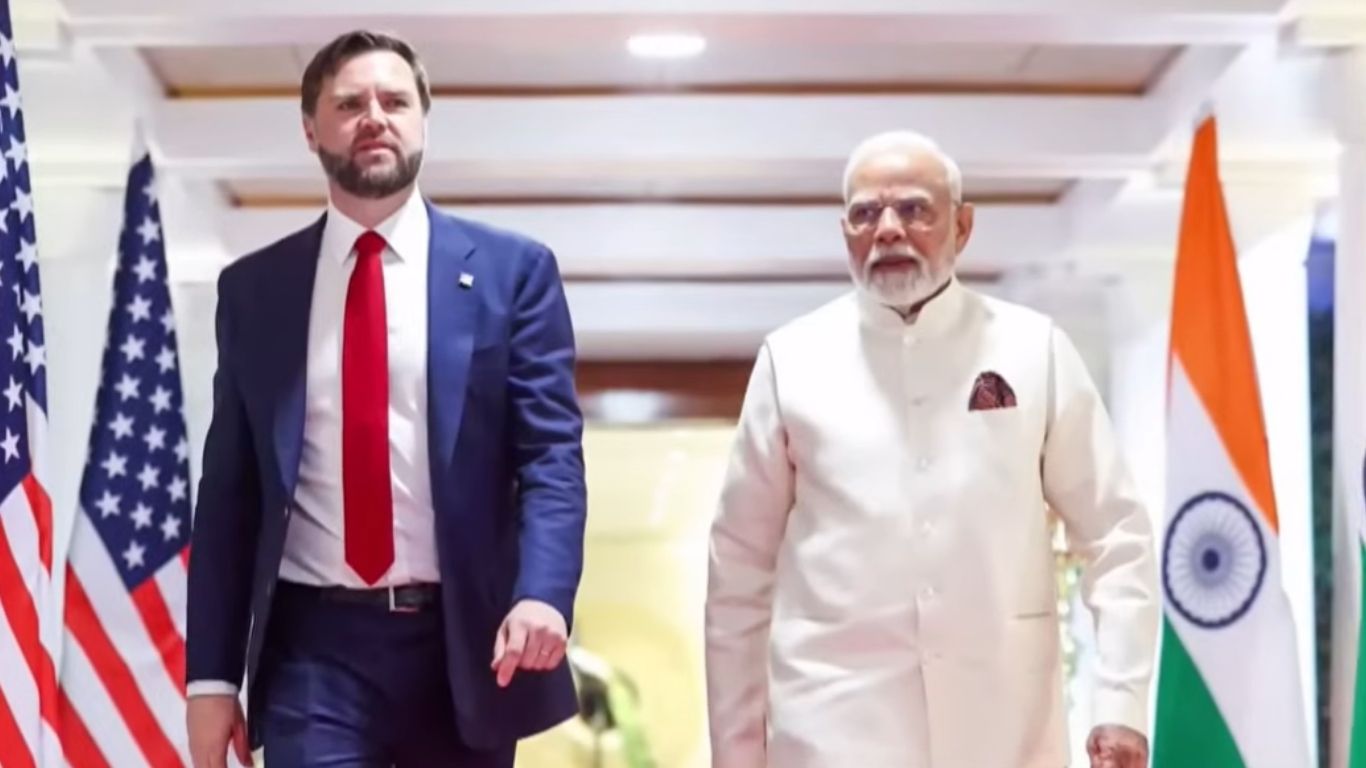
NEW DELHI (Diya TV) — Vice President J.D. Vance spoke with Indian Prime Minister Narendra Modi on Saturday, Aug. 8, as India and the United States sought to strengthen ties amid rising tensions in West Asia.
The leaders discussed ways to expand the U.S.-India comprehensive global strategic partnership. Their talks covered trade, defense and energy security. They also reaffirmed plans to deepen cooperation in critical and emerging technologies and critical minerals.
The call came at a sensitive time for the region. Days earlier, Turkiye, Saudi Arabia and Pakistan signed a mutual defense pact. The agreement has drawn attention as a sign of changing regional alignments during the wider West Asia conflict.
During the conversation, Modi also congratulated Vance and his wife, Usha Vance, on the birth of their son. He extended his best wishes to the family.
Modi later said on social media that he and Vance discussed ways to deepen the U.S.-India partnership across key areas. The prime minister also highlighted the importance of continued high-level engagement between the two countries.
An Indian government readout said the leaders reviewed progress in bilateral relations and noted continued momentum in talks between senior officials. They reaffirmed their commitment to cooperation in trade, defense, energy security, critical minerals and emerging technologies.
The two leaders also exchanged views on regional and global developments. However, the U.S. side had not released details of the conversation at the time of the report.
The proposed U.S.-India trade deal may also have figured in the discussion, although officials did not immediately confirm it. The agreement remains an important issue for both governments as they work to strengthen economic ties.
Modi and President Donald Trump met in France in June. During that meeting, they directed officials to work toward a balanced and mutually beneficial trade agreement. They also called for progress on a commercially meaningful deal.
U.S.-India relations have faced several challenges in recent months. Washington imposed higher tariffs on Indian goods last year, creating friction between the two countries. Trump also claimed a role in helping end the India-Pakistan military clashes in May 2025.
New Delhi rejected those claims. Indian officials said direct talks between India and Pakistan led to the end of the hostilities and maintained that the United States did not play a role in stopping the conflict.
U.S. immigration policies created another point of tension. Washington increased the H-1B visa fee, raising concerns in India because many Indian professionals work in the U.S. technology sector.
Despite those challenges, both countries have continued efforts to strengthen relations. U.S. and Indian officials have maintained high-level contact while seeking progress on trade, technology and strategic cooperation.
The latest Modi-Vance conversation could support those efforts. Trade remains a key issue, while defense and energy security have gained greater importance because of developments in West Asia.
Critical minerals and emerging technologies also offer new areas for cooperation. Both countries want to strengthen supply chains and reduce risks linked to dependence on limited sources.