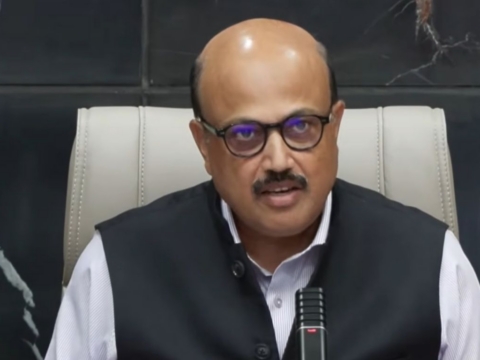
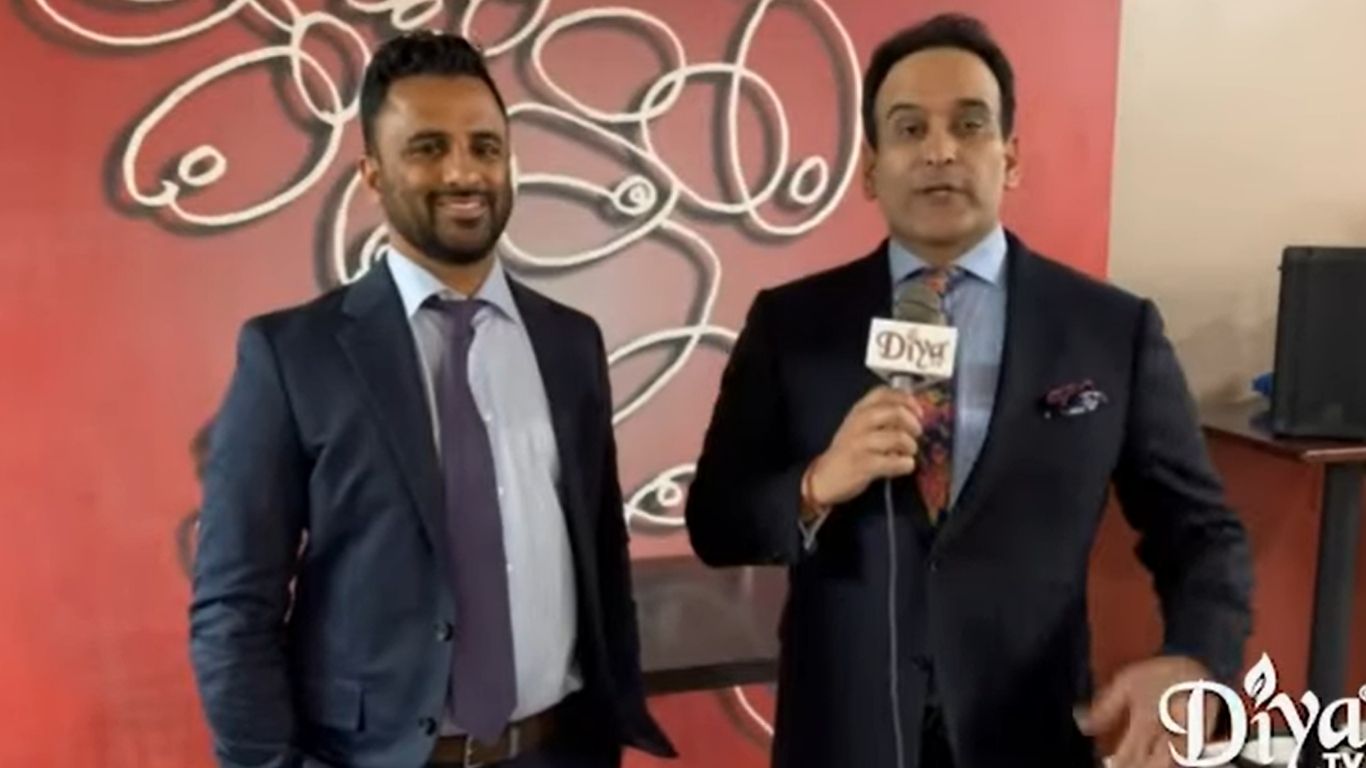
MILPITAS, Calif. (Diya TV) — On the night of California’s June 2 primary, congressional challenger Ethan Agarwal joined Diya TV at his election night event as early results began trickling in from California’s 17th Congressional District. In his first-ever run for public office, the 40-year-old tech entrepreneur and son of Indian immigrants mounted a fast-moving, 90-day campaign to unseat five-term incumbent Rep. Ro Khanna — and explained his vision for what comes next, win or lose.
“We announced on March 3rd,” Agarwal told Diya TV’s Ravi Kapur. “It’s been an incredible campaign. The groundswell of support that we’ve seen from the Indian community, the Jewish community, the Iranian community — so many communities that have realized that there is an important change that is required — and I’m honored and humbled by it.”
The CA-17 race shaped up as one of the most closely watched congressional primaries in the country, pitting Agarwal — a political newcomer backed by prominent figures in Silicon Valley’s tech and venture capital world — against Khanna, a progressive lawmaker widely regarded as a possible 2028 presidential contender. Both men are Indian American Democrats, which made the ideological contrast all the more striking.
Agarwal drew his sharpest line of differentiation around the question of local versus national focus. He argued that Khanna, consumed by national ambitions and high-profile progressive causes, had taken his eye off the communities within the district itself — spanning parts of Santa Clara and Alameda counties, including Fremont, Santa Clara, Sunnyvale, Cupertino, and the South Bay.
“It was really just a question of local versus national,” Agarwal. “I focused on local issues. He focuses on national issues. And the question that I posed to the voters was: Which is most important to you? And if someone says the answer is national, then I respect that. But I think there are a lot of issues directly in the district that need to be handled.”
Throughout the campaign, Agarwal positioned himself as a moderate who described himself as a Democrat “who believes in capitalism.” He criticized Khanna’s support for a proposed California ballot measure that would impose a one-time tax on residents worth over a billion dollars, as well as a federal wealth tax proposal Khanna co-authored with Sen. Bernie Sanders. Agarwal also made stock trading by members of Congress a central issue, calling for a ban on individual stock trading by members, their spouses, and dependent children.
What made Agarwal’s run particularly striking was its speed. He entered the race on March 3, having previously launched — and then abandoned — a long-shot bid for California governor. With just three months before the primary, his team built a coalition from scratch, drawing energy from communities that felt unrepresented in the existing dynamic between two established political forces.
“The groundswell of support has been amazing,” he said, describing the enthusiasm from diverse coalitions across the district as the driving force behind his continued push.
That coalition included backing from tech investors and entrepreneurs skeptical of progressive economic policies, as well as Jewish and Israeli American voters who viewed Agarwal as the more pro-Israel candidate in the field. Former Congressman Mike Honda, a longtime South Bay political figure, also endorsed Agarwal, lending him a measure of institutional credibility despite his newcomer status.
By election night, however, the numbers told a challenging story. With all 184 precincts in the district partially reporting as of June 2, incumbent Rep. Ro Khanna led the field with a commanding 58.8% of the vote — roughly 36,131 votes. In the fight for second place and a slot in the November general election, Republican Ritesh Tandon stood at 16.7% with 10,289 votes, followed by Republican Jennie Ha Phan at 12.6% with 7,743 votes. Agarwal was in fourth place with 6.1% of the vote — approximately 3,719 ballots — ahead of fellow Democrat Mike Katz at 4.9%.
Under California’s top-two primary system, only the two highest vote-getters advance to the November general election regardless of party. As the results stood on election night, Agarwal faced an uphill path to the runoff. Still, California’s heavy reliance on mail-in ballots means the count will continue for weeks, and the final standings won’t be certified until July 10.
Agarwal anticipated a difficult climb, framing the conversation around a potential runoff scenario rather than leading the primary outright. His mindset, regardless of the outcome, remained forward-looking.
If there is a path forward, Agarwal made clear he intends to take it the same way he built his campaign — through direct, personal engagement with every corner of the district.
“I want to go and meet everybody in the district as much as I can,” he said. “I want to go to every town hall. I want to go to every school. I want to go to every community center. I just want to make sure that people know who I am and know what the message is about.”