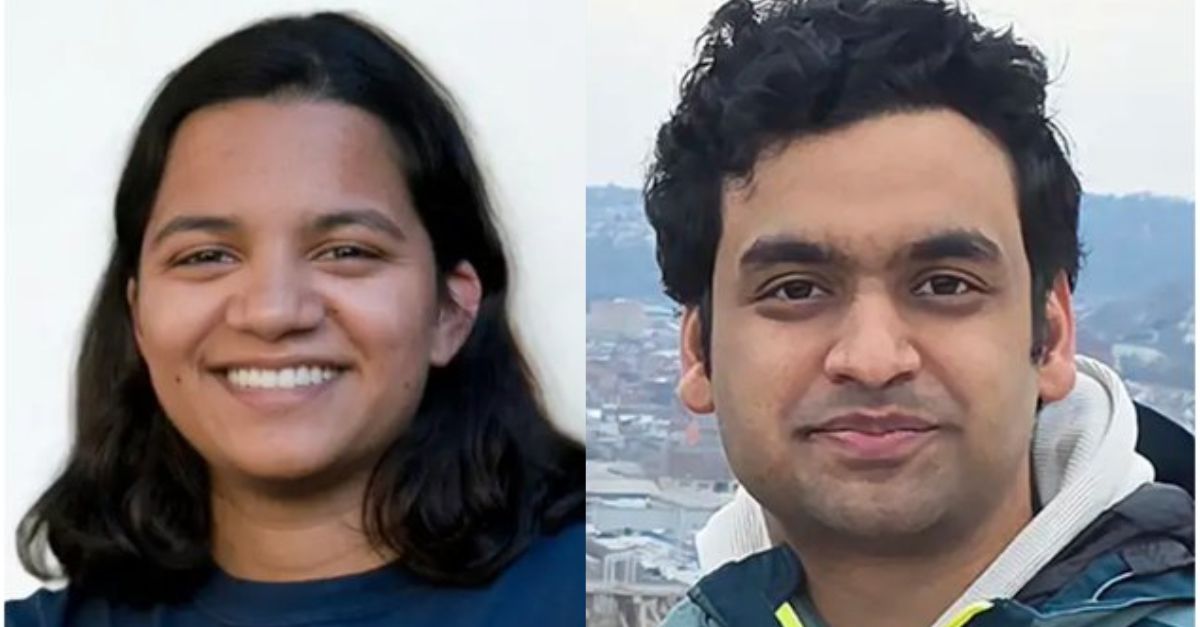
PITTSBURGH, Pa. (Diya TV) – Two Indian-origin doctoral students at Carnegie Mellon University are receiving major support to advance research in artificial intelligence. Leena Mathur and Pranjal Aggarwal were awarded the SoftBank Group–Arm Fellowship. The program funds tuition, research costs, and provides stipends to Ph.D. candidates focused on AI and human collaboration.
The fellowships were announced this month and are part of a broader partnership between Carnegie Mellon University (CMU) and Keio University in Japan. The initiative, backed by SoftBank Group Corp. and Arm, aims to promote groundbreaking AI research that benefits society and industry.
Leena Mathur, a student at CMU’s Language Technologies Institute, received a two-year fellowship. Her research focuses on socially intelligent AI systems. She develops algorithms that help robots understand human intent from speech and gestures.
Mathur’s work has practical applications in healthcare and daily life. For example, her AI systems could assist elderly or disabled individuals at home. By reading human cues, robots could respond more naturally and safely to human needs.
Pranjal Aggarwal, also based at CMU’s Language Technologies Institute, received a one-year fellowship. His research centers on autonomous computer-use agents. These AI agents interact with digital environments such as software platforms and scientific tools.
Aggarwal’s goal is to create self-improving systems. These systems would not only solve problems but also generate new challenges. This approach could open doors to new applications in AI, boosting innovation and economic growth.
The fellowships are part of CMU’s $110 million partnership with Keio University. Announced in 2024, the collaboration includes universities, government agencies, and private industry. Together, they explore robotics for home use, AI-driven biomedical research, and reducing errors in large language models.
SoftBank Group and Arm pledged $15.5 million to CMU this May to support the partnership. This funding covers the fellowship program and other AI research initiatives. The program focuses on four key areas: multimodal and multilingual learning, embodied AI for robotics, autonomous AI working with humans, and AI applications in life sciences.
Martial Hebert, dean of CMU’s School of Computer Science, welcomed the support. “Carnegie Mellon is thankful for the support of SoftBank Group Corp. to fund the SoftBank Group–Arm Fellowship,” Hebert said. He added that the program helps students harness AI to push scientific discoveries.
Hebert emphasized the broad impact of the initiative. “This program will catalyze transformative research and promote collaboration with industry,” he said. “It will help unlock the full potential of AI across multiple fields, including robotics, autonomy, and life sciences.”
The SoftBank Group–Arm Fellowship is part of a growing trend to fund AI research with real-world impact. By supporting young scientists like Mathur and Aggarwal, the fellowship encourages innovation in socially aware and autonomous AI systems.
For Mathur, the fellowship provides the resources to advance AI that understands humans better. For Aggarwal, it supports AI that learns and evolves within digital environments. Both students represent the next generation of researchers shaping the future of artificial intelligence.
As AI technology continues to grow, programs like the SoftBank Group–Arm Fellowship play a vital role. They provide financial support, mentorship, and collaboration opportunities. This helps researchers turn ideas into solutions that improve daily life and drive economic progress.
Carnegie Mellon’s collaboration with Keio University, backed by SoftBank and Arm, reflects the global effort to explore AI responsibly. It also highlights the importance of investing in talent to address complex challenges in technology, healthcare, and industry.