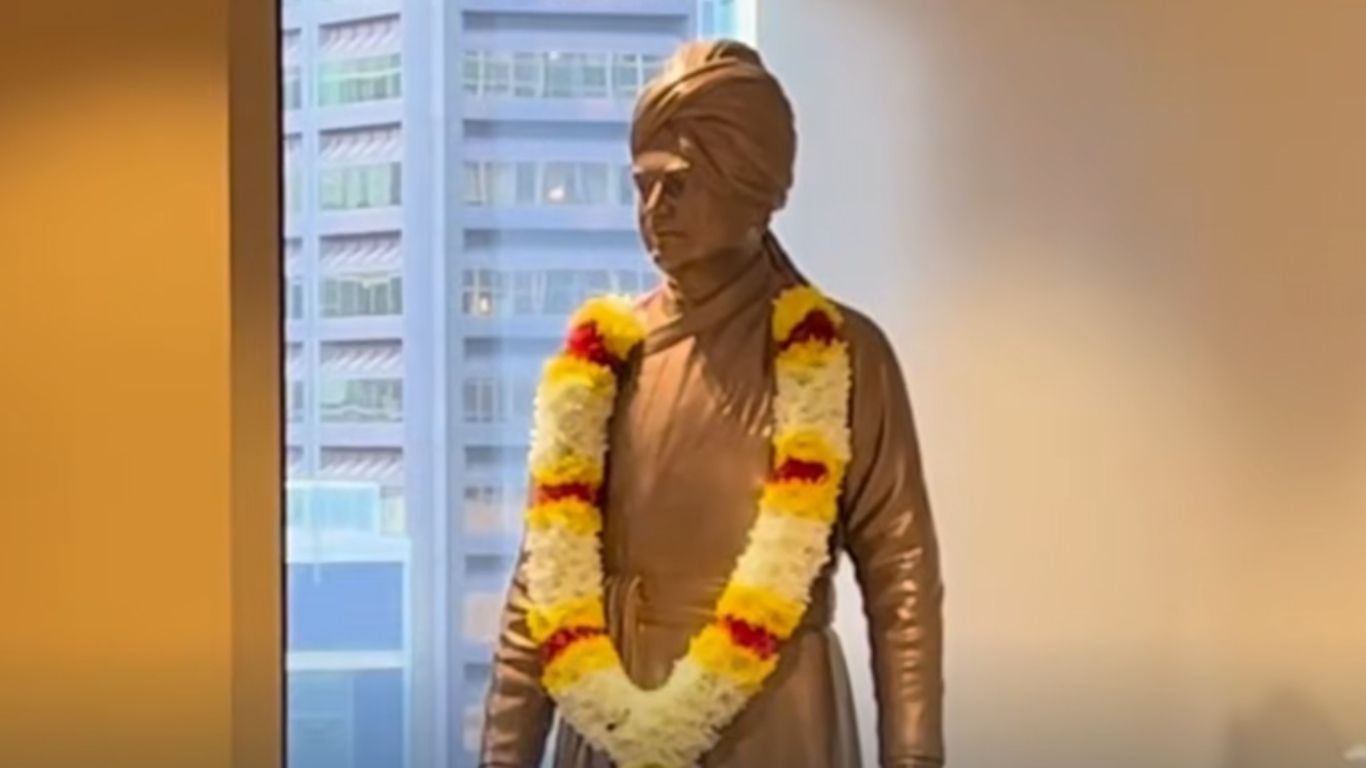
CHICAGO (Diya TV)— A life-size statue of Swami Vivekananda was unveiled at the Indian Consulate in Chicago, marking a significant tribute to the spiritual leader whose historic 1893 visit to the city transformed global perceptions of Hinduism and India.
India’s Ambassador to the United States, Vinay Mohan Kwatra, unveiled the statue 133 years after Swami Vivekananda arrived in Chicago to attend the Parliament of the World’s Religions. The ceremony brought together local elected officials, members of the Indian American community, and spiritual leaders.
Swami Vivekananda arrived in Chicago on July 30, 1893, after leaving India on May 31 of that year. He traveled thousands of miles to represent Hinduism at the Parliament of the World’s Religions, a landmark gathering of faith leaders from around the world.
The Chicago Record described him as a “learned Brahman Hindoo” with a bright personality and strong command of English. His presence quickly attracted attention in a city hosting visitors from across the globe. At the time, India was under British colonial rule. The country faced poverty, hardship, and declining confidence after centuries of foreign invasions and colonial exploitation. Many Indians looked for hope and inspiration during this difficult period.
On Sept. 11, 1893, Swami Vivekananda delivered the speech that would make him famous around the world. He began his address with the now-iconic words, “Sisters and brothers of America.” The audience responded with a standing ovation. His message of religious harmony, universal acceptance, and mutual respect resonated deeply with listeners.
Vivekananda urged people to reject religious intolerance and fanaticism. He warned against “sectarianism, bigotry, and its horrible descendants,” which he said had caused violence, destroyed civilizations, and driven nations into despair. His speech introduced millions to the spiritual traditions of India and highlighted the values of tolerance and acceptance that he associated with Hinduism.
Swami Vivekananda’s visit to Chicago became a defining moment in the cultural exchange between India and the United States. After the Parliament of Religions, he traveled extensively across America, delivering lectures on Vedanta philosophy and Indian spirituality. Through these lectures, he introduced Western audiences to concepts rooted in Sanatan Dharma, often referred to as Hinduism. He emphasized the importance of reason, compassion, logic, and respect for different paths to truth.
Vivekananda also presented India as a civilization with a rich intellectual and spiritual heritage. He highlighted the contributions of ancient scholars and thinkers, including Panini, Aryabhatta, and Patanjali. His teachings helped create a lasting connection between Indian spiritual traditions and modern Western thought. Historians and scholars continue to view his Chicago visit as one of the most influential moments in the history of interfaith dialogue.
The unveiling ceremony celebrated Vivekananda’s enduring influence on global spirituality and cultural understanding. Many attendees described the installation of the statue in Chicago as a symbolic homecoming. Swami Ishtmananda of the Vivekananda Vedanta Society of Chicago also addressed the gathering. He reflected on Vivekananda’s teachings and their continued relevance in today’s world.
The event was organized in collaboration with the Indian American Community Foundation. Community leaders said the statue will serve as a reminder of Vivekananda’s message of unity, tolerance, and mutual respect. More than a century after his historic speech, Swami Vivekananda remains a powerful symbol of India’s spiritual heritage. His words continue to inspire people across cultures and faiths, reinforcing the importance of dialogue, understanding, and peaceful coexistence.