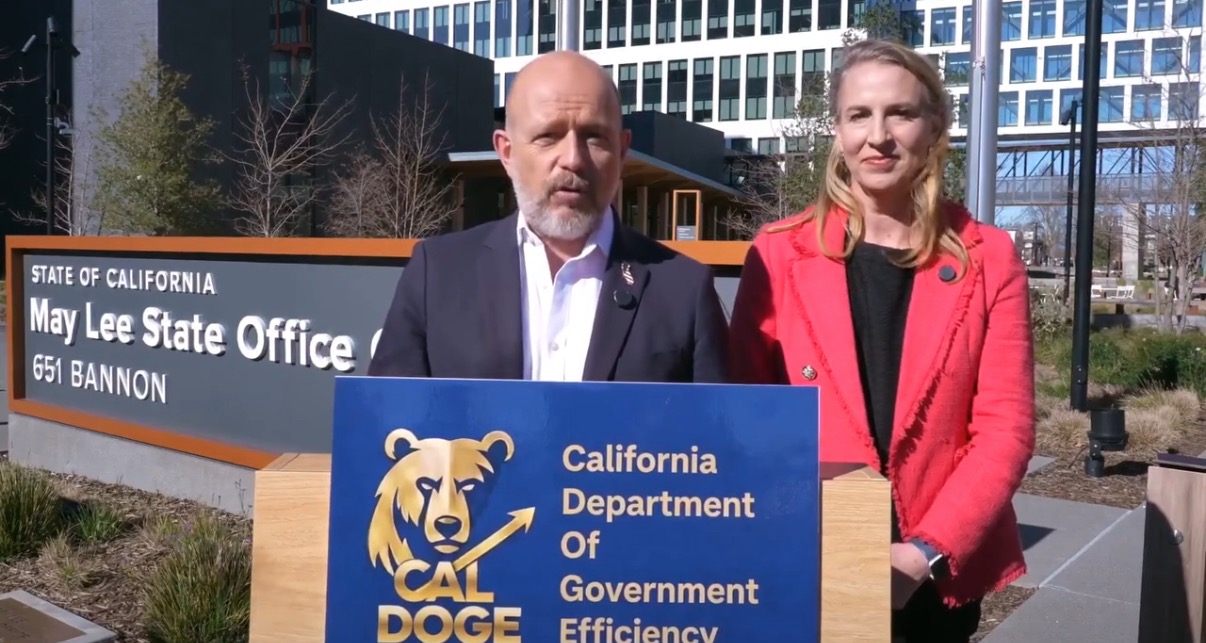
SACRAMENTO, Calif. (Diya TV) — A political dispute is intensifying in California over the use of cannabis tax revenue, after gubernatorial candidate Steve Hilton alleged that hundreds of millions of dollars earmarked for youth substance-use prevention have instead been directed toward political organizing efforts.
The allegations stem from an initiative Hilton has branded “Cal DOGE,” an unofficial campaign effort he says is focused on reviewing state spending. Hilton claims that approximately $370 million in cannabis tax funds have been awarded to organizations engaged in civic and community organizing activities rather than strictly substance-abuse prevention programs.
Hilton has publicly stated that his team filed a complaint with federal authorities, including the U.S. Attorney’s Office for the Central District of California and the Department of Justice, requesting an investigation into the grant program.
The funding in question originates from Proposition 64, the 2016 voter-approved measure that legalized recreational cannabis in California. Under the law, cannabis tax revenues are allocated to several areas, including youth education, prevention and treatment programs.
A substantial portion of those funds flows through Elevate Youth California, a statewide grant initiative administered by the California Department of Health Care Services. According to official program materials, Elevate Youth California seeks to reduce youth substance use through community-based prevention strategies, leadership development and youth engagement efforts, particularly in communities disproportionately affected by prior drug enforcement policies.
Program records indicate that Elevate Youth California has issued 517 grant awards across 57 counties, totaling approximately $370.2 million.
Publicly available grant listings show that the Jakara Movement, a Punjabi-Sikh community nonprofit organization, received an $800,000 award under Elevate Youth California’s Standard Track Cohort 5. Program documentation states that the funding supports peer-led engagement and prevention efforts aimed at reducing substance use among youth.
Another organization, South Asian Network, appears in Standard Track Cohort 6 with a listed $600,000 award. Grant materials describe the funding as supporting youth leadership development and prevention-focused civic engagement strategies.
Hilton and his supporters argue that certain grant-funded activities, particularly those involving civic engagement or organizing, exceed what voters intended when approving cannabis tax allocations for prevention. They contend that prevention dollars are being used to advance political mobilization rather than public health objectives.
State program materials, however, characterize youth leadership development, systems-change advocacy and civic participation as components of a broader public health model designed to address the underlying causes of substance use. The framework emphasizes community-level engagement and structural prevention strategies.
At this stage, the grant amounts and recipients are documented in publicly available state records, and no formal finding of misuse has been issued by federal or state authorities. Whether Hilton’s complaint results in a federal investigation remains unclear.